How Do I Get My Rehab Center Mentioned in ChatGPT and Google AI Overviews?


A rehab center earns mentions in ChatGPT and Google AI Overviews when crawlable public sources identify the facility. These sources must confirm its treatment services. It should also connect with a location and support trust signals. Start with OAI-SearchBot and Googlebot access. Build service pages and add location proof, clinical review, citations, outside mentions, schema markup, and answer blocks. Together, the work adds up to generative engine optimization for a treatment website.
OpenAI documents OAI-SearchBot for ChatGPT search features. A site that blocks OAI-SearchBot loses inclusion in ChatGPT summaries and snippets, though OpenAI may still surface a bare link and title when it finds the URL through a third-party source, and a noindex tag prevents even that. Google documents AI Overviews and AI Mode as Search features that need the same SEO basics, with index eligibility and snippet eligibility for supporting links.
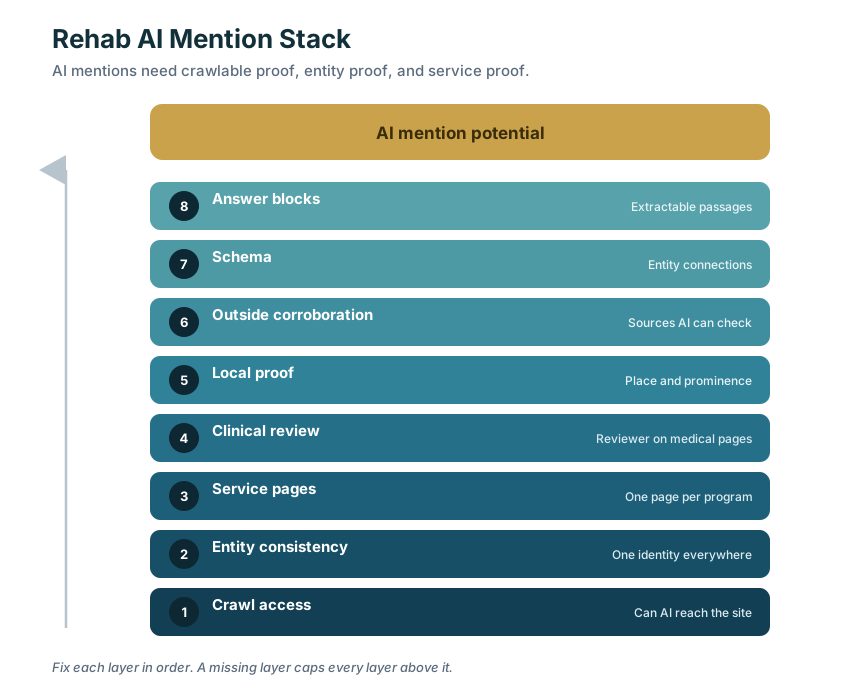
Start With Crawler Access
ChatGPT and Google AI visibility need crawl access before content work. A blocked page cannot compete as a source inside ChatGPT search answers, and a Google page needs indexing and snippet eligibility for AI Overviews or AI Mode.
| Check | Pass standard |
|---|---|
| robots.txt | Googlebot and OAI-SearchBot can reach public pages |
| noindex | service, location, bio, and resource pages allow indexing |
| sitemap | core rehab pages appear with current URLs |
| canonical | each page points to the chosen URL |
| status code | core pages return 200 |
| HTML text | facility facts appear as readable text |
| snippet controls | important pages allow useful snippet display |
OpenAI recommends allowing OAI-SearchBot in robots.txt for ChatGPT search presence. Google lists no extra technical requirement for AI Overviews or AI Mode beyond core Search requirements. Treat the crawl and index layer as core technical SEO before content work begins.
Make The Rehab Center A Single Web Entity
A rehab center needs one stable identity across the website and public profiles. ChatGPT and Google AI Overviews need matching facts before a provider can appear with confidence.
| Entity fact | Match across |
|---|---|
| facility name | website, Google Business Profile, citations |
| address | footer, location page, Google Business Profile |
| phone | website, Google Business Profile, directories |
| treatment services | program pages and location page |
| clinical team | bio pages and reviewer blocks |
| license | website and regulator source |
| accreditation | website and accreditation profile |
| brand owner | about page and public profiles |
Mixed phone numbers, old addresses, and different facility names weaken the entity. Consistent facts support ChatGPT search, Google AI Overviews, local rehab SEO, and referral partner trust.
Build One Page For Each Treatment Service
AI systems need page-level evidence for each treatment service. A single services page cannot prove medical detox, residential treatment, PHP, IOP, outpatient treatment, and dual diagnosis with enough depth.
| Service page | Must show |
|---|---|
| medical detox | service scope, location, safety limits, reviewer |
| residential treatment | level of treatment, facility, daily structure |
| PHP | schedule, clinical support, eligibility |
| IOP | weekly structure, service scope, location |
| outpatient treatment | treatment type and team |
| dual diagnosis | mental health and substance use support |
| family program | family role and contact process |
| admissions | first call, assessment, intake steps |
| insurance | verification steps and payer limits |
Each page should name the facility, treatment service, location, service limits, clinical team, review status, and next contact point. Broad claims about full recovery or complete treatment should be removed unless the page proves the exact service behind the claim.
Put Clinical Review On Medical-Risk Pages
Medical-risk pages need reviewer proof. Detox, withdrawal, medication-assisted treatment, dual diagnosis, crisis, pregnancy, and adolescent treatment pages have higher trust burden than admissions or insurance pages.
Google rater documentation defines YMYL topics as topics that can affect health, safety, financial stability, welfare, or well-being. Google also notes that stronger E-E-A-T match has more weight for YMYL topics.
Use a visible clinical review block.
Author: name and role
Reviewer: clinician name and credential
Review scope: medical accuracy, treatment terms, safety wording
Last review: month and year
Sources: near medical claims
A reviewer name alone has weak value. The review should improve safety wording, remove unsupported claims, and tie medical statements to sources.
Prove The Facility In Each City Or State
Local AI mentions need facility proof. A user may ask for detox near a city, dual diagnosis treatment in a state, or a rehab center near family.
Google local ranking uses relevance, distance, and prominence. Google Business Profile documentation notes that prominence can reflect links, articles, directories, reviews, and ratings from across the web.
| Local proof | Rehab execution |
|---|---|
| Google Business Profile | verified profile with matching data |
| facility photos | actual exterior, rooms, and common areas |
| reviews | ethical response process |
| citations | matching name, address, phone |
| location page | staff, services, directions, photos |
| community mentions | partner pages and local resources |
| local links | local organizations and media |
A copied city page adds weak proof. A location page with address proof, photos, staff bios, program links, and citations builds a stronger mention case.
Earn Corroboration From Sources AI Can Check
Outside corroboration helps public web systems confirm the rehab center. Linked and unlinked mentions both support entity trust when the source has relevance.
| Source | Trust job |
|---|---|
| license database | confirms operating authority |
| accreditation page | confirms outside review |
| Google Business Profile | confirms local entity |
| clinician directory | confirms staff identity |
| local news | confirms public presence |
| association profile | confirms treatment category |
| community partner page | confirms referral context |
| review platform | confirms reputation |
| local resource page | confirms service area |
Google warns against inauthentic mentions for generative AI visibility. Google also notes that spam systems and quality systems still apply to generative AI features.
Publish Facility-Specific Content AI Can Cite
Generic rehab content loses value because the web already has thousands of pages about addiction, detox, and treatment. A rehab center needs facility-specific content with details competitors cannot copy.
| Asset | Citation value |
|---|---|
| detox safety page | connects service, location, reviewer |
| family admissions checklist | answers family questions |
| level-of-treatment comparison | supports treatment selection |
| insurance verification page | answers payment friction |
| local recovery resource page | proves local usefulness |
| clinician-reviewed FAQ | creates safe short answers |
| reviewer bio page | proves medical responsibility |
| outcomes policy page | limits unsupported claims |
Google recommends unique, helpful, reliable, people-first content for AI features and warns against recycling common web content.
Use Schema To Connect People, Places, And Services
Schema markup helps machines connect the rehab brand, facility, program, author, reviewer, article, and breadcrumb trail. The markup must match visible page facts.
| Page | Schema markup |
|---|---|
| homepage | Organization, WebSite |
| facility page | LocalBusiness, MedicalOrganization, or MedicalClinic when accurate |
| treatment page | Service |
| medical education page | Article and MedicalWebPage |
| author bio | ProfilePage and Person |
| reviewer bio | ProfilePage and Person |
| page template | BreadcrumbList |
Google uses schema markup to read page content and gather facts about entities. Google also documents no special schema.org markup requirement for AI Overviews or AI Mode.
Add Answer Blocks To High-Intent Pages
AI systems need compact passages that answer actual rehab questions. Put answer blocks near the top of service, location, admissions, insurance, and medical education pages.
| Question | Best page |
|---|---|
| What happens when I call? | admissions |
| Does the center accept insurance? | insurance |
| What is medical detox? | detox page |
| What is residential treatment? | residential page |
| What is dual diagnosis treatment? | dual diagnosis page |
| Can family members speak with staff? | family program |
| Where is the facility located? | location page |
| Who reviewed the medical content? | reviewer bio |
Each answer should include the service, facility, limit, reviewer where needed, and next contact point. Medical claims need source-backed wording.
Measure Mentions With Fixed Tests
AI visibility data needs controls. ChatGPT answers can vary across prompt wording and web access. Google AI Overviews and AI Mode can vary across query, location, and result set.
Track signals that can be checked again.
| Signal | Source |
|---|---|
| ChatGPT referrals | analytics with utm_source=chatgpt.com |
| Google AI impressions | Search Console generative AI report |
| cited URLs | fixed prompt set |
| brand mentions | monthly prompt log |
| local inclusion | city and service prompts |
| competitor overlap | comparison prompts |
| business value | calls, forms, assisted conversions |
OpenAI documents the utm_source=chatgpt.com parameter for referral URLs. Google launched Search Generative AI performance reports in Search Console on June 3, 2026, with dedicated views for impressions in AI Overviews, AI Mode, and other Search generative AI features.
Follow The Right Implementation Order
AI visibility fails when a rehab site seeks mentions before fixing proof. Use the order below.
| Step | Work |
|---|---|
| 1 | Allow Googlebot and OAI-SearchBot |
| 2 | Fix indexation, snippets, sitemap, canonicals |
| 3 | Match facility identity across public profiles |
| 4 | Build service pages and location pages |
| 5 | Add reviewer proof to medical-risk pages |
| 6 | Publish source-backed answer blocks |
| 7 | Add schema markup for core entities |
| 8 | Improve Google Business Profile, reviews, citations, photos |
| 9 | Earn credible outside mentions |
| 10 | Track ChatGPT and Google AI visibility |
A rehab center with thin service pages should fix pages before PR. A center with weak local proof should improve Google Business Profile, citations, reviews, photos, and location pages before prompt tracking. Confirm the full chain with a drug rehab SEO audit.
Rehab AI Mention Graph
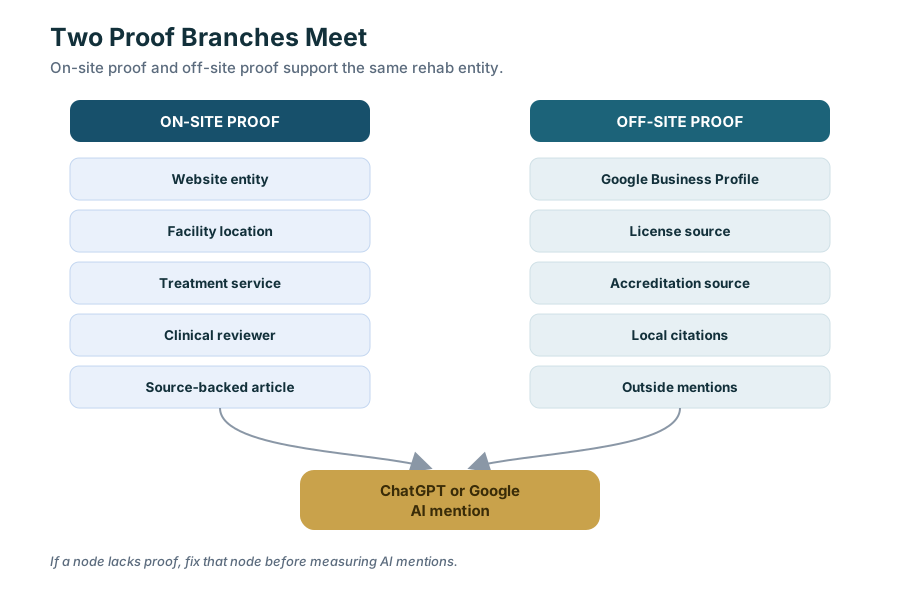
Use the graph as a QA map. If any node lacks proof, fix the missing node before measuring AI mentions.
Answer For Rehab Owners
To get a rehab center mentioned in ChatGPT and Google AI Overviews, build a public proof system that machines can crawl, parse, and verify. The work starts with crawler access and indexation, then moves through entity consistency, service pages, clinical review, local proof, outside corroboration, schema markup, and answer blocks.
Avoid shortcuts. ChatGPT search needs OAI-SearchBot access, and Google AI features use core Search requirements. Rehab centers earn AI mentions through verifiable treatment proof, no fake signals, no generic content volume. The ChatGPT side of the work is LLM SEO, and the Google side is AI Overview SEO, two halves of the same proof system.
Frequently Asked Questions
Can I submit my rehab center to ChatGPT?
No organic submission form guarantees a ChatGPT mention. Allow OAI-SearchBot, publish crawlable service pages, and build public proof worth retrieval. OpenAI documents OAI-SearchBot for ChatGPT search features.
How do I get my rehab center into Google AI Overviews?
A page needs indexing and snippet eligibility in Google Search to appear as a supporting link in AI Overviews or AI Mode. Google lists no extra technical requirement for those AI features.
Which rehab pages help AI mentions most?
Service pages, location pages, medical education pages, admissions pages, insurance pages, clinician bios, reviewer bios, and local resource pages help most. Each page needs visible proof, accurate facts, sources, internal links, and a direct answer block.
Does schema help with ChatGPT or Google AI Overviews?
Schema can support entity parsing, although Google documents no special schema.org markup requirement for AI Overviews or AI Mode. Use schema to label visible facts about the organization, facility, service, author, reviewer, article, and breadcrumb trail.
How do I track rehab AI visibility?
Track ChatGPT referrals with utm_source=chatgpt.com, Search Console generative AI reports, cited URLs, fixed prompt tests, brand mentions, local prompts, competitor prompts, calls, and forms.
Get Expert Advice
Professional consultation for your business needs. Connect with our experts today.