Humanizing AI Content for SEO With Expertise, Evidence and Expert Review

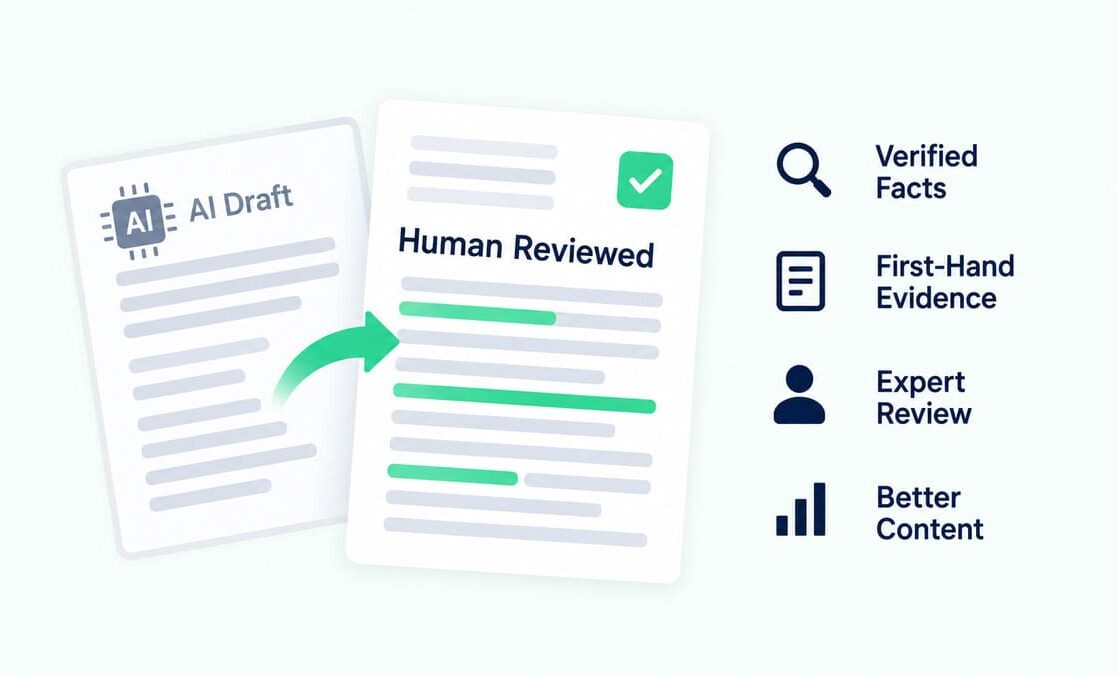
AI can organize research, suggest headings, summarize sources and create a first draft. Expert review adds facts, experience, evidence and editorial decisions outside model output.
Word swaps and sentence variation can improve readability. Expertise, claim verification and first-hand evidence require human input.
Humanizing AI content for SEO requires a stronger publication standard: original information, accurate claims, named sources, expert review and content worth reading without a ranking incentive. In May 2026, Google Search guidance emphasized unique viewpoints, first-hand experience and content beyond generic AI output.
What Human Review Adds
- Fact checking: Verify names, numbers, dates, quotes and technical claims.
- First-hand evidence: Add observations, tests, internal data and examples from completed work.
- Expert review: Add limits, corrections and decisions grounded in subject expertise.
- Publication accountability: Name the writer, reviewer, sources and research method when relevant.
What Makes AI Content Worth Publishing
A publication-ready article needs more than rewritten AI sentences. Word changes, shorter paragraphs and varied sentence lengths can improve reading. Those edits improve presentation only.
Expert review changes the substance. A subject expert can flag a technically accurate claim that fails in practice. A business can add unpublished internal data. An editor can remove advice outside reader needs. A specialist can show where a process fails and which conditions change the recommendation.
Use one publication test:
What original facts, experience or expert decisions appear in the finished page beyond the AI draft?
If the answer is none, the edit changed wording without adding original value.

Step 1: Check Every Claim Before Editing
Start with claim review before word changes. Separate the draft into four groups:
- facts an editor can verify;
- claims that require evidence;
- recommendations that require expert review;
- generic statements that add little reader value.
Claim review stops weak statements from becoming stronger-sounding copy.
Verify Names, Numbers, Dates and Technical Claims
AI output can contain incorrect statistics, outdated facts, invented references and false quotations. Verify every factual item before publication.
Check:
- statistics against the original source;
- quotations against the source text;
- product and software features against current documentation;
- legal claims against official material;
- dates and version numbers;
- technical SEO statements against primary documentation;
- company results against business records.
Confidence in wording never proves accuracy.
Use a Source Hierarchy
Use stronger evidence first:
- official documentation or primary records;
- original research or first-party business data;
- published academic research where relevant;
- credible secondary analysis.
When two sources conflict, inspect publication date, scope, method and source ownership before choosing which claim to retain.
Delete Unsupported Claims
Never use a weak source solely to preserve a sentence.
When evidence supports only part of a claim, narrow the claim or remove it. Evidence-first editing adds more reader value than cosmetic rewriting.

Step 2: Add Expertise Outside the AI Draft
Generative AI can reproduce patterns from existing material. A strong article needs information outside generic model output.
Use one editorial question:
What original evidence, experience or expert input can we add beyond the generic draft?
Add First-Hand Work
First-hand experience requires more than the phrase In our experience. The article should show what the expert observed, checked or changed.
Weak version:
Technical SEO audits can uncover indexing problems.
Expert version:
A page can appear in an XML sitemap, return a 200 status code and still fail to remain indexed. Our review goes beyond crawl access. We check index status, canonical URL, internal links, page purpose and the URL Google selects.
The expert version shows the checks behind the recommendation.
Add Original Evidence
Original evidence can include:
- internal search data;
- client findings with identifying details removed;
- survey results;
- test results;
- screenshots;
- before-and-after measurements;
- product testing;
- interview findings;
- observations from completed work;
- calculations using published data.
Only use evidence your team actually has. Never invent a study, sample size, result, quotation or client experience for authority.
Use three evidence labels during review:
Observed: What the team saw during completed work.
Measured: What the team recorded with a defined method.
Verified: What a primary external source confirms.
The labels help editors separate experience, measurement and external confirmation.
Add Limits and Exceptions
Generic content can present advice as universal. Experts define scope.
State when a recommendation applies to ecommerce category pages but fails for product variants. Name the CMS dependency when a technical fix changes across platforms. Identify trade-offs when a preferred method creates a cost, risk or technical constraint.
Limits make advice safer to apply.

Before and After: From AI Draft to Expert Content
The earlier version of the article included the following claim:
Adding more related entities improves topical authority and helps a page rank higher.
The sentence had three problems:
- no evidence connected entity coverage with ranking improvement;
- topical authority lacked a precise definition;
- the claim treated entity additions as a ranking technique.
Expert edit:
Related entities belong in an article when they add context readers need. Entity coverage alone never proves stronger rankings.
The revised sentence narrows the claim, removes unsupported ranking certainty and centers reader value. The edit adds editorial restraint over cosmetic variation.
Step 3: Use NLP as an Editorial Check
NLP tools can support content review. Google Cloud NLP API can identify entities and report salience for each detected entity.
Entity: a person, company, place, product or subject detected in text.
Salience: the prominence of an entity within the analyzed document.
Google Cloud documentation describes salience as information about the importance or centrality of an entity across the document. Treat the score as document-analysis data.
Check Topic Focus and Entity Coverage
Consider an article about technical SEO audits. Entity analysis can show heavy coverage of marketing and growth while the draft barely covers crawl access, indexing, canonical URLs or schema markup.
Return to the text and ask:
- Does the opening name the main subject in the first lines?
- Do the main sections answer the intended query?
- Do the sections cover the concepts readers need?
- Are unrelated sections pulling the article away from its primary purpose?
- Do related entities add useful context, or appear only for keyword coverage?
The tool flags areas for editorial review. An editor decides if each flagged area needs revision.
Treat Salience as Editing Data
A higher entity score never proves stronger content.
Forcing one term into headings and opening sentences can raise prominence while reducing readability. Use salience for editorial review. Avoid score chasing.
Reader value remains the publication test.

Step 4: Edit Every Section for Reader Value
AI drafts can contain acceptable sentences paired with weak editorial decisions. They can repeat one point under several headings, spend too many words on obvious ideas or sound certain when evidence remains weak.
Editors should remove repetition, rebalance section depth and qualify unsupported certainty.
Cut Generic Openings
Many AI articles spend too long announcing the topic.
Weak opening:
AI has changed digital marketing across many industries.
The sentence adds no useful information before the answer.
Stronger opening:
AI can create a first draft in seconds. Expert review must verify claims, add missing evidence and decide what reaches publication.
The stronger version reaches the editorial problem immediately.
Replace Broad Claims With Specific Detail
Flag broad words such as:
- improve;
- enhance;
- optimize;
- powerful;
- effective;
- important;
- significant;
- comprehensive.
Those words can work when the sentence also names the result.
Weak version:
Internal linking significantly improves SEO performance.
Stronger version:
Internal links help search engines discover related URLs and help readers move from a broad topic to the page that answers the next question.
The stronger sentence names the function. Specific detail has more value than intensity.
Vary Sentence Structure for Readability
Sentence variation can make an article easier to read.
Use short sentences for direct points. Use longer sentences when a qualification needs more detail. Break dense paragraphs where readers need a pause. Use questions only when a question supports a decision.
Skip arbitrary sentence-length formulas and writing scores. The aim is easy reading.
Remove Repeated Ideas
AI systems can repeat one idea with different vocabulary.
Flag repeated claims such as:
- add value;
- show expertise;
- improve quality;
- build trust;
- make content useful.
Each section needs its own job. One section can cover factual verification. Another can cover first-hand work. Another can cover authorship.
If two paragraphs teach the same point, combine them or remove one.
Step 5: Show Who Wrote, Reviewed and Checked the Content
Repeated authority claims never create trust. Readers need evidence of responsibility.
Google Search guidance encourages accurate authorship information and process information where readers expect it.
Name the Writer and Reviewer
Include:
- author name;
- professional role;
- relevant experience;
- reviewer name;
- reviewer role;
- author profile;
- company details linked to publication responsibility.
Limit credentials to the subject.
Show the Research Method
A research method becomes essential when an article uses original tests, surveys or analysis.
State the sample, dates, checks and source of each finding.
Hypothetical method example:
Our SEO team reviewed 120 category pages across 15 ecommerce sites from January through March 2026. The team checked indexability, canonical tags, internal links, schema markup and organic landing-page traffic.
Use genuine figures in published research. Remove any figure that lacks records.
Add a Publication Record
A short record can include:
Written: Name
Expert review: Name
Fact check: Name
Review date: Date
Research method: Short note or linked page
Disclose AI Use Where Relevant
AI disclosure can help when readers expect information about the production process.
A disclosure can state that AI helped organize research or draft text while a named expert checked claims, added first-hand information, verified sources and approved publication.
Disclosure depth should match the role AI played in research, drafting or editing.

Step 6: Build AI Drafts From Verified Inputs
Prompt quality affects the draft. Source quality limits draft quality.
A content brief should specify:
- reader profile;
- primary question;
- verified sources;
- original data from the team;
- claims that require citations;
- statements that represent professional opinion;
- reading level;
- audience terminology;
- subjects outside scope;
- unknowns that require human review.
Stronger inputs produce a more controlled first draft.
Supply Verified Source Material
Avoid a broad prompt such as:
Write an expert article about ecommerce SEO.
Supply:
- interview notes;
- audit observations;
- verified statistics;
- product documentation;
- expert comments;
- approved case studies;
- company research method;
- competitor findings where relevant.
Then ask the model to organize the material without adding unsupported information.
The human contributor remains the source of expertise.
Flag Missing Evidence Before Drafting
Use one instruction inside the content brief:
When supplied evidence lacks support for a claim, flag the missing information for human review.
The first draft can sound less polished, but the instruction reduces unsupported claims. An editor can add evidence or remove the claim.
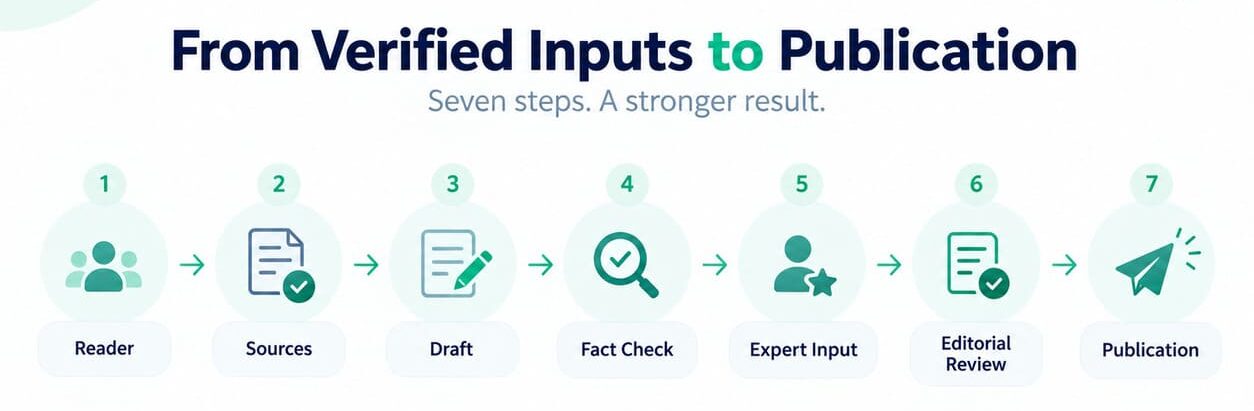
Seven Steps From AI Draft to Publication
- Define the reader and primary question.
- Gather verified sources, expert notes, data and examples.
- Create the first draft from supplied material.
- Verify every factual claim.
- Add first-hand work, original evidence, limits and expert decisions.
- Edit for readability, topic focus and repetition.
- Add author details, sources, research method and relevant disclosure.
Content Quality Also Needs AI Search Access
Strong content still needs technical access before an AI search product can surface it.
Google states that normal SEO fundamentals remain relevant for AI Overviews and AI Mode. Google also requires an indexed page that can appear in Search with a snippet for supporting-link eligibility.
OpenAI advises publishers to allow OAI-SearchBot when they want public pages eligible for summaries, snippets, citations and links in ChatGPT Search.
Content quality and technical access solve different problems. One improves the page. The other allows supported systems to discover and use the page.

Common Errors in AI Content Editing
Chasing AI Detector Scores
Exclude third-party AI detector scores from editorial approval.
Detector results can vary across tools and samples. Passing a detector proves none of the following: accuracy, originality, evidence quality or reader value.
Spend review time checking claims and improving substance.
Replacing AI Words Without Adding Value
Deleting words such as delve, realm or crucial can improve awkward writing.
An article containing weak information remains weak after those words disappear. Vocabulary cleanup is editing. Expertise requires more than vocabulary cleanup.
Inventing First-Hand Experience
Never manufacture mistakes, client stories, tests, opinions or first-hand observations to make generated text appear human.
False experience damages trust. Use verified evidence or remove the claim.
Treating NLP Scores Like Ranking Factors
Entity analysis can identify patterns inside a document. Its scores remain document-analysis data, separate from Google ranking metrics.
Use the tool for editorial questions. Avoid score chasing.
Adding Related Terms Without Purpose
A related term belongs in an article when the concept adds useful context.
If a term adds no reader value, remove it from semantic coverage.
Publishing Before Expert Review
AI can reduce drafting time. Shorter drafting time should leave more time for research, verification, examples, expert review and editing.
Those stages add original value.
Limits of AI-Assisted Editing
Human editing fails when the team lacks subject expertise.
If the team lacks enough subject knowledge to verify claims, AI-assisted writing carries higher factual risk. NLP tools can extract entities, identify patterns and support text analysis, but commercial value, practice accuracy and reader usefulness still require expert review.
Readability tools and content scores can flag editorial signals. Human reviewers should retain publication authority.
For health, finance, law or safety topics, expert review carries greater weight because errors can affect major decisions.
Frequently Asked Questions
What Makes AI Content Human-Led?
Human-led editing adds expert knowledge, evidence and editorial decisions to a generated draft. The work covers fact checking, original evidence, limits, generic-copy removal, readability and publication responsibility.
Detector scores fall outside the publication standard.
Can AI-Generated Content Rank in Google?
AI use alone never determines Google Search performance. Google Search guidance focuses on content quality across human and AI-assisted production.
Large-scale automated publishing with little original value can conflict with Google spam policies.
The stronger question asks what original information the finished page contains.
Do AI Detector Scores Affect SEO?
Google Search documentation lists no requirement for passing a third-party AI detector.
Use editorial review to check accuracy, originality, evidence, sourcing and readability. A detector score never establishes any of those qualities.
How Can NLP Tools Support Content Editing?
Google Cloud NLP API can identify entities and report their prominence within a document.
Editors can use the output to spot weak topic focus. Treat the result as editing data, separate from Google ranking metrics.
What Should an Expert Add to an AI Draft?
Strong additions include first-hand observations, original data, practical examples, factual corrections, limits, source selection and expert decisions.
An expert should also flag information the draft presents with unsupported certainty.
Does Sentence Variation Improve SEO?
Sentence variation can improve readability.
Evidence never establishes sentence variation as an AI-hiding technique or direct ranking factor. Use sentence structure to make the article easier to read.
When Should Publishers Disclose AI Use?
AI disclosure can help when readers expect information about the production process.
A strong disclosure should state the AI role, human review and fact-check process.
Add What Only Your Expertise Can Supply
Strong AI-assisted content succeeds through information beyond the generated draft.
Original value can come from company data, experience from completed work, a technical distinction discovered through practice or an editor removing a confident claim after evidence fails.
AI can help collect, organize, summarize and draft information. Human experts decide what reaches publication.
Ask one final question:
Does the page contain original expertise and evidence worth reading without a ranking incentive?