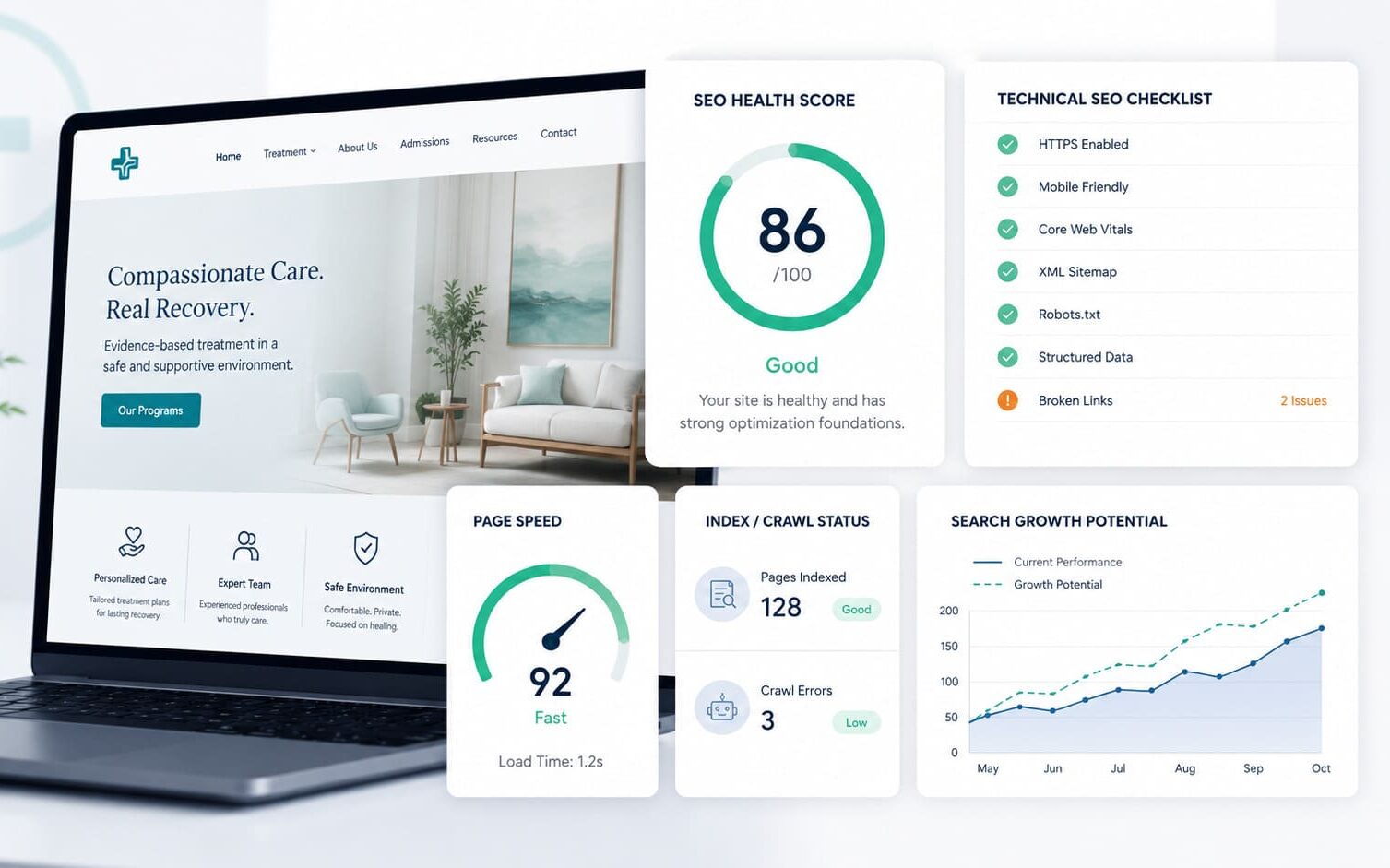
Drug Rehab SEO Audit

IMMWIT’s drug rehab SEO audit services help rehab centers identify and resolve search performance issues. We audit technical, local, content, schema, speed, indexation, and conversion factors. Our services are designed for addiction treatment providers, detox centers, and behavioral health brands, seeking to improve visibility across Google Search and AI-assisted discovery. Addressing audit issues early prevents unnecessary budget loss before investing in additional content, links, ads, or landing pages.

Drug Rehab SEO Audit

Trusted by over 100+ rehab and detox centers worldwide

Rehab Center
Rehab Center
Rehab Center
Rehab Center
Rehab Center
Rehab Center
Rehab Center
Rehab Center
Rehab Center
Rehab Center

What a drug rehab SEO audit finds

A drug rehab SEO audit evaluates the search systems that drive your website’s performance. It identifies how Google discovers, indexes, ranks, and displays treatment pages, and reviews Google Business Profile alignment, page quality, schema, site speed, and inquiry pathways. The audit results in a prioritized list of fixes to improve commercial search performance.

Google URL Inspection reports indexed versions, indexability, and page-level details. Search Console also helps with sitemap submission and index coverage review. A drug rehab SEO audit can find:

Pages Google cannot reach
Pages excluded from search
Slow admissions or insurance pages
Duplicate treatment or city pages
Weak internal links to commercial pages
Sitemap and canonical conflicts
Incomplete mobile content
Schema errors or entity mismatch
Google Business Profile inconsistency
Contact and insurance form friction

A rehab website may appear active, but underlying search issues can persist. Even with regular content updates, service pages may remain hidden. Unaddressed defects make it difficult to justify ongoing content investment.

Rehab Centers That Need a Search Diagnosis

Rehab centers should consider a search diagnosis when spending increases, but organic results do not improve. Even with existing content, reviews, ads, and local profiles, search value declines if the site structure prevents commercial pages from ranking.

Our rehab SEO audit helps centers make budget decisions before redesigns, migrations, expansions, or content updates. It identifies which assets require fixes, consolidation, removal, measurement, or rebuilding.

This audit fits:

  • Addiction treatment marketers are planning to increase their SEO spend.
  • Detox centers are dependent on paid search volume.
  • Multi-location brands need page consolidation decisions.
  • Admissions leaders need call and form attribution.
  • SEO managers need technical proof before fixing work.
  • Agency partners needing rehab-specific audit backup,
  • Behavioral health brands are preparing for site migration work,
  • Centers needing a ranked fix order before budget approval.

If revenue-generating pages exist but search performance remains weak, we identify the underlying issues.

What Happens When We Start SEO for Your Rehab Center

What We Check in a drug rehab SEO audit

At IMMWIT, we audit website components related to discovery, local relevance, page quality, and inquiry flow. Each area corresponds to a specific commercial search risk. Our report prioritizes fixes across technical, content, local, schema, and conversion systems.

Google defines Core Web Vitals around loading performance, interactivity, and visual stability. HTTP Archive reported that only 48% of mobile sites had good Core Web Vitals in 2024.

Treatment, admissions, insurance, and location pages are critical for commercial success. We review LCP, INP, CLS, images, forms, embeds, chat tools, and tracking code. Slow admissions pages can lead to missed opportunities before intake begins.

Often, pages prioritize loading videos, chat, tracking, and insurance forms, creating a polished appearance. However, mobile visitors may experience delays before accessing contact options.

Google uses mobile site content for indexing and ranking. Mobile-first indexing puts mobile page content at the center of search visibility.

Desktop pages may display service details, FAQs, links, and local information, while mobile pages often hide these elements behind menus or condensed sections. We compare both versions to ensure accurate identification of ranking issues.

On a desktop, a location page can display programs, insurance, and service areas. Mobile can show only a phone button and a thin intro.

Search visibility begins with crawl access and index inclusion. We review robots directives, noindex tags, redirects, blocked resources, and canonical signals. Search Console data reveals which pages Google excludes. If a page is excluded, content quality alone cannot secure rankings.

Technical exclusion beats copy quality on commercial queries. A detox page can appear in the navigation and XML sitemap. One noindex directive can still block search inclusion entirely.

A sitemap helps search engines discover URLs and crawl sites efficiently. Google also documents sitemap submission through Search Console, robots.txt, and API options.

Your sitemap should direct crawlers to treatment, location, insurance, and admissions URLs that hold commercial value. We compare sitemap URLs with index status, redirects, canonicals, internal links, and page purpose.

Old PPC URLs, thin archives, or redirected pages can crowd priority URLs. Commercial pages lose crawl focus when low-value URLs fill sitemaps.

Canonicalization identifies a representative URL for a set of duplicate pages. Rehab websites often have overlapping drug rehab, addiction treatment, detox, insurance, and city pages. We analyze duplicate clusters based on page purpose, internal links, sitemaps, and declared canonicals, then recommend whether to rewrite, merge, correct canonicals, deindex, or delete.

A site can publish drug rehab, addiction treatment, and substance abuse treatment pages. Three near-identical URLs then compete for a single commercial query.

Google uses links to discover pages and assess relevance. Anchor text helps users and Google identify the purpose of a linked page.

Commercial rehab pages require internal links from navigation, service hubs, locations, blogs, and FAQs. We assess crawl depth, orphan URLs, breadcrumb structure, anchor text, and blog-to-service pathways. Blog traffic that does not link to service pages fails to generate inquiries.

An alcohol rehab article can earn search traffic without linking to treatment pages. Visitors read, exit, and never reach the service offer.

Google uses structured data to read page content and entities. JSON-LD is Google-recommended where site setup allows it.

Our schema review evaluates markup for alignment with visible content, page purpose, and site architecture. Organization, service, location, FAQ, breadcrumb, and page-level entities must have consistent names and relationships. An unsupported schema can cause entity conflicts in search systems.

A location page can show one brand name, GBP another, and schema a third. Search systems then receive conflicting identity signals.

Google documents local results around relevance, distance, and prominence. Google also states businesses cannot buy better local rankings.

Local rehab SEO is weakened when Google Business Profile, citations, reviews, and location pages are inconsistent. We compare NAP, categories, services, reviews, location content, and citation data to ensure a unified local entity across all search platforms.

A GBP profile can list detox and outpatient services. The matching location page can mention only general treatment.

A commercial rehab page must help a buyer decide the next step. Treatment pages need program details, service-area context, decision factors, and inquiry direction. Insurance pages need coverage steps and contact directions. Location pages need local substance beyond city-name swaps.

We classify each page based on its search function. Blog posts are intended to educate prospects, while service pages must provide evidence, decision-making details, and clear calls to action.

A page titled drug rehab in Texas should not spend half its copy defining addiction. It should show access, programs, location relevance, and contact routes.

Google’s March 2024 updates added policies for scaled content abuse, expired domain abuse, and site reputation abuse. Google defines scaled content abuse as the creation of large numbers of pages for ranking manipulation.

We review large sets of URLs for repeated city pages, service duplicates, doorway-style pages, repurposed domains, and outdated landing pages. Our audit categorizes these assets for improvement, consolidation, canonical correction, deindexing, or removal.

A rehab site can publish 200 city pages with identical program copy. Only city names, headings, and phone numbers change.

Organic traffic has no commercial value when calls, forms, insurance verification, or admissions contact fail. We inspect phone CTAs, contact forms, insurance routes, mobile CTA placement, thank-you pages, call tracking, GA4 events, and form behavior.

Our review links organic visits to calls, forms, and insurance actions. If tracking is incomplete, performance reports may not reveal which pages generate inquiries. Delayed form loading can cause visitors to leave before initiating contact.

A mobile admissions page can show pop-ups before insurance verification appears. The offer exists, yet contact access gets blocked first.

Start Your Audit

Get a Clear Drug Rehab SEO Audit Roadmap

Get a clear audit of technical issues, treatment page gaps, local visibility, tracking problems, and priority SEO fixes.

Common Problems Found in Rehab SEO Audits

Most rehab SEO issues manifest as reduced traffic, declining local rankings, or fewer inquiries. Our audit identifies the technical, local, content, or conversion factors responsible for these symptoms.

Technical problems:
  • Treatment pages are missing from the Google index.
  • Noindex tags left after redesigns.
  • Redirect chains across old service URLs.
  • Sitemap URLs with no commercial value.
  • Google is selecting unexpected canonical URLs.
Local SEO problems:
  • GBP services are missing from the website pages.
  • NAP mismatch across citations.
  • Thin city pages.
  • Location pages use repeated copy.
  • Reviews disconnected from service content.
Content problems:
  • Commercial pages are written like blog articles.
  • Treatment pages are lacking decision detail.
  • Insurance pages are missing process information.
  • Duplicate program pages.
  • City pages with only location-name changes.

Why Rehab SEO Needs a Specialized Audit

Rehab SEO integrates local search, commercial service pages, treatment program pages, insurance searches, reputation signals, and high-trust decision points. Standard crawl reports may overlook how these elements interact.

A treatment website may feature strong content, yet location pages can introduce duplication. A well-designed homepage may exist alongside underperforming admissions pages. High rankings do not always translate to increased inquiries from service pages.

General SEO Audit Drug Rehab SEO Audit
Checks sitewide technical issues Checks treatment, admissions, insurance, and location page issues
Reviews titles and metadata Reviews program, location, admissions, and insurance intent
Checks duplicate content Finds duplicated city, program, treatment, and insurance clusters
Reviews local citations Compares GBP, NAP, services, reviews, and location pages
Checks broad speed scores Checks admissions, insurance, treatment, and location performance
Checks schema presence Checks entity consistency and visible-content match
Reports ranking issues Connects defects to commercial page performance

We audit rehab sites as integrated commercial search systems, connecting technical health, content strategy, local consistency, schema accuracy, and inquiry pathways.

Our Drug Rehab SEO Audit Deliverables

Our drug rehab SEO audit provides an executive summary and detailed technical SEO findings. It covers Core Web Vitals, mobile-first indexing, crawlability, and XML sitemaps. The report also reviews canonicals, internal links, local SEO, Google Business Profile, content quality, schema, and risks from scaled content. Conversion routes, tracking, and prioritized fixes are included. The roadmap outlines what to fix, merge, remove, measure, or rebuild first.

Contact Us

Audit Priority Levels

Each finding carries a different level of risk. Our audit prioritizes these issues before any remediation begins.

Critical

Critical Issues

Critical issues can stop important pages from appearing, loading, or converting.

  • Key pages marked noindex
  • Important pages blocked through robots.txt
  • Broken migration redirects
  • Service pages pointing canonicals elsewhere.
  • Indexed staging URLs
  • Admissions pages failing mobile usability
High

High-Priority Issues

High-priority issues weaken pages already eligible for search. Many reduce performance on pages connected to calls, forms, or service searches.

  • Slow treatment pages
  • Duplicate city pages
  • Thin location pages
  • GBP and website mismatch
  • Weak internal links to service pages
  • Invalid schema on commercial pages
  • XML sitemap carrying outdated URLs
Medium

Medium-Priority Issues

Medium-priority issues enhance relevance, presentation, and measurement quality. While they rarely cause major problems on their own, they can limit the effectiveness of stronger pages.

  • Generic anchors
  • Weak meta descriptions
  • Underdeveloped FAQs
  • Missing breadcrumb schema
  • Blog overlaps with service pages
  • Low-value archive pages
  • Minor heading mismatches

How the Audit Process Works

The audit begins with access to search, analytics, and local data, and concludes with a prioritized list of fixes and specific page-level recommendations.

Site Access and Data Review

We begin by collecting website, search, analytics, and local visibility data. The baseline review includes Google Search Console, GA4, Google Business Profile, XML sitemaps, and ranking exports. Access to the CMS, call tracking, and form tracking further enhances the baseline assessment.

Technical and Local SEO Audit

After the access review, we conduct a site crawl to identify technical barriers. We also review local assets by comparing Google Business Profile, NAP, citations, services, reviews, and location pages. These checks reveal how search systems access and classify the site.

Content and Page-Type Review

The page-type review includes detox, residential treatment, PHP, IOP, outpatient, insurance, admissions, city, state, and commercial blog pages. Each page type serves a distinct purpose. For example, a detox page should promote service access, while an insurance page should guide visitors toward coverage contact.

Findings and Roadmap

Our final report organizes findings into a prioritized sequence. Each issue is assigned a page context, commercial impact, and priority. The 30, 60, and 90-day roadmap ranks technical fixes, local SEO improvements, content recommendations, consolidation targets, and tracking updates.

Drug Rehab SEO Audit-process

Pages We Review During the Audit

A rehab SEO audit requires a thorough review of commercial pages. We assess pages that influence rankings, local relevance, intake confidence, and inquiry flow, ensuring each page type aligns with its intended search purpose.

Core commercial pages:

  • Homepage
  • Main drug rehab page
  • Addiction treatment page
  • Alcohol rehab page
  • Detox page
  • Residential treatment page
  • PHP page
  • IOP page
  • Outpatient page
  • Dual diagnosis page

Inquiry pages:

  • Admissions page
  • Insurance verification page
  • Contact page
  • Thank-you pages

Local pages:

  • Location pages
  • City pages
  • State pages
  • Service-area pages

Parts of Your Rehab Website We Review

A rehab website functions as more than a collection of pages. Search performance relies on technical setup, page purpose, local signals, and inquiry pathways. We evaluate these elements collectively.

Technical SEO setup
Page speed and Core Web Vitals
Mobile page experience
Crawlability and indexation
Treatment program pages
Detox, residential, PHP, IOP, and outpatient pages
Insurance verification pages
Admissions and contact pages
City and state location pages
Google Business Profile alignment
Local citations and NAP consistency
Internal links and navigation routes
Schema and entity markup
Duplicate and thin pages
Blog pages are competing with commercial pages.
Conversion tracking and inquiry routes
AI search and entity signals

The audit results demonstrate how the website performs as a search asset, commercial asset, and source of inquiries. Google Search Central provides AI Overviews and AI Mode for site owners, enabling an AI search readiness review as part of the audit.

What Makes the Audit Useful

While a basic audit may simply list problems, our audit prioritizes solutions.

We distinguish technical blockers from content weaknesses, local signal issues from schema problems, and indexation errors from conversion friction. This approach helps you allocate budget to the most critical issue categories first.

Some pages require rewriting, while others need consolidation or canonical correction. Certain URLs may need to be removed from search results. The audit helps you:

  • Identify pages needing urgent technical fixes.
  • Find pages that should merge.
  • Flag pages needing search removal.
  • Separate local SEO issues from content issues.
  • Prioritize speed fixes on commercial pages.
  • Strengthen internal links to service pages.
  • Connect tracking defects to inquiry measurement.
  • Define page-level fix order.
What Makes the Audit Useful

Request a Drug Rehab SEO Audit

Before investing in additional content, links, ads, or landing pages, identify the issues currently limiting your website’s performance. Avoid allocating further resources without first addressing existing problems.

We audit the technical, local, content, schema, speed, indexation, and conversion systems that drive rehab website visibility. Request a drug rehab SEO audit to receive a prioritized assessment of what needs improvement across your most valuable pages.

Frequently Asked Questions

What is included in a drug rehab SEO audit?

A drug rehab SEO audit covers technical SEO, local SEO, content quality, schema markup, speed, indexation, duplicate pages, and conversion paths. We check the pages and signals that affect rehab visibility in search results. The result is a ranked fix list.

Why do rehab websites need a specialized SEO audit?

Rehab websites combine treatment pages, location pages, insurance pages, admissions pages, and review signals. Those page types create different SEO risks than a standard brochure site. Our audit reviews those risks across commercial pages.

Can duplicate city pages hurt rehab SEO?

Duplicate city pages can create indexation, quality, canonical, and intent problems. We check city pages for originality, local relevance, internal links, and search purpose. Pages may need improvement, consolidation, canonical correction, or removal.

Does the audit include a Google Business Profile review?

Our local SEO review covers Google Business Profile alignment, categories, services, NAP consistency, reviews, citations, and location page support. The audit compares website signals against local profile data.

Does the audit include Core Web Vitals?

Core Web Vitals review covers LCP, INP, CLS, mobile performance, scripts, images, forms, and layout movement. Our focus stays on admissions, insurance, treatment, and location pages.

Does the audit include schema review?

Schema review checks organization, service, FAQ, breadcrumb, local entity, and page relationships. We test accuracy, validity, crawlability, and support for visible content.

Will the audit tell us what to fix first?

Our roadmap ranks critical, high-priority, and medium-priority items. It shows which technical, local, content, schema, and conversion issues need work first.

Related Blogs

We are Growing Businesses Since 2010

We Cover top 70 cities around the world

UNITED STATES
  • New York
  • Los Angeles
  • Chicago
  • Houston
  • Phoenix
  • Philadelphia
  • San Antonio
  • San Diego
  • Dallas
  • San Jose
  • Austin
  • Denver
  • Miami
  • San Francisco
  • Indiana
  • Ohio
  • Columbus
  • Seattle
  • Las Vegas
  • New Jersey
UNITED KINGDOM
  • London
  • Birmingham
  • Glasgow
  • Liverpool
  • Bristol
  • Manchester
  • Sheffield
  • Leeds
  • Edinburgh
  • Leicester
  • Coventry
  • Bradford
  • Cardiff
  • Belfast
  • Nottingham
  • Brighton and Hove
  • Southampton
  • Kent
  • Sussex
  • Surrey
CANADA
  • Toronto
  • Montreal
  • Vancouver
  • Calgary
  • Edmonton
  • Ottawa
  • Mississauga
  • Winnipeg
  • Quebec City
  • Hamilton
  • Brampton
  • Kitchener
  • Laval
  • Halifax
  • Markham
  • Gatineau
  • Vaughan
AUSTRALIA
  • Sydney
  • Melbourne
  • Brisbane
  • Perth
  • Adelaide
  • Gold Coast
  • Canberra
  • Newcastle
  • Wollongong
  • Hobart
INDIA
  • Mumbai
  • Delhi
  • Bangalore
  • Hyderabad
  • Ahmedabad
  • Chennai
  • Kolkata
  • Pune
  • Noida
  • Lucknow
  • Indore
  • Patna
  • Chandigarh
  • Visakhapatnam
  • Jaipur
NOVA AI IMMWIT AI • Online
Hi — I'm Nova by IMMWIT. Tell me what growth, SEO, AI visibility, or software help you need, or tap Quick quote below. I'll collect the details for the IMMWIT team.
Choose a service Scroll for more options
Optional - company profile
More question ideas