






IMMWIT delivers E-E-A-T optimization services for AI SEO. Brands partner with us to strengthen service pages through evidence, expert review, accurate markup, entity structure, and enhanced buyer trust. Our AI SEO experts audit content, personnel, supporting proof, governance, technical access, and AI visibility. Request an E-E-A-T and AI SEO audit to get started.
Trusted by over 100+ companies worldwide
A service page may state its offer but still fail to build trust. Buyers review examples, sources, reviewers, policies, and records before making contact. Google confirms that AI Overviews and AI Mode continue to rely on standard SEO fundamentals, such as crawl access, internal links, page experience, text accessibility, and structured data that matches visible content.
According to the Pew Research Center, 65% of U.S. adults encounter AI summaries in search results, yet only 6% express strong trust in this information. Your pages should provide verifiable evidence for buyers before they make an enquiry.
Our E-E-A-T optimization services address the entire trust framework supporting commercial pages. We review evidence, personnel, claims, entities, markup, technical access, content quality, and reporting. Each component is structured as a service task with defined business value, owner notes, and deliverables.
IMMWIT audits priority pages, buyer purpose, evidence depth, and author context. Reviewer roles, markup status, entity signals, links, and crawl access are included in the diagnostic. Index status and AI visibility data shape task order. You receive ranked content, technical, governance, and reporting actions.
Each evidence asset is assigned a business role before any page edits. Our team organizes reviews, testimonials, case studies, credentials, policies, and service examples. Buyer questions guide the placement of these assets across pages, FAQs, CTAs, and comparison sections. Report samples are used to substantiate significant claims.
High-value pages require visible ownership to establish buyer trust in service claims. We review authors, reviewers, team bios, credentials, expert input, and approval roles. Update owners to receive maintenance notes for future revisions. People’s signals are included only when relevant to accuracy.
Strong service claims require supporting evidence near buyer decision points. Our AI SEO experts review screenshots, case notes, client stories, and workflows. Audit samples and measurable examples are assigned placement notes. Service pages, proof hubs, FAQs, links, and enquiry zones are each given defined roles.
Brands appear fragmented when services, personnel, industries, and records are disconnected. We map these relationships into a unified search context model. Internal anchors, markup fields, content edits, and evidence placement are aligned with this model. Service page ownership is also documented for ongoing maintenance.
Schema enhances page context when visible content aligns with the markup. Our review includes Organization, Service, WebPage, BreadcrumbList, FAQPage, Person, and eligible Review markup. We exclude fake reviews, hidden claims, and mismatched entity data. Validation notes guide developer corrections.
Priority service pages need evidence near the buyer’s decision. We refine openings, scope blocks, answer sections, FAQs, proof modules, and CTAs. Internal links and metadata support the sales message. Buyer questions shape order, while service evidence carries persuasion.
Risky claims can create friction for buyers, reviewers, and account teams. Our governance process addresses sources, testimonials, review eligibility, AI-assisted drafting, and corrections. Markup support and update cycles are included in the publishing checklist. Teams receive clear approval guidelines.
Effective reporting requires evidence, progress tracking, and identification of remaining blockers. We document completed updates, query movement, AI checks, search performance, and enquiries. Technical validation and markup status are reported alongside content progress. Each report outlines next steps with owner notes.
An E-E-A-T and AI SEO audit evaluates priority pages before any edits are made. At IMMWIT, we assess service pages, YMYL pages, comparison pages, and supporting blog posts. The audit identifies pages where trust impacts enquiries, buyer decisions, and service page performance.
Google tracks index status and snippet eligibility for links supporting AI Overviews or AI Mode. We use this data to review crawl access, visible text, snippets, canonical tags, internal links, and technical access before making page edits.
Our team examines case studies, screenshots, policies, testimonials, and service process documentation. We also review authors, reviewers, credentials, approvals, and update roles. The audit connects brand, services, personnel, locations, industries, and proof assets throughout the site.
You receive an issue score, a prioritized page list, evidence requests, owner notes, and an initial 30-day task plan.
E-E-A-T SEO services should translate quality signals into actionable service improvements. Google defines E-E-A-T as experience, expertise, authoritativeness, and trustworthiness, with trust as the primary focus. IMMWIT audits these signals across pages, evidence, personnel, policies, markup, links, and access.
Service experience requires evidence that buyers can verify. Examples, screenshots, workflows, audit samples, client scenarios, and project notes demonstrate practical expertise. IMMWIT ensures priority pages substantiate delivery knowledge with tangible materials.
Expertise requires a visible owner. Our review includes authors, reviewers, credentials, team pages, source guidelines, approval roles, and update owners. Pages display people signals when they enhance buyer confidence and accuracy.
Authority is established across the entire site network. We review case studies, mentions, backlinks, testimonials, topic coverage, service clusters, and internal link structure. Existing evidence is directed to priority pages, and missing assets are added to the roadmap.
Trustworthiness encompasses risk management, transparency, and accuracy. We examine business details, contact information, policies, privacy context, claim language, review practices, markup accuracy, and update signals. Risky promises are removed, and evidence is placed near high-value claims.
Buyers seek evidence before initiating contact, requesting proposals, or scheduling sales calls. We assess current proof assets, identify poor placement or missing service records, and determine optimal asset placement.
We enhance existing proof sections or develop a new proof hub. Evidence is positioned near claims, CTAs, FAQs, and key buyer decision points.
High-trust pages require accountable individuals behind the content. Google recommends disclosing who created the content, how it was produced, and its purpose. We follow this standard by assigning authors, reviewers, and source guidelines.
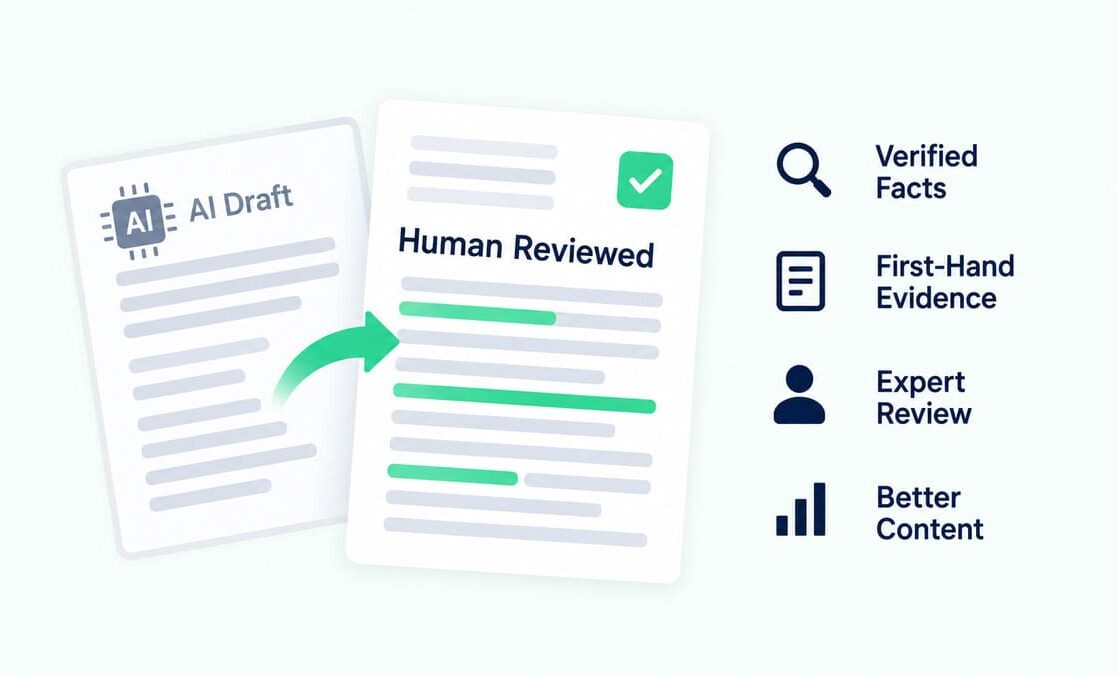
AI-assisted content must also be reviewed before publication. Our team verifies reviewer notes, source usage, approval steps, and ownership records for key service pages.
People signals help buyers identify who created, reviewed, approved, and maintains each page. These signals are especially important for YMYL, technical, and high-value service pages.
We integrate brand details, service pages, expert roles, case studies, reports, testimonials, FAQs, policies, structured data, and internal anchors into a unified entity model. This model demonstrates how your business, services, personnel, and evidence contribute to service credibility.
You receive a brand entity map, service relationship map, people-to-page map, proof-to-claim map, internal link map, and technical relationship log. These outputs clarify which pages should link to audit, About, service, proof, and contact pages, helping your site avoid mixed signals.
Contact UsSchema markup must reflect visible page content. Our schema experts audit structured data, visible content, page purpose, JSON-LD, and validation issues before implementation. According to Google, structured data must represent page content, and AI features do not require a dedicated AI-only schema.
We focus on valid markup, visible content, technical access, and verified technical output. You receive a JSON-LD plan, validation notes, an issue log, and prioritized repair actions.
Content areas reviewed:
Priority pages must address buyer questions before buyers consider other providers. We revise opening copy, service scope, proof placement, FAQs, internal links, metadata, and CTA language to align with enquiry intent.
We rebuild each page around buyer decisions. Service details move above generic claims. Examples appear near important promises. FAQs cover price, scope, timeline, markup, and platform questions. Internal links connect parent services, proof hub, About, and contact pages.
Each page supports search, comparison, and enquiry in a single location. Buyers can clearly see your offerings, understand their credibility, and identify the next steps.
High-trust content requires publishing guidelines before going live. Google’s spam policy addresses attempts to manipulate generative AI responses in Google Search and scaled content abuse. We implement source quality checks, claim reviews, reviewer roles, and publishing controls to minimize risk on high-trust pages.
| Control area | What we check |
|---|---|
| Claim governance | Ranking, results, health, legal, finance, and conversion language. |
| Source policy | Source name, publication date, page relevance, claim context, and citation placement. |
| AI content policy | Accuracy, originality, buyer value, evidence support, reviewer notes, and approval status. |
| Author policy | Ownership for sensitive, service, YMYL, and priority content. |
| Reviewer policy | Expert input for technical content, high-ticket offers, regulated topics, and risk-heavy copy. |
| Review policy | Visible testimonials, eligible reviews, source context, wording, and markup eligibility. |
| Schema policy | Markup accuracy, visible content support, claim match, and page purpose match. |
| Update policy | Page checks after service updates, source updates, offer changes, or old claims. |
| Correction policy | Content repair process, issue owner, approval step, and revision record. |
AI visibility efforts should prioritize assets under your business’s control. Pew analyzed 68,879 Google searches from 900 U.S. adults. In that study, AI summaries appeared in 12,593 searches; users clicked traditional results in 8% of visits with AI summaries, and source links within AI summaries received clicks in only 1% of visits.
OpenAI states that ChatGPT Search delivers timely answers with links to relevant web sources, and source references may appear in a sidebar. Source-ready pages require service records, verifiable facts, answer sections, and entity links across answer-focused platforms.
Weaker pages result in missed opportunities. Well-optimized service pages enable buyers to compare, verify, and initiate contact more effectively.
E-E-A-T optimization services support teams seeking stronger trust signals, robust proof assets, thorough markup review, clear content ownership, and comprehensive AI SEO reporting.
IMMWIT begins with a discovery phase, followed by audits of content, evidence, people signals, markup, technical access, and AI visibility. Each task is assigned an owner, defined output, and approval checkpoint.
E-E-A-T optimization services improve evidence, people signals, entity relationships, markup, governance, and page quality behind a website. IMMWIT applies the service to commercial pages, YMYL pages, comparison pages, proof hubs, and AI SEO reporting.
Yes. IMMWIT serves as an E-E-A-T optimization agency for brands that need audit support, page improvements, people signals, entity mapping, schema markup services, governance, and AI visibility reporting.
An E-E-A-T audit checks priority pages, proof assets, author signals, reviewer roles, entity links, structured data, technical access, content risks, and reporting signals. The output ranks tasks for implementation.
Yes. E-E-A-T optimization supports AI SEO by ensuring evidence-rich pages, text accessibility, internal links, entity context, answer blocks, source quality, and schema markup aligned with visible content.
Yes. IMMWIT reviews Organization, Service, WebPage, BreadcrumbList, FAQPage, Person, and the eligible Review schema. Each markup recommendation must align with the page’s visible content and purpose.
Yes. Our team checks content owners, authors, reviewers, credentials, team pages, approval roles, source rules, and updates ownership for high-trust content.
The service can support readiness through source-ready pages, technical access, answer sections, entity links, and evidence. No agency can promise fixed AI Overview, ChatGPT, Perplexity, Gemini, or Copilot placement.
Start with service pages, YMYL pages, comparison pages, high-traffic pages, conversion pages, and pages linked to enquiries. Those pages carry the largest trust burden.
Cost depends on page count, audit depth, proof assets, markup needs, technical issues, governance work, reporting scope, and implementation support. Start with an audit when the budget or scope needs prioritization.
IMMWIT reports completed tasks, markup validation, search movement, AI visibility checks, enquiry actions, internal links, proof updates, and remaining blockers. Reports focus on completed work and next decisions.
We Cover top 70 cities around the world