A good ranking on Google no longer fills your beds. Families now ask AI platforms detailed addiction treatment questions. Generative Engine Optimization (GEO) helps those platforms verify and cite your treatment center. We organize clinical pages, credentials, local records, and structured data. Your rehab center reaches qualified families through Large Language Model (LLM) responses across major platforms.
AI treatment answer · live example
“Medical detox near Columbus, OH that takes Aetna and has private rooms?”
Based on verified records, Competitor 1 offers medically supervised detox in Columbus with private rooms and is in-network with Aetna.
An AI citation places your rehab center inside a direct treatment answer. Families see services, insurance, location, and clinical credentials before visiting websites. Early visibility can bring a qualified inquiry.
Retrieval engines need exact facts before AI quoting begins. We convert program details into focused answers, optimized HTML tables, and bulleted text blocks. Each page serves one search query and one family’s need. Verified statistics and authoritative research data support every clinical claim.

AI search engines process highly personal context within one request. Clinical need, location, insurance, privacy, and family concerns appear together.
“Need alcohol detox in Los Angeles with Aetna insurance and a private room.”
Your pages must answer each need without making families search across many pages. Generative AI SEO connects location, insurance, detox care, and room details with the right service pages.
Local service area, map details, and admission information.
Accepted plans, coverage details, and benefit verification.
Medical monitoring, withdrawal care, and next treatment steps.
Room options, privacy details, and residential comfort.
Families once typed “rehab near me” into a search box. Conversational AI platforms now process detailed requests across several variables. AI algorithms use context beyond traditional keyword density signals. Each conversational search query maps to a dedicated treatment page.
Public discussion adds context to the reputations of treatment centers. Platforms like Reddit, Quora, and WebMD may influence the evidence retrieved. AI sentiment can surface themes of safety, communication, and staff. Text-rich reviews add context beyond star ratings. Ethical review collection avoids scripts, incentives, and fake accounts.
Specific clinical pages support precise treatment matching. Relevant content connects diagnoses, populations, treatment modalities, and program levels. Detailed pages answer complex AI search queries with specific program data.
Local AI recommendations depend on accurate facility records. Name, Address, and Phone (NAP) details must match everywhere. Facility pages also need correct geographic coordinates. Maps, directories, licensing records, and insurance profiles require identical details. Directory categories must also match your licensed treatment services. Our local record audit corrects conflicts across priority sources.
Each platform finds treatment sources through different systems. Google AI Overviews uses indexed Search pages and supporting web citations. ChatGPT can cite accessible sources through search-enabled responses. Perplexity surfaces current sources from a refreshed web index.
ChatGPT can cite accessible sources through search-enabled responses.
Perplexity surfaces current sources from a refreshed web index.
Google AI Overviews uses indexed Search pages and supporting web citations to assemble answers, so eligible indexed pages are essential.
Gemini visibility depends on matched treatment prompts, source consistency, and entity clarity.
Reports show which treatment questions need new source content.
We test every platform using a single approved prompt library. Results show where your facility appears and which source wins. Reports show which treatment questions need new source content.
Check My Cross-Platform VisibilityYour facility needs four recommendation signals: proof, answers, architecture, and intent. We audit each signal against programs, locations, credentials, and admissions priorities. Every improvement supports one measurable source requirement.
Healthcare recommendations require verified proof from recognized sources. Our team places Joint Commission (JCAHO) or CARF accreditation badges near relevant programs. Staff profiles name qualified healthcare professionals, licenses, and specialties. HIPAA review checks patient data use across marketing and tracking workflows.
Conversational knowledge retrieval needs short answers with specific clinical facts. Major headings open with one direct response. A 40-word factual summary block covers each high-value question. Data-driven medical facts replace broad promotional claims. Retrieval engines can quote focused passages with less context loss.
Website architecture assigns one purpose to every clinical page. Detox, residential treatment, PHP, IOP, and aftercare receive separate destinations. Semantic clusters connect related services without mixing clinical intent.
Natural-language user prompts reveal how families describe their treatment needs. Headings mirror those questions without awkward keyword repetition. Opening sentences answer one family treatment question immediately. Supporting details cover cost, privacy, insurance, or admission requirements. Medical terms are provided with plain definitions in addition to accepted clinical terminology. Voice queries also need location and insurance details.
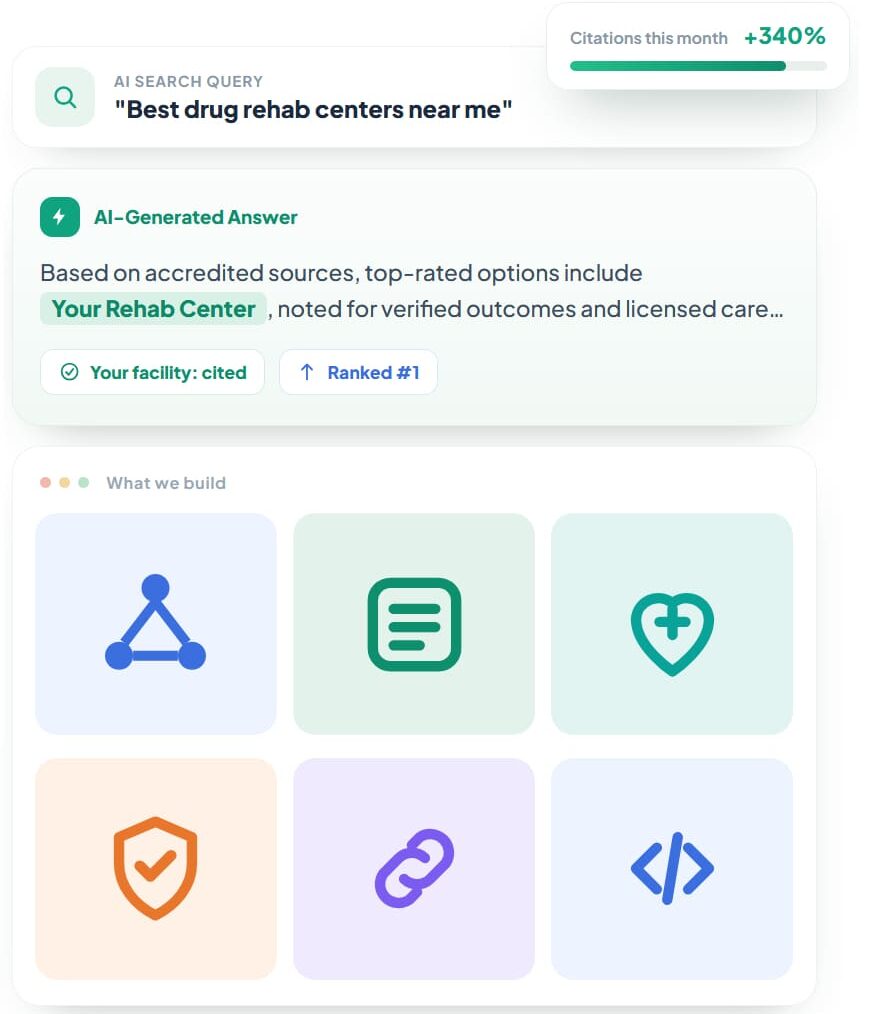
Six assets support reliable AI citation for addiction treatment centers. Every asset solves one source problem across content, code, or proof. Your facility receives a complete technical and editorial build.
Entity architecture defines your provider across public sources. Citable blocks support extraction from relevant program pages. Medical mapping, authority proof, internal links, and schema complete delivery.
A healthcare knowledge graph treats your facility as a single provider. Nodes cover locations, staff, programs, conditions, insurers, and accreditations. Entity review resolves conflicting relationships before AI search engines process pages.
Citable blocks create compact passages for search engines to index. Each block answers one focused family question. Optimized HTML tables and bulleted text blocks hold operational facts. Retrieval-Augmented Generation (RAG) pipelines can extract each passage with minimal context loss.
Medical entity mapping connects family terms with accepted clinical terminology. The Unified Medical Language System joins many biomedical vocabularies and standards. Family wording remains beside clinical terms for easy reading. Consistent medical concepts support diagnosis and therapy pages. Each synonym maps to a single clinical concept across all pages.
Verified source authority shows who supports each clinical statement. Credential pages reference licenses, accreditation, and NPI records. Qualified healthcare professionals receive complete profiles with roles and specialties. Research claims include named sources, dates, methods, and limits. Third-party registries provide independent verification of facility details. Source checks confirm every link before clinical claims reach publication.
Generic “click here” links add little semantic value. Entity-rich anchors identify destination purpose, such as “inpatient medical alcohol detox”.
We add advanced JSON-LD schema across your website. JSON-LD schema code is inserted directly into the website’s HTML source. MedicalBusiness identifies your facility as a medical organization. MedicalCondition labels pages covering relevant diagnoses. MedicalTherapy tags accurately identify services and treatment modalities. Geographic coordinates, hours, insurance, and locations complete local records. Validation checks catch missing fields before deployment.
Our six-stage process covers visibility, entities, data, publishing, external records, and crawler access. Each stage produces an output that your team can inspect. Our optimization frameworks connect every task with admissions priorities and measurable data.
We test AI search queries across treatment, location, insurance, and admissions. Results establish Share of Voice (SoV) inside ChatGPT, Perplexity, and Google AI Overviews.
Our specialists connect your facility with verified public records. Services, locations, staff, credentials, conditions, therapies, insurers, and directories are all in one map. Conflicts become visible before page production starts.
Operational facts move into approved extraction formats. Table labels help families scan important details. Source notes document dates, methods, and supporting organizations. Machine-readable data supports accurate extraction across AI search engines.
Page deployment follows the approved entity and content map. Service pages answer one focused clinical treatment question. Location pages cover access, insurance, and admission information. The approved JSON-LD schema is applied to each relevant template. Quality checks review headings, links, metadata, and mobile reading.
External profiles must match your website across priority directories. Directory identity, categories, descriptions, and hours need to be consistent. Sentiment review covers public discussions and profiles. Detailed reviews reveal recurring themes in communication and treatment. Compliance checks protect patient privacy during response workflows. Source changes are entered into one correction log for approval.
AI web crawlers need readable pages and accurate access rules. We review modern AI user agents, including GPTBot, ClaudeBot, and PerplexityBot. OAI-SearchBot helps ChatGPT discover approved website pages. PerplexityBot helps Perplexity discover current website sources. Claude-User can access websites for user requests. Server rendering makes core pages readable sources for AI web crawlers. Prompt tests check AI citation after indexing updates.
AI visibility reporting measures the presence of generated treatment answers. Keyword rankings alone miss facility citations inside LLM responses.
Monthly reports track platform mentions, cited pages, answer context, and competitor visibility. One prompt library supports every reporting cycle. Comparable prompt groups create a stable monthly benchmark.
Our strategies are built on measurable data. We connect each result to a single source asset. Your team sees which asset improved each tracked prompt group.

Treatment centers choose IMMWIT for accountable GEO delivery. Technical SEO, healthcare content, data systems, and AI testing are included in one plan.
As a drug rehab Generative Engine Optimization (GEO) agency, IMMWIT focuses on qualified inquiries. Every recommendation connects with facility data, available programs, and admissions priorities.
Named specialists cover technical SEO, data engineering, healthcare copy, and compliance. One accountable lead coordinates every specialist project role. Your team receives direct access to responsible experts.
Proof starts with a dated benchmark across selected AI search queries. IMMWIT reports citations, source pages, competitor mentions, and answer context. Client results include methods, campaign scope, and reporting periods. Unsupported performance claims remain outside every client report.
Measurement begins before content or code changes. Every deliverable carries one benchmark and one target. Dashboards track prompt visibility, schema health, crawler access, and citations. Compliant tracking access adds admissions data to reporting. Facility leaders can review progress without having to read technical logs.
We review how AI search engines describe your treatment center. At IMMWIT, we check clinical, local, insurance, and admission questions across major platforms. You receive missing entities, weak evidence, crawler barriers, citation opportunities, and one focused production roadmap.
Generative Engine Optimization structures treatment content, credentials, schema, and entity data for AI citation. It supports visibility across ChatGPT, Perplexity, Gemini, and Google AI Overviews.
GEO supports facilities with verified credentials, useful content, and accessible source data. Families ask AI about insurance, location, detox, therapies, and co-occurring disorders.
Traditional SEO targets rankings, links, and website visits. Generative AI SEO targets citations, entity recognition, extraction, and answer inclusion.
A standard rehab SEO agency may focus on content and backlinks. GEO adds entity architecture, JSON-LD schema, RAG-ready blocks, crawler review, and prompt reporting.
AI platforms compare relevance, credentials, location data, public reputation, and source consistency. Verified services and detailed clinical pages provide stronger evidence for citations.
Medical schema markup classifies facility facts inside website code. It can identify services, conditions, therapies, locations, hours, and insurance.
Public reviews may enter retrieval results or indexed datasets. Detailed, recent reviews help families assess staff, communication, and treatment experience.
Technical changes require recrawling before visibility can change. Entity authority develops across publication, indexing, and external corroboration cycles.