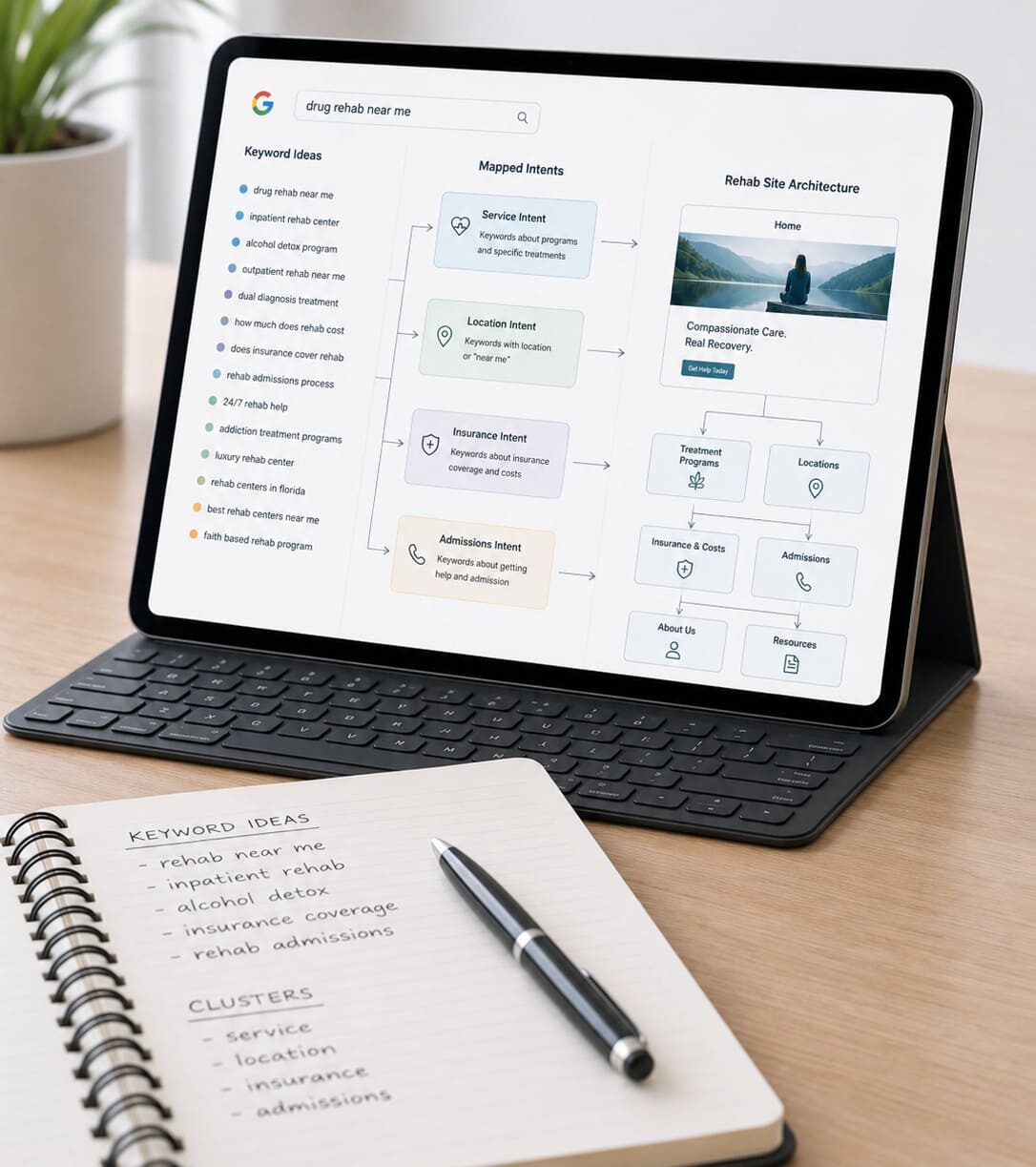




IMMWIT builds drug rehab keyword research around page type, local relevance, trust signals, and AI visibility. Our drug rehab search intent mapping process maps rehab keyword demand into decisions for service, location, insurance, and admissions pages. Updates, consolidation, and exclusions stop low-value pages from reaching production or wasting campaign budget.
Trusted by over 100+ rehab and detox centers worldwide
Rehab SEO breaks when search volume controls page planning. Keyword volume indicates demand but misses page purpose, buyer state, and trust burden. A high-volume phrase can still point toward the wrong page.
Rehab keyword planning must separate local, insurance, admissions, treatment, and family intent before production. According to Google, ranking systems prioritize reliable, people-first content created to benefit readers. For rehab websites, stronger planning starts with a page purpose beyond search volume.
We approach rehab keyword planning as a foundation for site architecture.
Search intent mapping fails when keyword clusters are assigned to incorrect destinations. Accurate keyword-to-page mapping maintains page quality, as each user has a specific goal. Broad rehab pages can dilute relevance for local, payer, admissions, and educational needs.
Local searches require proximity indicators and provider credentials. Insurance-related language should be paired with payer terms, while admissions terms need clear contact options and decision points. Educational terms are best addressed in concise answer sections, and comparison terms require supporting evidence and selection criteria.
According to Google, March 2024 spam policies cover scaled content abuse, expired domain abuse, and site reputation abuse. We use search intent classification before production, reducing weak pages before the budget gets spent.
Drug rehab SEO involves greater risk than general healthcare SEO. A single page may serve owners, marketers, families, and admissions teams. Poor keyword selection can lead to unnecessary page creation, trust issues, and increased remediation costs.
According to Google, recovery-oriented drug and alcohol addiction service advertising in the United States requires certification. Paid channel friction raises the value of organic search architecture.
Healthcare SEO requires a clear page purpose, precise entity accuracy, and strong trust signals. Our rehab SEO experts view each keyword as a search asset with reputational implications.
Our drug rehab keyword research and search intent mapping audit evaluates each cluster before page approval. Intent mapping determines page destination, required evidence, and commercial value. The keyword map translates search demand into lower-risk page decisions.
We define the query goal before page planning begins, such as local treatment intent, insurance research, admissions readiness, family concern, commercial review, or education. Each cluster is assigned a single search task and an appropriate destination.
Each cluster receives a page type: service page, location page, treatment page, insurance page, admissions page, FAQ page, comparison page, update, or exclusion.
Treatment relevance ensures service alignment before content production. Detox terms are matched with detox content, while dual diagnosis terms require both mental health context and treatment relevance.
Local relevance assesses proximity, service area, and supporting location evidence. City keywords must be substantiated with more than geographic references. This filter prevents weak local pages from entering production.
Trust requirements determine the necessary level of supporting evidence. Reliable sources validate factual claims, while provider context enhances credibility for treatment and admissions content. Limiting claims helps protect sensitive pages from overstatement.
CTA direction aligns user readiness with the appropriate action. Insurance terms lead to verification, admissions terms to contact options, and B2B terms to audits. Each query type requires a tailored call to action.
SEO opportunity and AI visibility point toward different content assets. Some clusters require query-ready content or an FAQ schema. Others require entity-rich content, GEO planning, or LLM citation blocks.
Exclusion risk safeguards the roadmap from poor keyword choices. Unsafe terms, irrelevant traffic, duplicate ideas, and low-value queries are removed from the campaign plan. This includes drug sourcing terms, celebrity searches, and unsafe detox queries.
At IMMWIT, we begin with market demand and translate it into page decisions. Intent mapping eliminates uncertainty before investing in content. Drug rehab keyword research delivers value by guiding build, update, consolidation, and exclusion actions.
The process begins with a rehab search entity map. We define entities such as drug rehab, detox, inpatient and outpatient treatment, insurance, admissions, local search, and AI visibility. Entity mapping ensures comprehensive topical coverage before keyword collection.
We gather the complete keyword universe for rehab search demand, including commercial, local, treatment-level, insurance, admissions, comparison, and FAQ terms. Head terms highlight high-volume demand, while long-tail terms reveal opportunities competitors may overlook.
Semantic keyword clustering organizes terms by search intent rather than word similarity. NLP clustering distinguishes groups that need separate answers, dedicated pages, or exclusions.
Each cluster is assigned a search intent classification. We separate local, informational, insurance, admissions, comparison, family, and commercial search states. Intent determines page type, CTA direction, and required evidence.
Keyword-to-page mapping translates research into site architecture. Local rehab terms are directed to location or service area pages; insurance terms to payer content; admissions terms to intake pages; and FAQ terms to concise answer sections.
Risk review filters weak page concepts before production. We identify thin location pages, duplicate treatment pages, unsupported claims, and low-value query groups. Scaled, duplicate, and low-value ideas are removed from the roadmap before content investment.
An SEO roadmap organizes research into a prioritized execution plan. The team ranks pages, updates, FAQ blocks, and local opportunities, with separate notes for AI visibility assets. BrightEdge reported that 63% of healthcare queries included AI Overviews in its June 2024 dataset. The roadmap specifies actions to build, fix, consolidate, or avoid.
Our deliverables convert rehab search demand into actionable SEO decisions. We identify which keyword groups deserve pages, which existing pages require updates, which local terms need supporting evidence, and which terms pose risks before production.
We develop a targeted keyword universe for rehab search demand, including core, local, treatment-level, insurance, admissions, comparison, FAQ, and long-tail terms. The output identifies demand groups suitable for page planning.
A search intent matrix assigns each cluster to a specific search state, recording intent type, funnel stage, page type, CTA direction, trust requirements, and risk notes. Writers consult the matrix before drafting content.
NLP topic clusters organize related terms by search meaning. We distinguish between terms suitable for a single page and those requiring dedicated pages. This approach minimizes overlap before content creation.
A page-type map translates clusters into site decisions, identifying service pages, location pages, insurance pages, admissions pages, FAQ blocks, and updates. This map helps prevent unnecessary content production.
A local SEO map analyzes demand for states, cities, near-me, and service areas. It identifies requirements for location evidence and broader service-area opportunities, enabling the marketing team to separate city page candidates from wider service area content.
An SEO and AI visibility roadmap prioritizes organic search and opportunities for answer extraction. It highlights query-ready sections, FAQ schema candidates, entity headings, AI Overview targets, and answer engine optimization assets.
An exclusion and risk list protects campaigns from poor keyword choices. It flags unsafe queries, low-value terms, duplicate page ideas, and thin content risks. The roadmap removes traffic sources that could undermine site quality.
Keyword research identifies demand across search terms, while search intent mapping translates that demand into page decisions. Both are essential for rehab SEO, but mapping guides execution.
| Keyword Research | Search Intent Mapping |
|---|---|
| Lists search terms | Assigns page purpose |
| Prioritizes volume | Prioritizes intent and risk |
| Groups similar phrases | Groups searcher needs |
| Suggests topics | Recommends page types |
| Misses unsafe terms | Flags exclusion risk |
| Produces a spreadsheet | Produces an SEO roadmap |
We use the map to align search demand with site architecture.
Costly rehab SEO decisions often occur before content enters the CMS. Weak keyword logic approves pages that the site cannot support. IMMWIT reviews each cluster before production. Every avoided weak page saves on production costs, crawl resources, and future remediation.
Our rehab SEO experts safeguard your budget, site quality, and organizational trust.
Rehab visibility spans organic results, map results, AI summaries, and LLM answers. Our map identifies which visibility surface each cluster can support. BrightEdge healthcare data supports a query-ready structure across AI Overview search results.
Google Search rewards clear page purpose, people-first content, and accurate intent coverage. We assign clusters to pages that address demand while maintaining topical focus.
Local search requires evidence of location beyond city modifiers. The map links near me require service area logic, location pages, and alignment with Google Business Profile.
AI Overviews need extractable answers and consistent entity signals. We identify clusters requiring concise definitions for AI extraction. The roadmap also highlights FAQ blocks and query-ready sections.
LLM visibility relies on consistent entities and information that is ready for retrieval. The roadmap indicates AI citation readiness, comparison structure, schema support, and citation-ready sections.
Request a drug rehab keyword map before another weak page is produced. The keyword map provides actionable page decisions, specifying which pages to build, update, consolidate, or remove from the roadmap.
We review search demand, page structure, local opportunities, and AI visibility assets. Our rehab SEO experts deliver prioritized recommendations for service pages, location pages, insurance pages, admissions pages, existing content, and exclusion risks.
These answers cover common questions before ordering drug rehab keyword research.
It identifies search terms people use for addiction treatment, detox, insurance, admissions, local providers, and comparisons. The team connects those terms to search intent and page recommendations.
Keyword research identifies search terms across the rehab market. Search intent mapping assigns each term to a site role. The outcome may point to a service page, a location page, an FAQ block, or an exclusion note.
Drug rehab SEO operates inside healthcare-sensitive search markets. Keywords can involve local provider choice, insurance, family concern, urgent demand, and trust requirements.
We recommend city pages only with local intent and location evidence. Weak city pages can lead to thin content and duplicate content risks.
Yes, the map identifies clusters needing query-ready content, FAQ schema, entity-rich headings, and extractable definitions. Those assets can support AI visibility alongside organic search.
Our deliverables include a keyword universe, a search intent matrix, NLP topic clusters, a page-type map, a local SEO map, an AI visibility roadmap, and an exclusion list. It shows build, update, consolidate, or avoid actions.
Yes, the rehab SEO audit checks page purpose, intent match, local relevance, duplicate risk, and AI visibility. Our audit identifies updates, consolidation, exclusion, or stronger targeting.
We Cover top 70 cities around the world