Rank for treatment queries with stronger program pages, local proof, insurance content, and admissions tracking. At IMMWIT, we build SEO for residential treatment centers around the people most likely to contact your admissions team. We connect treatment intent with pages that answer program, insurance, location, and contact questions.
Trusted by over 100+ rehab and detox centers worldwide
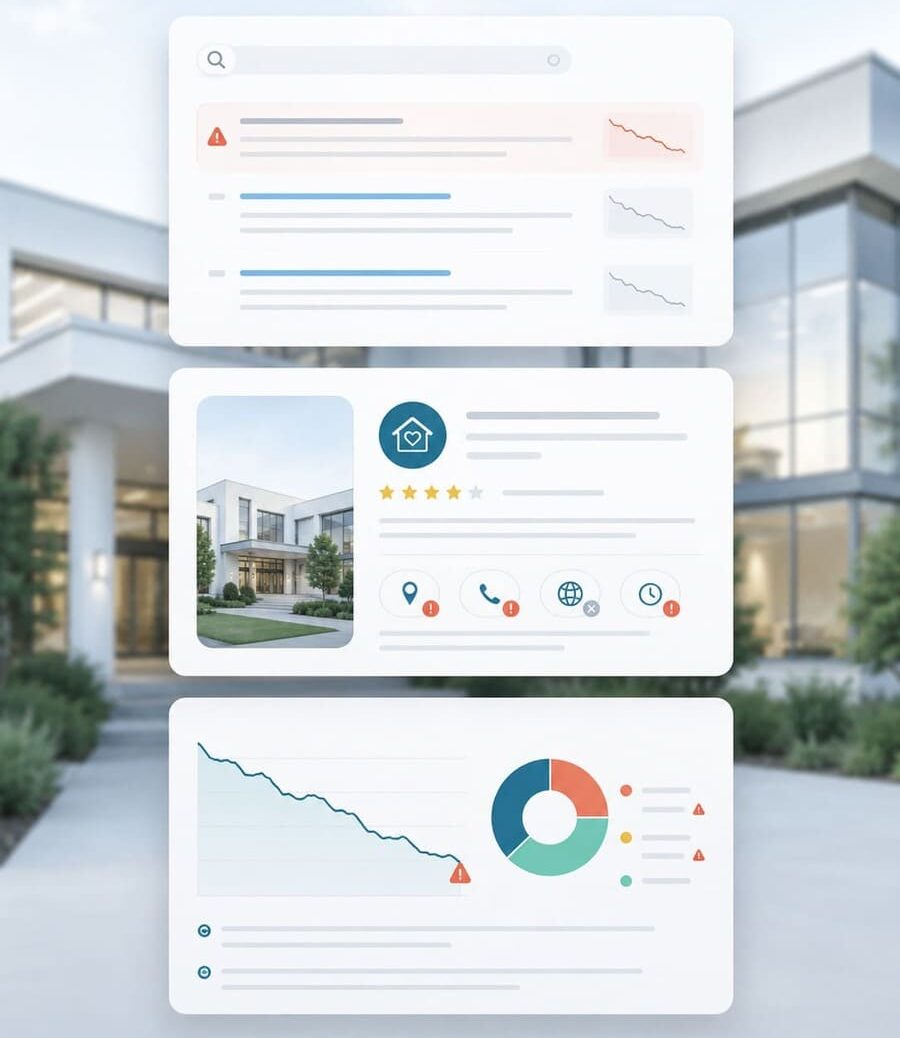
Google visibility can look strong while admissions quality remains weak. Broad rankings may send visitors who are not relevant to the program. Residential treatment SEO should target queries tied to service need, payer match, location, and contact intent. Common signs:
Residential treatment marketing carries higher stakes than ordinary local SEO. Many agencies chase map rankings, city pages, and blog volume. Families compare program credibility, insurance steps, staff proof, and contact options. A basic local campaign misses those decision points.
| Basic local campaign | Residential treatment SEO |
|---|---|
| Chases local rankings | Builds provider credibility |
| Writes broad service pages | Builds program and condition pages |
| Tracks visits | Tracks inquiry quality |
| Optimizes GBP alone | Connects GBP, website, citations, and admissions |
| Publishes generic articles | Builds decision-support content |
Residential treatment queries carry clinical, financial, privacy, and local intent. People compare programs, staff credentials, insurance steps, reviews, and admissions options. Health-related pages need helpful content, expert input, and visible trust markers. Residential treatment SEO must connect query intent with accurate service pages. It also needs measurement tied to admissions quality.
Google states that its ranking systems prioritize helpful, reliable information created for people, with E-E-A-T used as part of content quality review.
Residential, inpatient, dual diagnosis, trauma, detox, adolescent, and adult pages need separate SEO logic.
Verification, payer details, pre-authorization language, and contact options influence conversion.
GBP, facility address, photos, citations, reviews, and location pages support provider identity.
Calls, forms, insurance clicks, and qualified inquiry signals show commercial value.
At IMMWIT, we build SEO around treatment queries with stronger admissions potential. Rankings are important when the right person reaches the right program page. A person looking for residential treatment may need mental health support, addiction support, dual diagnosis support, or detox first. Each query needs a page aligned with service scope, location, payer details, and contact intent. We connect those pages through internal links and conversion tracking.
Program pages carry commercial weight for residential treatment SEO. Each page should address a distinct treatment decision, including service scope, care level, audience, location, and admissions next step.
One page cannot serve every program intent.
Residential treatment pages need direct service details. Cover program structure, admission criteria, facility environment, clinical oversight, insurance options, and next steps. Add photos, FAQs, internal links, and calls to admissions where they support the decision.
Mental health residential treatment pages should focus on condition relevance. Mention depression, anxiety, trauma, PTSD, mood concerns, or other offered services. Add staff credentials near clinical claims. Link condition pages toward admissions and insurance content.
Addiction treatment pages need substance-specific intent. Alcohol, opioid, stimulant, and polysubstance queries may deserve separate pages. Cover residential rehab, treatment approach, family concerns, and insurance verification. Add one direct CTA near the first service proof block. Keep recovery claims conservative and factual.
Dual diagnosis pages should connect mental health symptoms, substance use patterns, and residential support without flattening every condition into one page. Co-occurring care needs its own entity coverage. Add admissions screening details and related internal links.
Detox and step-down pages should show the service sequence. Cover detox, residential care, PHP, IOP, and aftercare where available. People need to see how levels connect. Add internal links between each level and the admissions page.
Age changes intent. Teen pages need parent language, safety details, family involvement, and school coordination. Adult pages need autonomy, insurance, work concerns, and privacy cues. Referral partners may need criteria, documentation, program scope, and contact details. Build each page for its audience.
We build residential treatment SEO from diagnosis to reporting. Each service improves query relevance, facility proof, page quality, or admissions measurement. Our team starts with the highest-impact blockers first.
A residential treatment SEO audit finds the issues blocking rankings and inquiry quality. We review technical health, local visibility, content depth, trust signals, and conversion routes. The audit also identifies program, condition, insurance, and location topics needing stronger pages. Priority fixes come first.
Keyword mapping separates education queries from admissions-ready queries. Residential treatment, trauma, dual diagnosis, insurance, and local terms need separate page targets. We group terms through program, condition, payer, audience, location, and contact intent. Each group earns a page role. The map directs content and internal linking.
It removes barriers to the website’s organic performance. We review crawl access, indexation, redirects, canonicals, schema, speed, mobile performance, and internal links. Fixes help search engines process service pages with fewer errors.
We improve titles, headings, treatment entities, FAQs, internal links, proof elements, and admissions CTAs. Each page should answer one treatment decision. Depth beats repetition.
Local SEO connects facility identity across Google, the website, citations, reviews, and location pages. We improve GBP fields, categories, services, photos, Q&A, posts, and website links. Citation cleanup supports consistency in names, addresses, and phone numbers. Location pages reinforce service relevance. Review work follows privacy-aware rules.
Topical authority grows when supporting content strengthens service pages. Our SEO expert clusters around programs, conditions, insurance questions, family concerns, referral topics, and local intent.
Treatment websites need visible proof. We improve staff bios, credentials, licensing references, accreditation details, privacy cues, secure forms, and ownership signals. Photos and program specifics support visitor confidence. Clinical review notes help sensitive pages.
SEO reporting should connect visibility with admissions signals. We track organic calls, forms, insurance clicks, GBP actions, source pages, and inquiry quality. CRM source data can strengthen reporting when available.
Our local SEO helps residential treatment centers prove they are a real provider in a real location. It connects your Google Business Profile, website, address, phone number, reviews, photos, citations, and service pages. When those signals match, people can verify your facility more quickly and contact admissions with greater confidence.
Local trust signals include:
Ethical SEO for residential treatment providers protects provider trust. Families should reach accurate service pages, visible provider details, and honest contact options. We enhance visibility around the center’s identity, useful content, and measurable admissions signals.
Residential treatment SEO should connect rankings with business signals your admissions team can actually use. At IMMWIT, our team tracks how people find your website, how they interact with program and insurance pages, and which actions lead to better inquiries. We show which pages, keywords, and local signals are helping admissions conversations.
Search visibility tracking shows which queries and pages earn organic reach. We review rankings, impressions, clicks, indexed pages, landing pages, and snippet movement. Query groups show which topics deserve more support.
Local visibility tracking reviews Google profile activity and map presence. Metrics include GBP calls, website clicks, directions, map impressions, and citation health. Location-page performance adds more context. Review patterns can flag trust issues.
Website engagement tracking shows how visitors move through service pages. We review phone clicks, form starts, form completions, insurance clicks, CTA clicks, and page depth. Program pages need different benchmarks than blog pages. Insurance pages need event-level tracking. Admissions pages need contact-route data.
Admissions quality tracking connects SEO with inquiry relevance. Review qualified calls, poor-match calls, payer-match inquiries, program-match inquiries, booked assessments, and CRM source data. Lead quality feedback improves future keyword and page priorities.
Many treatment websites lose rankings and inquiries due to fixable issues. We find page, local, content, tracking, and trust problems blocking organic growth. Each fix connects to visibility, credibility, or inquiry quality.
A thin program page cannot carry every treatment query. Weak pages miss conditions, service level, insurance context, staff proof, and next steps. We build deeper pages with unique intent coverage. FAQs and internal links support each service page.
Weak insurance pages create hesitation at a high-value contact point. People need verification steps, payer details, forms, phone options, and expectation language. Our SEO expert strengthens insurance pages with content, CTAs, FAQs, and tracking.
Mismatched GBP details, citations, phone numbers, and location pages create doubt. Families compare details across Google and the website. We clean local data and improve location pages. Local schema supports page context.
Visitors leave when contact options lack direction. Treatment pages need phone CTAs, forms, insurance links, and contact expectations. That is why we add conversion blocks at decision points. Tracking shows which routes produce quality inquiries.
Generic articles may bring visits without supporting admissions pages. Treatment content should strengthen programs, conditions, locations, insurance pages, and family questions.
Traffic reports alone cannot prove admissions value. Treatment centers need call quality, form quality, insurance-click data, and source detail. We connect queries and pages with inquiry data. Admissions feedback sharpens priorities. Better reporting improves future SEO choices.
Tracking tools need extra discipline on healthcare websites. Forms, pixels, call tools, and analytics can capture sensitive interaction data. Our team reviews event tracking and reduces unnecessary data capture. Reporting should support performance without avoidable privacy exposure.
We build SEO for treatment providers with a category-specific structure. People choose us because we focus on high-intent queries, program pages, local proof, insurance content, trust signals, and admissions tracking. Our work connects rankings with inquiry quality. Every recommendation linked back to visibility, credibility, or conversion.
Request an SEO audit for residential treatment from IMMWIT and see where your website is losing rankings, trust, and admissions quality. We review technical SEO, keywords, program pages, insurance content, local visibility, GBP, conversion routes, and tracking. Get priority fixes your team can use to improve visibility and attract better inquiries.
SEO for residential treatment centers improves organic rankings, local visibility, program pages, insurance content, and qualified admissions inquiries. It connects treatment-related queries with pages covering programs, conditions, locations, and admissions.
Residential treatment SEO needs stronger trust signals, health-topic accuracy, local provider proof, insurance details, and admissions tracking. General SEO may miss program relevance and inquiry quality.
SEO can support more qualified admissions inquiries when pages match high-intent treatment queries. Track calls, forms, insurance clicks, GBP actions, and inquiry quality.
A strong website needs program pages, condition pages, insurance pages, admissions pages, location pages, staff pages, FAQs, family resources, and referral content. Each page should support a distinct decision.
Yes. Local SEO helps people, and search engines verify the facility address, phone number, services, reviews, photos, citations, and Google Business Profile.
Google Business Profile optimization improves profile accuracy, categories, services, photos, phone number, website link, reviews, Q&A, posts, and admissions links.
Treatment centers should track rankings, impressions, organic clicks, GBP actions, phone clicks, forms, insurance clicks, qualified calls, booked assessments, and inquiry sources.
Yes. Treatment SEO touches health content, privacy, reviews, claims, and online tracking. Teams should avoid exaggerated recovery claims, fake listings, fabricated reviews, and unreviewed tracking tools.
Timeline depends on competition, site health, content depth, technical issues, local signals, and publishing pace. Early fixes can improve crawl health, while competitive rankings need sustained execution.
A specialized agency offers treatment keyword mapping, program-page strategy, local proof-of-work, insurance page optimization, trust signal planning, and admissions-focused reporting.
We Cover top 70 cities around the world