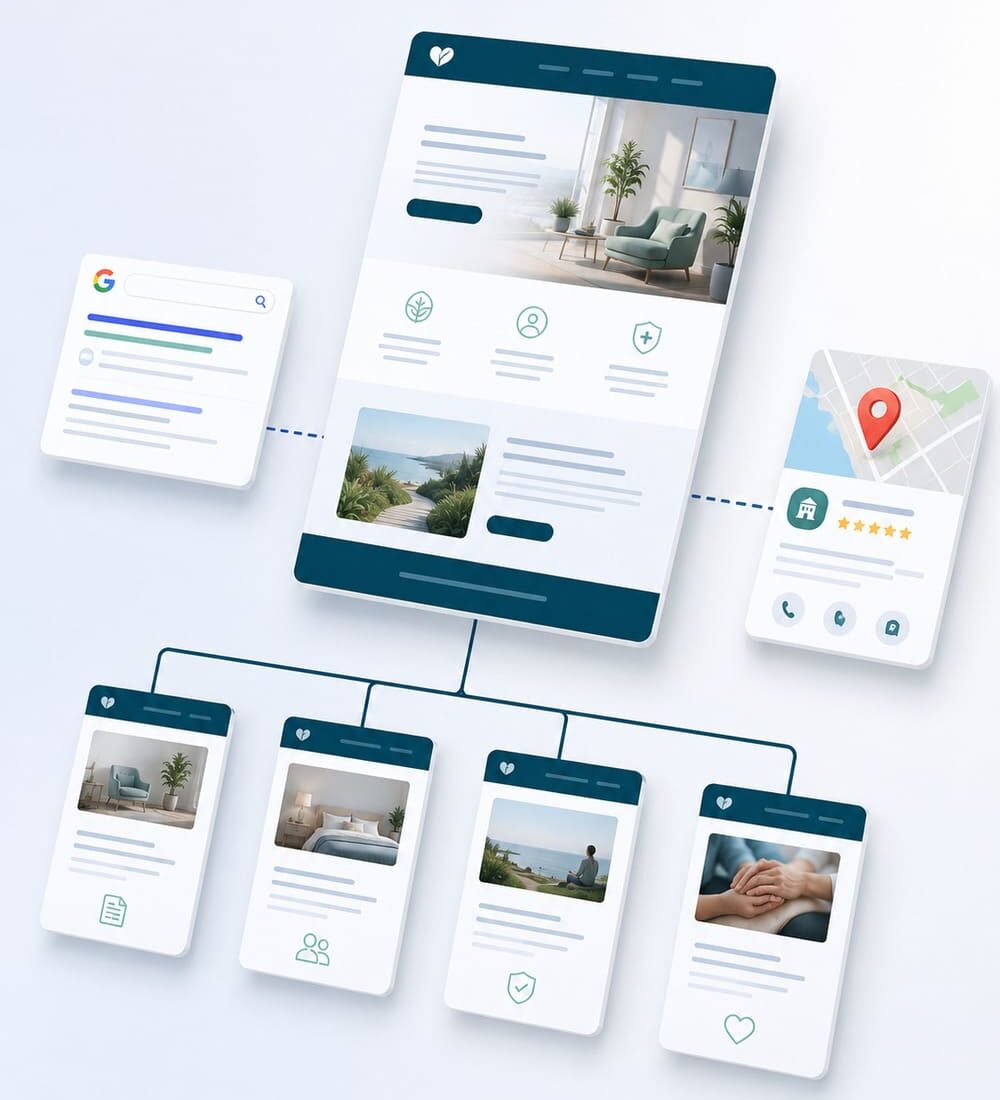
Even strong treatment center content can lose people inside a weak site structure. Services, conditions, locations, insurance, admissions, and resources need to be defined on the site. When those sections compete, patients work harder, and Google ranks a weaker site lower. SEO-friendly website architecture fixes page order before more content gets written. Our team maps page groups, URL silos, internal links, technical requirements, and trust signals.
Trusted by over 100+ rehab and detox centers worldwide
Patients visit a treatment center’s website with different needs. Some need treatment options, some need condition information, some need insurance details, and some need a way to contact admissions. Website architecture organizes those needs into service categories, condition topics, program pages, a treatment hub, location pages, insurance pages, and admissions steps.
Our team builds the website structure through navigation, page hierarchy, internal links, URL folders, headings, and schema markup. Patients move from information to inquiry. Google gets crawlable links, readable page groups, and stronger signals about each page’s purpose.
Google Search Central connects SEO work with crawling, indexing, and content interpretation. Our site architecture work supports crawlable URLs, indexable pages, readable page relationships, and organized content groups.
Treatment center SEO starts with site structure, since every core page must perform a single job. Service pages show what the center provides, condition pages answer condition questions, and location pages show where care is available.
More content on a weak structure creates more cleanup later. A new treatment page can compete with an old blog post, a city page can repeat another location page, and an admissions page can remain disconnected from treatment pages.
Trust signals belong in the website structure. For treatment centers, reviewer signals, privacy pages, source-backed treatment language, and accurate service details need to be in place before new copy is written.
Search engines need page groups they can crawl and classify. Google Search Central recommends logical site organization, descriptive URLs, related directories, and links between relevant pages. Our team maps those page groups before content production begins.
Many treatment centers have landing pages and technical SEO, while the full site structure remains weak. Each layer serves a different job in treatment center SEO. Mixing those roles forces campaign pages to carry architecture work.
Our team uses website architecture to organize the full treatment center site. Page mapping covers the homepage, treatment hub, service pages, condition pages, location pages, insurance pages, and admissions pages. A treatment hub can connect addiction treatment, dual diagnosis, and mental health treatment pages.
Landing pages support one campaign, offer, or admissions action. One landing page may focus on insurance verification, assessment requests, or a single campaign audience. Website architecture organizes the rest of the site around durable page groups.
Technical SEO covers crawlability, indexability, mobile performance, canonical tags, XML sitemaps, redirects, and schema validation. Those elements provide Google with access to the site. Website architecture decides which pages belong in the structure. Schema markup adds page-level meaning signals when the visible content supports it.
Your treatment center website needs more than a homepage and contact page. Architecture includes service, condition, level of care, location, insurance, admissions, education, clinician, and privacy pages. Each page group serves one search purpose.
Our team maps these groups before writing or rebuilding content. For treatment centers, reviewer signals, privacy pages, and source-backed treatment language belong inside the architecture. SAMHSA identifies treatment options, including medications, counseling, behavioral therapies, recovery support, and confidentiality rights.
Each treatment center page gets one main job. The page must match the reason someone reached it.
Our team maps the page before writing copy. We classify pages through treatment intent, condition research, local access, insurance questions, or admissions. Sensitive topics also need privacy review, accurate treatment language, and source support.
We map each page to a single main search intent. Service pages target treatment intent. Condition pages target problem research. Someone looking for IOP needs a program page, while someone researching anxiety needs a condition page. Mixed intent weakens the page before the copy begins.
Service pages answer what the center offers. Examples include addiction treatment, dual diagnosis treatment, and mental health treatment.
Condition pages answer what the visitor may be facing. Examples include opioid addiction, alcohol use disorder, depression, and anxiety. The split creates a defined job for users and search engines.
Treatment pages connect with level-of-care pages when the program structure supports the service. Residential treatment, PHP, IOP, and outpatient pages show program intensity. Our team only connects to the programs the center provides.
Location pages list the treatment options available at each facility. Facility pages need an address, phone number, available programs, and local service links. The Google Local Business documentation supports business details such as hours, departments, reviews, and location data.
Insurance and admissions pages connect with core treatment content. Someone reading a treatment page may need insurance verification before contacting the center. Location pages may need a direct admissions option. Insurance forms need privacy language, limited fields, and a visible next step.
Resource content supports education before a visitor reaches a service page. A resource hub can answer early questions without competing with service pages.
We link resource content back to relevant treatment pages. A resource about alcohol use signs can connect to alcohol addiction treatment and family resources.
Visitors may enter through the homepage, a treatment page, a condition page, a location page, or a resource article. Each entry point needs a useful next page. Disconnected pages lose visitors before admissions ever see the inquiry.
Someone may start on opioid addiction, move to addiction treatment, compare IOP, then reach insurance verification. Location pages can connect to programs offered at that facility. Resource articles can route education traffic toward a relevant service.
Those links move patients from research pages toward treatment and admissions. Google also uses links to discover and interpret related pages.
Contact UsSEO-friendly URL silos group related pages under the right parent folders. Google recommends descriptive URLs and logical site organization for users and search engines.
Treatment pages belong in a core service area, such as /treatment/addiction-treatment/. Condition pages belong in a separate folder, such as /conditions/opioid-addiction/. The split supports classification between service content and problem-focused content.
Location URLs group facility pages, city pages, or service-area pages. A local URL may follow /locations/city-state/. Duplicate city pages may need merging, canonical cleanup, or removal.
Insurance and admissions URLs remain close to the main website structure. Useful examples include /insurance/ and /admissions/. These pages answer high-intent questions before a visitor contacts the center.
Resource articles belong outside the service folder. A structure such as /resources/ separates education content from core treatment pages. Those articles can still connect back to service and condition pages.
Our audit finds where the website structure breaks down. We review page inventory, URL groups, internal links, indexable pages, duplicate pages, schema needs, local page signals, and admissions movement. The output is a new architecture plan.
Our crawl builds the working page inventory. It captures indexable pages, broken links, redirects, duplicate URLs, low-visibility pages, and technical errors. Search Console data can add indexed pages, crawl issues, and coverage details when available.
Each existing page receives a purpose label. Treatment pages, condition pages, location pages, insurance pages, admissions pages, clinician pages, and resource pages move into the current site map.
Missing treatment and condition topics become candidates for new pages. Overlapping URLs reveal pages competing for the same job. Each flagged page receives a next action: review, merge, rewrite, or remove.
Internal links reveal how pages support one another. URL silos expose weak folder logic, duplicate grouping, and misplaced content. We review Google Business Profile alignment, NAP consistency, schema needs, and service-to-admissions connections.
Your rehab website architecture plan converts the audit into page-level decisions. It shows what to build, merge, move, rewrite, or remove. You receive a revised page map, URL plan, internal linking plan, schema notes, local page notes, source-review notes, and technical priorities.
Strong site architecture planning connects patient needs, core pages, and crawlable page groups.
Our treatment center website architecture checklist focuses on page structure, links, URLs, trust signals, and technical access. Each item makes the site easier to use, crawl, verify, or expand.
Request an audit if several items are missing. More content will only add weight to a weak structure.
Strong site architecture planning connects patient needs, core pages, and crawlable page groups. Our treatment center website architecture checklist focuses on page structure, links, URLs, trust signals, and technical access. Each item makes the site easier to use, crawl, verify, or expand.
Request an audit if several items are missing. More content will only add weight to a weak structure.
Request an SEO-friendly website architecture audit for your treatment center before adding another service page, location page, or resource article. More content leaves the weak page structure unfixed.
At IMMWIT, we review page groups, URL silos, internal links, local pages, schema needs, technical SEO, and source-backed treatment claims. You receive a page map, URL plan, internal link plan, duplicate page notes, schema notes, local page notes, and an implementation priority list.
You see which pages to build, merge, move, rewrite, or remove. Start with the audit before your team invests in more pages.
Website architecture can hurt SEO when important pages are hard to find, duplicated, or disconnected. Common signs include weak internal links, duplicate location pages, missing service pages, isolated blog content, and missing indexable pages. An architecture audit reviews those issues before more content gets added.
No. Website architecture covers page structure, URLs, internal links, navigation, schema, and page purpose. A redesign changes the visual layout. Architecture decides how the website works for patients and Google before design begins.
Major treatment services need dedicated pages when demand and service depth support them. Service pages focus on one treatment offer and the visitor’s need behind it. Addiction treatment, mental health treatment, and dual diagnosis treatment may each need a dedicated page. Smaller services can support the main service pages.
Some sites need new pages. Others need a better page structure for already published pages. New pages cover missing treatment, condition, or location topics. Existing pages may need merging, stronger internal links, new folders, or better placement inside the site.
Insurance and admissions pages belong near the core treatment and location pages. Someone reading about a program may need insurance verification before contacting the center. These pages reduce extra searching and support a more direct inquiry route. Privacy language and limited form fields also matter.
Website architecture can support local treatment center rankings through stronger location pages. Each location page needs to include available programs, service-area details, contact information, alignment with the Google Business Profile, NAP consistency, and relevant internal links. The LocalBusiness schema can also provide Google with business details when the page content supports it.
Use location pages for actual facilities or valid service areas. Repeating the same page across cities weakens the local structure. Each location page needs programs, contact details, service-area context, and admissions information. An audit identifies which location pages to retain, merge, or remove.
After the audit, you receive a page map, a URL plan, an internal link plan, a duplicate page list, and a priority order. The plan shows which pages to build, rewrite, merge, move, or remove. Your team gets an implementation order before expanding content.
We Cover top 70 cities around the world