At IMMWIT, we improve detox center SEO across Google Search, Maps, AI answers, and service pages. Our work targets qualified admissions inquiries, insurance verification starts, and contact-ready demand. Our detox center SEO service covers keyword research, service page optimization, local and technical SEO, schema markup, content depth, and admissions reporting.
Trusted by over 100+ rehab and detox centers worldwide
High-intent detox demand reaches Google before it reaches admissions. Competitors, directories, and map results can capture that demand first. Our SEO for detox centers closes the visibility gap at the query level.
People search for:
Each query deserves a matching page, location signal, and contact option. Weak visibility sends qualified demand into another facility funnel.
Qualified detox inquiries come from matching the right query with the right page. Our SEO services connect service intent, location intent, and contact intent. We create pages that help people compare treatment options before contacting admissions. Reports should show contacts, not traffic alone.
Qualified inquiry signals can include:
Basic local SEO can help a business appear nearby. Detox SEO has a harder job. A person seeking detox may need service details and reassurance about privacy. They may also need insurance requirements and proof of facility.
Detox searches are personal. People may compare cost, location, safety, privacy, and availability before contacting admissions. Our job is to make the page answer those concerns before asking for a call.
A broad addiction-treatment page cannot cover every detox-related search. Alcohol detox, drug detox, opioid detox, medical detox, and insurance searches each need their own page intent. We build pages around the exact questions people bring to Google.
Local visibility depends on more than adding a city name. Your website, Google Business Profile, reviews, address, hours, service categories, photos, and phone details need to match. We improve those signals so people can verify the facility and contact admissions with more confidence.
Search visibility does not start with more pages. It starts with helping Google identify what your detox center offers, where it serves people, and which contact step belongs on each page. We build that visibility across organic search, Google Maps, AI answers, and admissions contact points.
At IMMWIT, we connect detox SEO work to qualified admissions interest. Service pages, local signals, insurance pages, mobile CTAs, Google Business Profile actions, and forms all need to connect with qualified admissions interest.
Our detox SEO campaign shows which searches generate useful contacts. We map queries to pages, improve contact points, and measure calls, forms, insurance starts, and local actions. Search visibility should support admissions value, not vanity traffic.
Our detox SEO services cover demand mapping, page quality, local visibility, technical health, content depth, AI visibility, and admissions reporting. Each service improves one part of the search-to-contact journey.
Keyword research separates broad traffic from admission intent. We group detox queries around services, locations, substances, insurance, and contact readiness. Medical detox near me, alcohol detox in the city, and detox accepting insurance need separate page targets.
Service page optimization improves titles, headings, FAQs, schema, internal links, and contact placement. A medical detox page needs service depth. An alcohol detox page needs a safety context. An insurance page needs verification steps.
Local SEO for detox centers connects Google Business Profile, citations, reviews, city pages, and phone actions. Service categories and NAP consistency support local relevance. Stronger local data helps people verify the facility before contact.
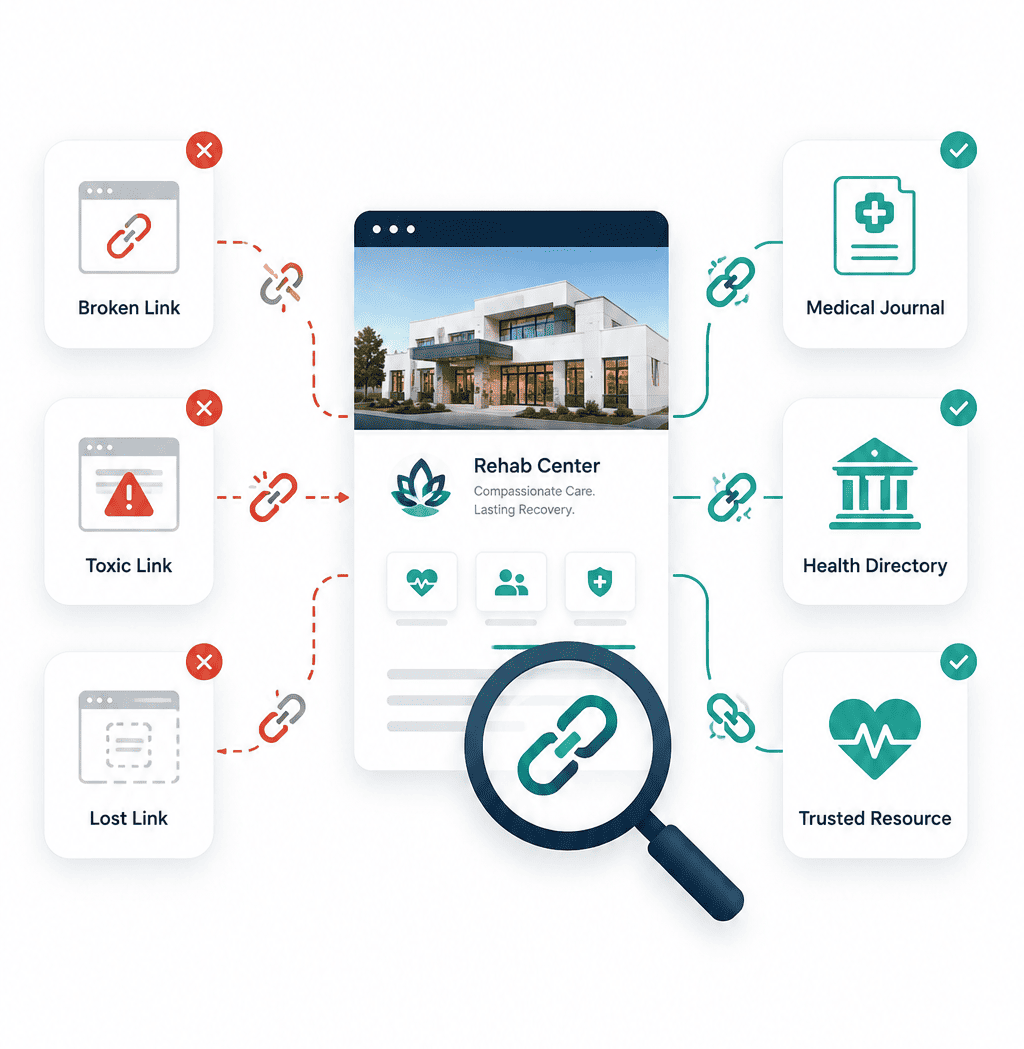
Technical SEO checks crawl access, indexing, redirects, broken links, page speed, mobile usability, sitemaps, and schema. A slow mobile page can reduce contact actions. Redirect errors can break the authority flow between related pages. Indexing issues can hide service pages. Crawling error can reduce attention on priority URLs.
Content strategy maps detox topics to decision needs. Pages can address withdrawal management, insurance verification, family questions, local treatment, and service comparisons. Each topic supports the purpose of one page. Internal links connect related pages without repeating copy.
AI search and GEO optimization add answer blocks, definitions, FAQs, schema, and entity summaries. Service-to-location pairings help machine systems classify the page. Entity consistency improves recognition across service, provider, location, and contact signals.
Our detox SEO report should show more than rankings and traffic. We address which pages brought calls, forms, insurance starts, Google Business Profile actions, and other contact signals. We also review technical health, as broken pages or tracking issues can mask the campaign’s value.

Directories and competing centers can shape the first impression a person has of your website before they even reach it. Our SEO team helps you show stronger service, local, and contact proof across search. We focus on facility-owned pages and stronger Google Maps signals. We also add the answers people need before choosing an admissions contact.
People may land on a detox page with questions about safety, insurance, substances treated, privacy, and what happens after they reach out. If the page only gives a short service description, they may leave before contacting admissions. We rebuild those pages around the questions people need answered first.
Our team creates each detox page around a single service and a contact action. Someone may want to know which detox services are available, how insurance works, and what happens after they reach out. Each page should answer those questions, show trust proof, and make the admissions step easy to find.
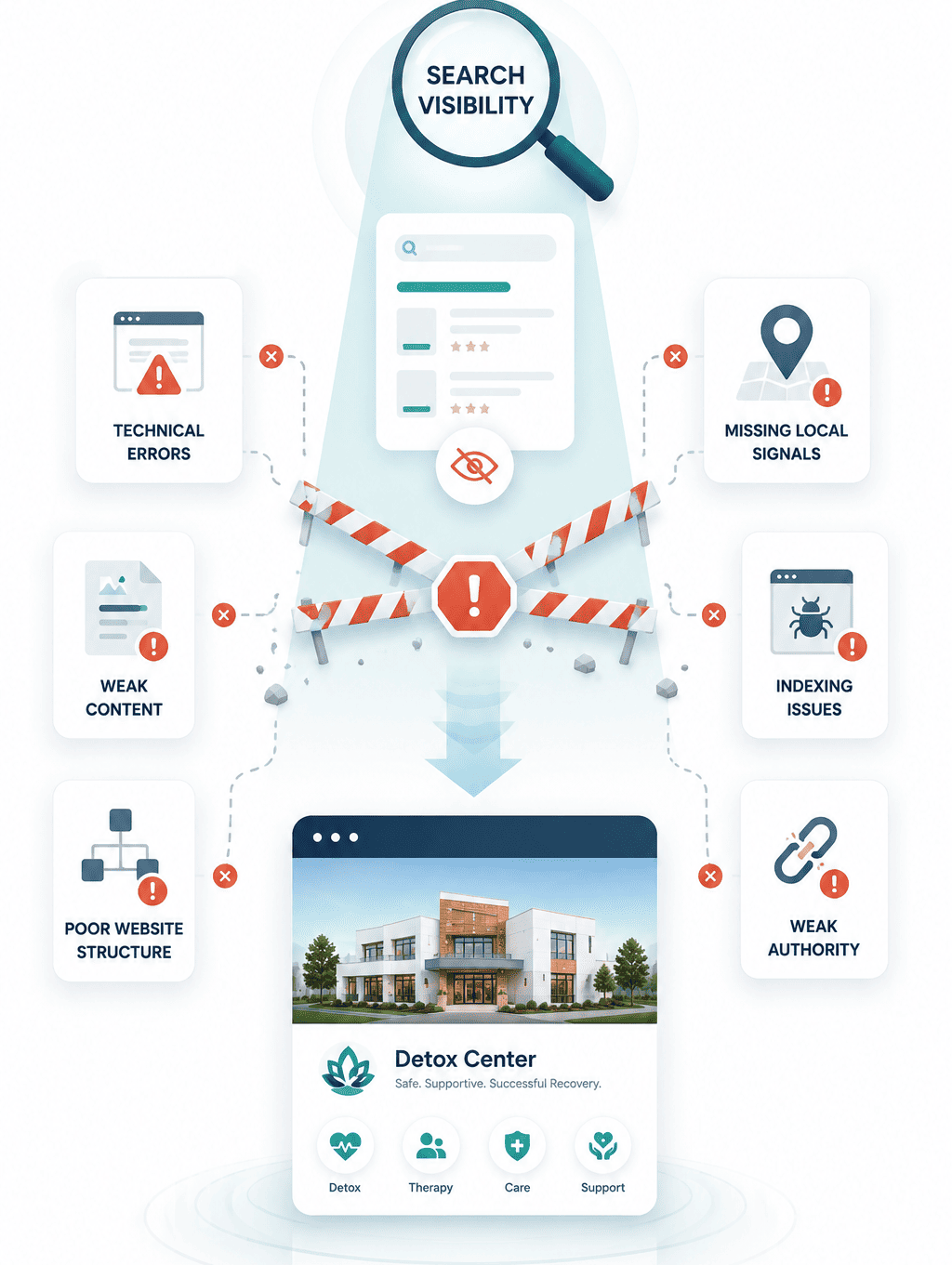
SEO for Detox centers can break down before the main service pages ever get a fair chance to rank. The problems arise from weak targeting, poor local data, thin pages, technical blockers, or reports that do not show admissions value. Our team reviews these problems together, then prioritizes the fixes that affect visibility and inquiry tracking.
Detox keywords get mixed together too easily. We separate service, city, substance, insurance, and family intent before assigning pages.
One page trying to cover every service weakens relevance. Our team segregates major detox intents into stable page groups.
City pages fail when they only swap location names. We add local proof, service relevance, and contact details.
Local trust drops when business details do not match. It is important to check GBP, directories, hours, categories, phone numbers, and service data.
Search visibility suffers when important pages have crawl or indexing issues. Our SEO experts check technical blockers before expanding content.
Generic content makes detox pages sound interchangeable. We add service-specific language, substance context, insurance details, and family questions.
People need proof before contacting a treatment provider. That’s why we also check facility details, privacy language, photos, and accreditation context.
Only rankings do not show business value. We connect reporting with calls, forms, insurance starts, GBP actions, and page conversions.
Detox providers do not all need the same SEO structure. A single-location medical detox center has different page needs than a multi-location treatment group. At IMMWIT, we build the SEO plan around each provider’s services, locations, and admissions process. We also account for the people each provider needs to reach.
Medical detox centers need pages that show service depth without sounding vague. The content should connect supervision, intake, location, insurance language, and contact options. People should know what the center offers before they reach admissions.
Alcohol detox pages need to answer alcohol-specific concerns. Families may want to know what support exists, what information admissions needs, and how insurance verification works. We arrange these pages around service clarity, family questions, and contact readiness.
Rehab centers with detox programs need a clean level-of-care structure. Detox pages should connect with content on residential treatment, PHP, IOP, aftercare, and admissions. That structure helps users and search engines understand where detox fits in the treatment journey.
Multi-location detox centers need more than copied city pages. Each location should have distinct local proof, service details, profile consistency, and contact tracking. Google Business Profile management also needs attention across markets, since each location can attract different searches and calls.
Behavioral health groups often cover several service lines. Detox, rehab, therapy, mental health, and dual diagnosis pages can overlap without a clean structure. We organize those pages so that each service has a defined role, stronger internal links, and fewer keyword conflicts.
SEO tools help identify query demand, page issues, competitor movement, technical problems, and reporting signals. The tool stack supports decisions across visibility, pages, local profiles, and contact tracking.
It shows queries, pages, impressions, clicks, and indexing data. Identifies active demand and weak page performance.
GA4 connects traffic behavior with page outcomes. It helps review landing pages, channels, engagement, and conversions.
Supports keyword research, competitor positions, SERP review, and ranking movement. It helps prioritize queries with commercial value.
Helps with backlink review, competing pages, content opportunities, and authority checks. Detox pages need link context before expansion.
It crawls URLs, metadata, internal links, canonicals, and status codes. It finds technical issues across priority detox pages.
PageSpeed Insights evaluates page speed and Core Web Vitals. Mobile contact pages need strong performance.
It reviews performance, accessibility, SEO checks, and page quality signals. Provides page-level diagnostics.
The Schema Markup Validator checks the syntax of structured data and entity markup. It helps catch schema errors before publication.
Checks eligible markup types and rendering. It helps review supported rich-result markup.
Supports event tracking and tag deployment. It can track CTA clicks, form events, and phone interactions. Tracking should avoid sensitive health details.
Detox centers choose IMMWIT when ranking is more necessary than visibility. The work has to bring the right searches to the right pages, prove the facility is legitimate, and show which contacts are worth admissions time. That is where our detox SEO process differs.
Get a detox SEO audit before adding more pages or budget. We review rankings, service pages, Google Business Profile, technical health, schema, content depth, AI visibility, and tracking. You receive prioritized findings tied to search visibility and contact quality. Call us now to enhance your online presence.
SEO for detox centers improves organic search, Google Maps, and AI search visibility for detox facilities. It covers keyword research, local SEO, service pages, technical SEO, schema, content, and reporting. The aim is to qualify contacts from treatment-related searches.
Detox SEO focuses on immediate service intent, medical detox pages, withdrawal topics, insurance questions, and location verification. Rehab SEO covers broader program research and longer treatment comparisons. Detox pages need stronger contact cues. Both require trust-safe health content.
Start with the homepage, detox service page, medical detox page, alcohol detox page, drug detox page, insurance page, admissions page, and location pages. Prioritize pages already receiving impressions or contact actions.
SEO can improve visibility for queries connected with service intent and local demand. Better pages can help people contact the right facility. SEO cannot guarantee admissions.
Local SEO matters because many detox searches include city, nearby, or Google Maps intent. Google Business Profile, reviews, citations, and location pages support that visibility. Accurate service data helps people verify the facility. Strong local proof can improve contact confidence.
SEO and PPC can support the same inquiry goals. PPC can provide paid visibility, while SEO builds owned organic and local assets. Shared reporting can improve page priorities and inquiry quality.
We Cover top 70 cities around the world