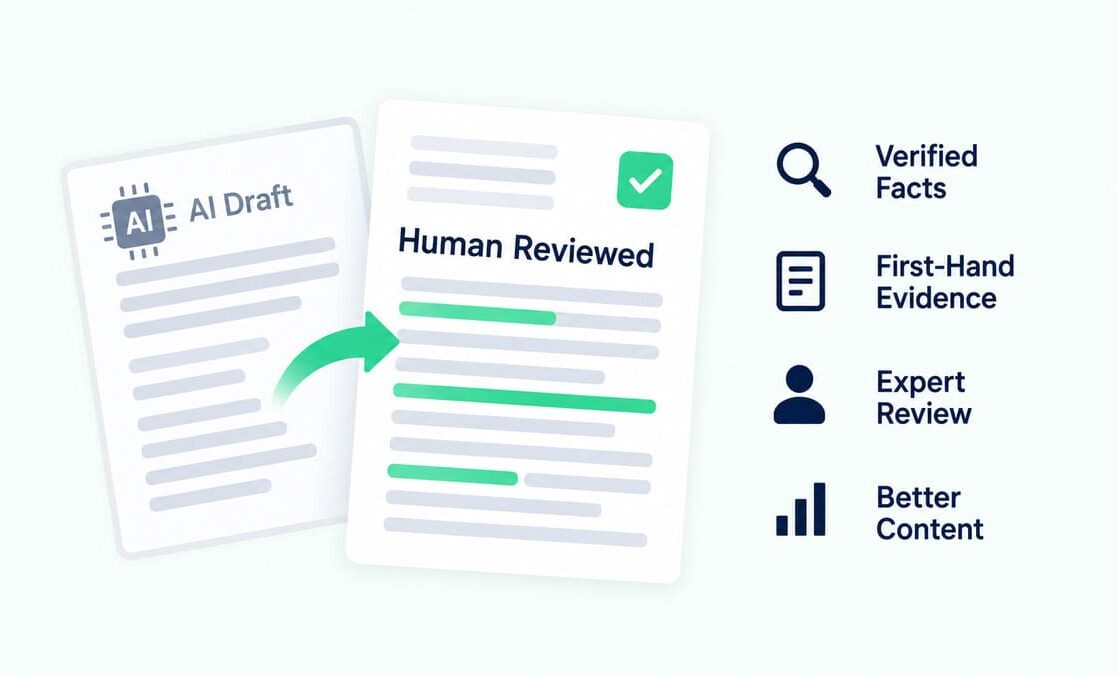
GEO Website Optimization: Rank in Google and Get Cited in AI Search


Generative Engine Optimization (GEO) prepares website pages for generated answer systems. Platforms such as Google AI Overviews, AI Mode, ChatGPT Search, Perplexity, Gemini, and Bing Copilot require accessible and retrievable source material.
Effective pages offer crawl access, indexable text, clear answer blocks, supporting evidence, schema markup, relevant links, and author information. According to Google Search Central, generative AI features rely on core Search ranking systems.
The primary objectives are to rank the page, enable source retrieval, provide cited evidence, and clearly summarize value.

What Is GEO Website Optimization?
GEO website optimization transforms a page into a viable source for AI search. It encompasses content quality, crawl accessibility, schema implementation, linking, trust signals, and performance measurement.
Website teams implement GEO on service pages, product pages, articles, comparison pages, and content hubs. High-quality pages address the main query promptly and substantiate each claim. Source quality is critical, as AI systems select only a limited number of citations. The original GEO paper reports up to a 40% improvement in visibility.
These results are based on experiments using the GEO benchmark and generative engines. In practice, GEO implementation begins with one high-value page and then extends to related assets.
Why GEO Website Optimization Has Priority Now
AI-generated answers now impact source exposure before users click. Google AI Overviews may cite sources within generated summaries. Independent AIO research across 55,393 queries found an overall rate of 13.7%.
In the same dataset, question-form searches achieved a 64.7% activation rate. As a result, visibility now includes rankings, citations, mentions, referrals, and conversions.
Pages must offer substantive content, supporting evidence, accessible structure, and clear source value. Google Search Central cautions against creating scaled pages solely for ranking manipulation. Thin articles with repetitive phrases waste crawl resources and lose reader engagement. High-quality source articles provide proof, examples, relevant entities, and measurable outcomes.
GEO vs SEO vs AEO vs LLMO
SEO, AEO, LLMO, and GEO each serve distinct functions. SEO focuses on ranking, visibility, organic traffic, and measurable conversions. AEO structures direct answers for extraction across search result surfaces.
LLMO enhances entity recognition and semantic interpretation for model-based retrieval. GEO leverages these layers for retrieval, citation, summarization, and influence on answers.
| Method | Full form | Primary function | Website work required | Measurable output |
|---|---|---|---|---|
| SEO | Search Engine Optimization | Improve organic visibility | Crawl access, index eligibility, useful content, internal links, authority, technical health | Rankings, impressions, clicks, CTR, conversions |
| AEO | Answer Engine Optimization | Format direct answers | Definitions, FAQs, answer blocks, question based headings | Featured snippets, People Also Ask, answer extraction |
| LLMO | Large Language Model Optimization | Improve semantic interpretation | Entity consistency, source context, fact order, relationship mapping | Lower ambiguity, stronger AI interpretation |
| GEO | Generative Engine Optimization | Improve AI source use | SEO base, answer blocks, evidence, schema, trust, examples, source mapping | AI citations, supporting links, brand mentions, answer influence |
SEO: Crawl access, indexation, ranking signals, and traffic
SEO establishes the technical foundation for GEO source visibility. Google’s technical requirements include Googlebot accessibility, HTTP 200 status codes, and indexable content.
AEO: Direct answer formatting for search extraction
AEO transforms page sections into concise answers suitable for search extraction. This approach uses definitions, FAQs, brief summaries, and question-based headings.
LLMO: Entity mapping and semantic organization for models
LLMO ensures consistency in terms, names, facts, and relationships. Integrate the GEO website optimization with AI search, schema, linking, citations, and measurement.
GEO: Retrieval, citation, and generated answer use
GEO integrates search accessibility, direct answer formatting, entity mapping, supporting evidence, and authority signals. Cite original research initially, then reinforce with internal proof and examples.
Search relationship across all four methods.
Google treats generative AI visibility work as search optimization. The page still needs technical access, useful content, answer sections, and source confidence.
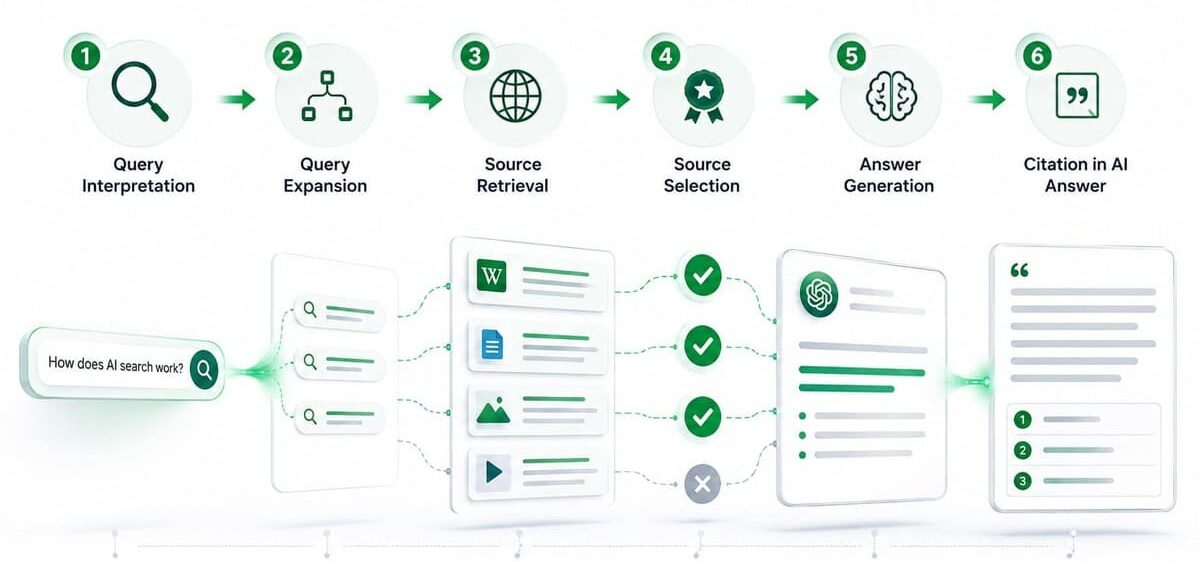
How AI Search Finds, Selects, and Cites Website Content
AI search progresses through interpretation, expansion, retrieval, selection, generation, and absorption. Pages lose opportunities if they lack access, relevance, supporting evidence, freshness, or authority.
Citation systems vary by platform, query, topic, and source pool. Website owners can influence outcomes by managing page quality, accessibility, factual accuracy, examples, and measurement.
Query Interpretation
AI systems analyze the topic, intent, entities, and desired answer type. Position the core answer early and include related terms in close proximity.
Query Fan Out
Google’s generative AI search documentation explains the concept of query fan out. Address definitions, comparisons, checklists, schema, trust signals, and measurement in your content.
Source Retrieval
Retrieval selects candidate pages from available indexes or source pools. Using a noindex tag or blocking crawlers can exclude a source at an early stage.
Citation Selection
Citation selection identifies sources to support answers and compile source lists. A 2026 paper distinguishes between citation selection and citation absorption.
Answer Generation
Answers are generated based on selected sources, model behavior, and platform guidelines. Pages that include definitions, data, comparisons, and step-by-step instructions serve as stronger source material.
Citation Absorption
Citation absorption evaluates a source’s contribution within the generated answer. The 2026 framework analyzed 602 prompts and 21,143 citations, as well as 18,151 fetched pages and 72 extracted features.
Click, Mention, or Conversion
GEO outcomes extend beyond clicks to include citations and brand recognition. Track citations, mentions, referrals, branded queries, engagement, and conversions collectively.
GEO Website Optimization Checklist
A GEO checklist should verify crawl access, index eligibility, and snippet eligibility. It should also audit entities, answer placement, links, schema, trust signals, examples, and tracking mechanisms.
Apply the checklist to a single valuable page before full-site expansion. Choose a homepage, service page, product page, category page, comparison page, or article. Each item should support Google ranking and AI source use.
Audit Crawl Access
Ensure Googlebot can access the URL, assets, and main content. Review robots.txt, firewall settings, redirects, server errors, scripts, and crawl reports.
Review Index Eligibility
Inspect robots meta tags, canonical tags, duplicate pages, thin content, and sitemap status. Pages must be accessible, return a successful status, and contain indexable content.
Preserve Snippet Eligibility
Avoid restrictive snippet controls unless required by policy or legal considerations. Eligibility for generative AI features depends on both indexation and snippet availability.
Define the Main Entity Early
Introduce GEO website optimization and Generative Engine Optimization early in the content. Include references to SEO, AEO, LLMO, AI search, citations, schema, and AI Mode.
Answer the Main Query Early
Provide a concise answer immediately after the introduction. Address the page’s purpose, ranking objectives, citation goals, and optimization areas.
Map the Heading Order
Use a single H1, descriptive H2s, and H3s for process steps. Ensure headings align with user questions and the intent of each section.
Build Citation Ready Blocks
Incorporate definitions, tables, processes, checklists, examples, statistics, citations, and FAQs. Structural GEO research indicates a 17.3% increase in citation rates.
Strengthen Internal Links
Connect the page with SEO, technical SEO, schema, analytics, and AI search pages. Anchor text should describe the target page and expected topic.
Apply Schema Markup
Apply schema markup that matches visible content and aligns with the article’s purpose. Schema enhances page identity, author information, and search interpretation.
Add Source Confidence Signals
Display author information, business identity, publication dates, sources, examples, and editorial processes. These trust markers support readers and strengthen citation review signals.
Insert Original Examples
Include page audits, before-and-after samples, screenshots, field notes, or workflow examples. Original information and thorough analysis enhance page quality.
Measure and Refresh
Monitor Search Console data, citations, mentions, referrals, engagement, leads, and revenue. Update content when research, platforms, rankings, or citation behaviors change.

How to Format Content for AI Search Citations
Content intended for AI citation should provide early answers, precise entities, supporting evidence, examples, and extractable sections. Use definitions, tables, steps, checklists, statistics, source links, use cases, and FAQs to support citation selection.
Formatting affects citations because AI systems rely on limited source material to generate answers. A citation-ready section should contain an answer, proof, example, and metric.
- Definition block: Place a 40 to 70-word definition near the opening section.
- Comparison table: Compare GEO, SEO, AEO, and LLMO before the checklist.
- Process steps: Show crawl access, indexation, retrieval, citation, absorption, and measurement.
- Checklist block: Convert recommendations into page audit items with testable outputs.
- Evidence block: Add Google documentation, academic research, statistics, and case examples.
- Example block: Apply GEO to articles, service pages, SaaS pages, and product pages.
- Statistics block: Include sourced numbers, publication dates, sample size, and study scope.
- FAQ block: Answer long tail questions with compact, complete responses.
- Entity consistency: Repeat core terms naturally across headings, examples, tables, and schema.
- Reader format: Use short paragraphs, descriptive headings, tables, and scannable lists.
The same structural GEO research reports an 18.5% improvement in perceived quality across six engines.
Technical SEO Requirements for GEO
Technical SEO underpins GEO, as source visibility begins with accessibility. Crawl blocks, index errors, duplicate content, weak links, and poor rendering all reduce citation potential.
Even high-quality content fails if crawlers cannot access the URL. Snippet restrictions also limit eligibility for generative AI features. Begin with a technical review before expanding content.
- Crawl access: Review robots.txt, firewall rules, redirects, blocked scripts, and crawl reports.
- Index eligibility: Inspect robots meta rules, canonicals, sitemap entries, duplicates, and thin pages.
- HTTP status: Return HTTP 200 on the main URL.
- Indexable text: Place the core answer in processable page text.
- Snippet eligibility: Allow search snippets unless policy or legal limits apply.
- Canonical URL: Point search systems toward the main page version.
- Internal link depth: Link valuable pages from hubs, service pages, and articles.
- JavaScript rendering: Verify key text appears after rendering without blocked scripts.
- Page experience: Improve loading, layout stability, mobile readability, and intrusive elements.
- Image support: Add useful visuals, compression, filenames, and descriptive alt text.
- Video support: Add transcript, summary, schema, and visible context.
- XML sitemap: Include valuable pages and remove blocked or outdated URLs.
- Semantic HTML: Use headings, paragraphs, lists, tables, and navigation elements.
- Duplicate control: Merge weak duplicates and strengthen the canonical version.
Schema and Entity Optimization for GEO
Schema markup defines page type, author, organization, breadcrumbs, FAQs, steps, images, and videos. Entity optimization links the article topic to related concepts throughout the website.
Schema should reflect visible content, author information, and page identity. Google states that markup helps Search collect information about the web and its entities. There is no special schema requirement for generative AI search.
| Schema type | Use case | GEO purpose |
|---|---|---|
| Article | Article or resource page | Headline, author, publisher, date, page identity |
| Breadcrumb | Multi level navigation | Page hierarchy and topical placement |
| Organization | Brand or business identity | Company entity and official website |
| Person | Author profile | Author identity and expertise context |
| FAQ | Visible FAQ section | Question and answer mapping |
| HowTo | Process page with actual steps | Step sequence and task context |
| ImageObject | Diagrams or screenshots | Image metadata and topic context |
| VideoObject | Embedded video | Video metadata and transcript alignment |
Include Generative Engine Optimization in the opening section. Feature GEO website optimization in the title, H1, introduction, at least one H2, FAQ, and conclusion. Link the article to SEO, AEO, LLMO, Google AI Overviews, and AI Mode. Add references to ChatGPT Search, Perplexity, Gemini, and Bing Copilot as appropriate.
Ensure markup matches the visible page content and aligns with the page’s intent. Google advises against using markup for hidden information, even if it is accurate.
Trust Signals for GEO Performance
Trust signals make a GEO page easier to evaluate. The page should display author identity, publication dates, sources, examples, business details, editorial processes, and citation limitations.
AI search platforms and readers require evidence before establishing trust in a source. Fake statistics, missing author information, copied summaries, and undisclosed business details undermine confidence.
- Author name: Identify the person or organization responsible for the article.
- Author bio: Mention SEO, content, technical, AI search, or analytics experience.
- Published date: Put the first publication date near the article metadata.
- Updated date: Show the latest review date for AI search accuracy.
- Source links: Cite Google documentation, academic papers, platform documents, and original data.
- Original examples: Add audits, screenshots, content blocks, schema samples, or workflows.
- Scope limits: State that platforms control ranking, serving, citation, and traffic.
- About page: Link to business identity, team, expertise, and service details.
- Contact page: Provide business verification and contact information.
- Editorial process: State review owner, update cadence, and fact-checking responsibility.
- Topic cluster: Link related pages around SEO, AI search, schema, and technical SEO.
- Brand consistency: Match brand, author, logo, profiles, and organization data.
Google Search Central recommends providing original information, thorough analysis, proper sourcing, and clear author background. These elements enhance page credibility for both readers and search quality systems.
How to Measure GEO Website Optimization
Measurement distinguishes between ranking, citation, referral, mention, engagement, and revenue data. Search Console reports queries and clicks, while manual checks identify the presence of AI sources.
An effective GEO dashboard should include both search data and answer visibility metrics. Review citation absorption, as a citation may appear with minimal influence on the answer.
| Metric group | Data point | Decision signal |
|---|---|---|
| Google visibility | Impressions, clicks, CTR, average position | Ranking movement and query reach |
| AI citation | Source lists, supporting links, cited pages | Source selection across platforms |
| Answer influence | Reused facts, tables, definitions, procedures | Citation absorption and source depth |
| Brand demand | Branded queries, mentions, direct visits | Recognition after AI exposure |
| Engagement | Scroll depth, time, internal clicks | Reader value after arrival |
| Conversion | Forms, calls, demos, sales inquiries | Business impact from visibility |
Google Search Console Metrics
Track impressions, clicks, CTR, average position, indexed pages, and query growth. These numbers show Google visibility after content and technical updates.
AI Search Citation Metrics
Search repeated prompts across Google AI Overviews, ChatGPT Search, Perplexity, Gemini, and Copilot. Log cited URLs, answer wording, source order, and missing target pages.
Brand Mention Metrics
Monitor branded searches, unlinked mentions, AI mentions, and external references. Brand momentum may become evident before direct traffic increases.
Engagement Metrics
Track scroll depth, time on page, internal clicks, downloads, and return visits. These metrics indicate whether visitors are engaging with the article.
Conversion Metrics
Measure audit requests, form submissions, demos, calls, sales inquiries, newsletter signups, and assisted conversions. GEO success requires business outcomes beyond search exposure.
Content Refresh Signals
Monitor for ranking declines, outdated claims, expired screenshots, missing sources, platform changes, and increased competition. Refresh content by adding supporting evidence, examples, and improved organization.
Common GEO Website Optimization Mistakes
Common GEO mistakes include inadequate technical access and delayed topic definition. Additional issues involve generic AI content, excessive keyword repetition, overuse of schema, and lack of supporting evidence.
Refer to this list during page reviews and content quality control. Each issue can diminish search visibility, citation potential, reader trust, or measurement accuracy.
- Defining GEO after a long opening section with weak context.
- Publishing a broad GEO article with zero website audit.
- Treating GEO as an SEO replacement across the article.
- Promising quick rankings without evidence or competitive context.
- Promising guaranteed AI citations across Google or AI platforms.
- Repeating the GEO website optimization unnaturally across headings and paragraphs.
- Adding schema while ignoring content quality and source usefulness.
- Ignoring crawl access during the first technical review.
- Ignoring index eligibility across canonicals, robots meta, and sitemaps.
- Restricting snippets without a valid policy or legal reason.
- Publishing generic AI content without original value or source proof.
- Writing long paragraphs with zero answer blocks or scan points.
- Leaving out comparison tables for GEO, SEO, AEO, and LLMO.
- Leaving out examples from pages, audits, and source blocks.
- Leaving out sourced statistics for GEO and AI citation behavior.
- Making AI search claims without proof from sources or testing.
- Hiding author information across article metadata and author pages.
- Missing update dates for a changing AI search topic.
- Missing internal links to SEO, schema, and analytics pages.
- Ignoring manual AI citation checks across major AI search tools.
- Tracking rankings while ignoring citations, brand mentions, and conversions.
- Creating many similar pages for minor query variations.
Google’s spam policy covers ranking manipulation, generative AI response manipulation, keyword stuffing, and scaled content abuse. Avoid low-value pages and unsupported citation claims.

GEO Website Optimization Execution Sequence
Apply GEO to one key page before expanding site-wide. Address crawl access, indexation, snippet eligibility, answer placement, section order, supporting evidence, links, schema, trust signals, and measurement.
Begin with a page that already contributes to revenue or authority. Suitable targets include the homepage, service pages, product pages, category pages, comparison pages, and high-quality articles.
10 Step GEO Audit
- Confirm crawl access.
- Confirm index eligibility.
- Confirm snippet eligibility.
- Add the main GEO definition near the top.
- Add a direct answer block after the introduction.
- Add a GEO, SEO, AEO, and LLMO comparison table.
- Add an AI citation process section.
- Add a website optimization checklist.
- Add schema matching visible content.
- Track rankings, citations, mentions, referrals, and conversions.
First Pages to Revise
Start with the homepage, service pages, product pages, category pages, comparison pages, and high-performing articles. Prioritize pages with revenue impact, existing impressions, or rankings near the top of the first page.
Review Cadence
Review each page every 60 to 90 days. Reassess after Google documentation updates, competitor changes, ranking declines, lost citations, outdated examples, or new research.
Conclusion
GEO website optimization improves a website’s accessibility, interpretability, retrievability, citation potential, and summarization. It begins with SEO fundamentals, clear answer structure, precise entities, supporting evidence, schema, links, trust signals, and measurement.
Audit one key page first, then expand the process. Ensure technical accessibility, include a strong answer block, and support claims with credible sources. Measure Google performance and AI visibility within a unified dashboard.
GEO Website Optimization FAQs
What is GEO website optimization?
GEO website optimization prepares content, technical access, schema, links, and entities. It targets search ranking, AI retrieval, citation, and summarization.
What does GEO represent?
GEO equals Generative Engine Optimization for AI search visibility. The term describes website work aimed at AI-generated search visibility.
Does GEO replace SEO?
GEO works beside SEO and depends on SEO foundations. Search access, index eligibility, links, useful content, and authority remain required.
Can GEO support quick ranking movement?
GEO can improve long-tail reach when a page offers specificity, utility, accessibility, and organization. Ranking still depends on competition, authority, links, freshness, and intent match.
How do I optimize for Google AI Overviews?
Create useful content, maintain crawl access, allow indexation, and preserve snippets. Add descriptive sections, cite sources, apply schema, and strengthen internal links.
Do I need a special schema for GEO?
The special schema has zero requirements for Google generative AI search. Use schema only when it matches visible content and improves page interpretation.
Which content earns AI search citations?
AI search favors relevant, specific, source-backed, organized content with extractable evidence. Citation research supports definitions, numerical facts, comparisons, and procedures.
How do I measure GEO success?
Measure rankings, impressions, clicks, query growth, AI referrals, brand mentions, and citations. Add engagement, answer influence, conversion, and revenue data.