Multi-Location Rehab SEO Services

IMMWIT provides multi-location rehab SEO services for addiction treatment organizations with multiple facilities. We enhance each location’s pages, profiles, listings, links, tracking, and reporting.

Our SEO campaign includes location and program page updates, Google Business Profile optimization, citation cleanup, technical SEO, internal linking, call and form tracking, and location-level reporting. Our team can identify which markets need attention, which locations are performing well, and which assets require updates.

Multi-Location Rehab SEO Services

Trusted by over 100+ rehab and detox centers worldwide

Rehab Center
Rehab Center
Rehab Center
Rehab Center
Rehab Center
Rehab Center
Rehab Center
Rehab Center
Rehab Center
Rehab Center

Every Rehab Location Needs Its Own Local Search Rankings

Each rehab location competes in its own local search market. A strong domain alone cannot compensate for weak facility pages in different cities, states, or treatment areas.

Each location requires accurate business data, relevant program content, a high-quality Google Business Profile, local proof, and market-specific information. We review rankings, GBPs, location pages, program links, calls, forms, and competitors by market to distinguish strong locations from weaker ones.

Our SEO experts understand where local SEO is effective, where it needs improvement, and where to prioritize budget allocation.

Every Rehab Location Needs Its Own Local Search Rankings

We Help Each Rehab Location Page Rank for the Right Treatment Searches

A rehab location page should reflect the specific treatment programs offered at that facility. For example, a detox location requires different content than an outpatient-only facility, and a PHP location needs different links than a residential facility.

  • Program match: Map detox, residential, PHP, IOP, and outpatient programs, as well as dual diagnosis, to eligible facilities.
  • Location relevance: Build each facility page around photos, program availability, contact data, and facility details.
  • Page routing: Match treatment searches with the correct location page, program page, or admissions page.
  • Internal links: Connect each facility page with the services offered at the location.
  • Inquiry tracking: Measure calls, forms, GBP actions, and location-page performance separately.

If detox is available at two locations, detox content should direct users to those facilities. If outpatient care spans multiple markets, outpatient SEO requires a broader location structure. Accurate mapping reduces poor-fit inquiries and improves alignment for each location search.

Our SEO Campaign Is Built for Treatment Centers Managing More Than One Location

Our SEO campaign is built for treatment groups with multiple locations, varied program offerings, central admissions teams, and distinct markets. A single-location SEO package is insufficient for larger treatment networks.

Multi-location rehab SEO involves greater operational risk. Programs vary by facility, phone routing can obscure source data, Google Business Profiles require individual oversight, and local listings may conflict across directories. Copied pages can undermine trust before any inquiry occurs.

We assign each facility a ranking target, each program a location relationship, and each inquiry source a reporting role. Marketing and admissions teams can then identify which location requires the next update.

Why Addiction Treatment Location Pages Lose Rankings, Calls, and Admissions Opportunities

Addiction treatment location pages lose performance when content, profile data, program links, and call sources are misaligned. Even with a strong domain, a rehab facility page can miss local demand if it lacks unique proof, accurate service details, or effective internal links.

Copied pages weaken the facility’s trust.

Many rehab websites reuse identical location copy, simply changing the city name. This approach fails to demonstrate the facility, staff, service mix, local context, insurance process, or admissions contact. Facility-specific content addresses this trust gap.

Program mismatch breaks relevance.

Detox, residential, PHP, IOP, outpatient, and dual diagnosis pages must link only to locations offering those services. Incorrect program links reduce search relevance and inquiry quality. A program-to-location map corrects copy, internal links, and form routing.

Tracking gaps hides lost opportunities.

Calls and forms can originate from location pages, program pages, insurance pages, GBPs, or a shared admissions number. Without source reporting, it is difficult to identify which location is underperforming. Location-level call and form tracking resolves this issue.

SEO Problems That Stop Treatment Center Locations From Ranking

Treatment center locations often lose rankings due to multiple SEO issues affecting the same market. Thin pages, weak GBPs, citation errors, poor internal links, technical problems, and broken tracking can all harm a location’s performance.

Thin location pages

A short page with a city name and phone number rarely proves enough.

Copied facility content

Reused text diminishes uniqueness, local relevance, and user confidence.

Wrong program links

Detox, residential, PHP, IOP, and outpatient pages need accurate facility relationships.

GBP conflicts

Duplicate profiles, old addresses, weak categories, and poor photos reduce local profile quality.

Citation errors

Inconsistent names, addresses, phone numbers, categories, or URLs weaken location identity.

Internal link gaps

Facility pages need relevant links from program, admissions, insurance, and hub pages.

Technical issues

Indexation, canonical, speed, schema, and crawl problems can suppress valuable pages.

Tracking breaks

Shared numbers and forms can hide the location behind each inquiry.

A strong market may require only technical cleanup, while a weak market may need a rebuilt location page, GBP correction, listing cleanup, and improved program links.

Your strongest location should not receive the same strategy as your weakest market. Each solution should have a specific page target, market rationale, and measurable business outcome.

Why Rehab Center SEO Is Different From Regular Local SEO

Generic local SEO may update a profile, but rehab SEO must demonstrate which facility offers each program, how admissions contact functions, and why the location is trustworthy.

Addiction treatment content requires a higher level of trust. Prospective clients compare services, care levels, reviews, photos, insurance details, staff credentials, and local signals before reaching out. A rehab SEO campaign must ensure accuracy while driving qualified inquiries.

SAMHSA data show a large treatment need nationwide, which raises the bar for accurate treatment-sector content. For SEO, use facility proof, program accuracy, source-backed claims, and careful no-guarantee language.

We Fix the SEO Foundation Behind Every Treatment Center Location

IMMWIT strengthens the SEO foundation for each treatment center location. We address page structure, profile accuracy, listing consistency, technical accessibility, internal relevance, and source tracking.

A clean structure enhances local rehab rankings, treatment program relevance, GBP quality, and inquiry tracking. Without it, adding new content may not resolve ranking issues.

A multi-location SEO audit begins by cataloging every facility, program, phone number, tracking number, and GBP. It also reviews listing sources, location pages, and treatment program pages.

The audit compares individual locations instead of averaging the website into a single score. Your team receives a facility priority list indicating which markets need page updates, GBP corrections, technical cleanup, or tracking improvements first.

Website structure determines how search engines navigate between pages and programs. A well-organized structure connects location hubs, program hubs, admissions pages, insurance pages, and proof assets through intentional internal links.

A location offering residential treatment should have a clear link to the residential page. Facilities without detox should not be associated with detox content through improper linking. Improved structure enables better crawl access and clearer program context for each location.

Google local ranking considers relevance, distance, and prominence. For rehab centers, profile data must accurately reflect the operating facility. Categories, services, hours, photos, reviews, and address details require careful management.

We review eligible profiles, identify duplicates, verify service listings, and assess reviews, photos, and location-page links. Each treatment location receives a more accurate and consistent local profile.

Citation cleanup reconciles facility data across local listings, healthcare directories, data sources, and business profiles. Name, address, phone, category, website, and location data must reinforce the same facility identity everywhere.

Old addresses get flagged. Duplicate listings get isolated. Wrong categories get corrected. Mismatched URLs get updated. Clean citations give each rehab location a clearer local footprint.

Technical SEO determines whether valuable rehab pages are crawled, indexed, distinguished, and measured. Crawlability, indexation, canonical tags, redirects, schema, speed, sitemaps, duplicate content, and URL structure all impact multi-location performance.

A cleaner technical structure improves page discovery. Search engines can distinguish facility pages from program pages, admissions pages, and eliminate duplicate content.

Location-level tracking links inquiries to specific pages, profiles, programs, and facilities. Calls, forms, analytics, GBP actions, landing pages, and CRM fields should all indicate the inquiry’s origin.

We organize reporting by source, page, profile, program, location, and phone route. A central admissions number can be used, but facility-level reporting must remain accurate despite shared numbers.

Scale Every Treatment Location With Stronger Local Visibility

Strengthen location pages, treatment program visibility, Google Business Profiles, internal links, citations, tracking, and admissions pathways across every facility without sacrificing local relevance.

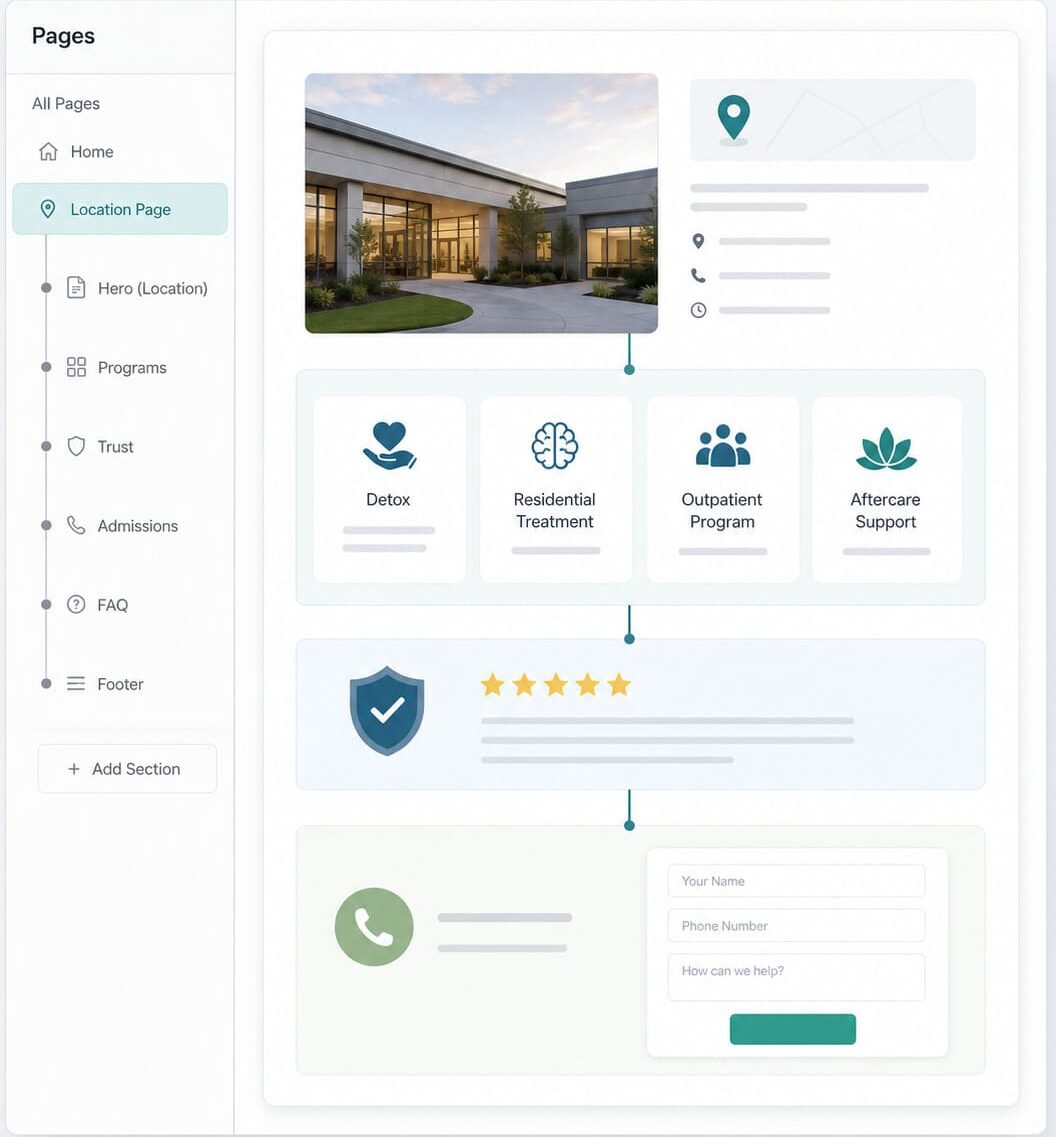
Pages That Connect Each Location to Programs, Trust, and Admissions

A rehab website should not treat location pages as isolated landing pages. Each facility page must connect to treatment program pages, admissions content, insurance information, staff credentials, reviews, photos, and local trust signals.

Our page strategy creates a content cluster around each location. Clear connections enable easier navigation, more relevant content, stronger trust, and a more effective inquiry process for admissions teams.

Rehab Location Page Buildout

A rehab location page should describe a single operating facility. It must include address data, phone routing, program availability, photos, reviews, staff credentials, local context, admissions information, and insurance details.

A Phoenix facility and a Dallas facility cannot read like the same page with swapped city names. The buildout gives each facility distinct proof, distinct relevance, and a distinct inquiry route.

Treatment Program Page Improvement

Treatment program pages cover detox, residential treatment, PHP, IOP, outpatient care, dual diagnosis, alcohol treatment, drug treatment, and related services. Each program carries its own search intent and may connect to different locations.

Improving program pages adds service clarity, comprehensive coverage, internal links, location availability, FAQs, and admissions routes. The content remains SEO-focused without providing clinical recommendations.

Connecting Program Pages to the Right Locations

Program pages should link only to facilities that offer the service. If IOP is available at three locations, the IOP page should direct users to those three facilities. If residential treatment is offered at one location, the residential page should not suggest network-wide availability.

Accurate program-to-location routing maintains search relevance and user trust. It also ensures admissions teams receive inquiries linked to the correct facility and service.

Admissions and Insurance Content

Admissions and insurance pages answer questions that appear before a call or form. Those pages need verification language, contact routes, insurance context, program links, and location references.

The content must guide visitors to the appropriate team through the correct page. It should not promise coverage, placement, reimbursement, or outcomes. When done properly, admissions and insurance content reduces friction before inquiries.

Facility Proof and Local Trust Signals

Proof should be present where inquiries occur. Facility photos, staff details, clinical team context, licensing, accreditation, reviews, local information, and accurate business data all build trust.

Reviews are important, but they cannot bear the entire trust burden. A rehab page also requires facility details, staff context, program clarity, photos, insurance information, and accurate local data.

Pages That Connect Each Location to Programs, Trust, and Admissions

What Each Location Page Needs to Earn Trust and Local Rankings

Follow this standard for location pages: one facility, one local market, one clear program mix, and one direct inquiry route. A comprehensive location page includes address data, phone information, photos, hours, programs offered, staff credentials, reviews, local context, insurance information, and admissions content.

Relevant internal links matter as much as page copy. A location offering PHP, IOP, and outpatient care needs links to those program pages. A location without detox should not carry detox relevance through careless copy or internal links.

For AI optimization, local SEO, and user trust, content must answer: What exists at this location, and how can a qualified inquiry reach the appropriate team?

Each Location Page Needs Real Facility Details to Build Trust

Copied rehab location pages often substitute proof with vague claims. A page may repeatedly mention compassionate care yet lack facility photos, staff details, program offerings, address context, or admissions information.

A stronger location page replaces generic claims with specific proof. It shows the facility, services, team context, reviews, local details, insurance information, and contact route. Those details help each location gain relevance rather than borrowing language from another page.

How the SEO Work Moves From Audit to Location Growth

Our process begins with asset inventory and market diagnosis, followed by page updates, profile cleanup, technical improvements, tracking, and ongoing monthly enhancements. Each step identifies what requires the next update.

Map Every Location, Treatment Program, Phone Number, and Google Business Profile

The first step is to create a location inventory. Facilities, programs, phone numbers, tracking numbers, GBPs, listings, location pages, and program pages are mapped together.

This step reveals missing assets. The inventory identifies facilities without pages, profiles lacking accurate data, and programs without location relationships.

Review Search Performance in Each Local Market

Each local market undergoes a separate performance review. Rankings, organic traffic, GBP activity, page performance, calls, forms, and competitor visibility highlight differences in location strength.

This review produces a market priority list. Your team can identify which markets need page expansion, GBP corrections, technical cleanup, or improved internal links.

Match Treatment Programs to the Right Locations

Program mapping assigns each service to the facilities that offer it. Detox, residential treatment, PHP, IOP, outpatient care, and dual diagnosis all require accurate page relationships.

This step enhances relevance and inquiry routing. Visitors seeking IOP should not be directed to locations where IOP is unavailable.

Fix the Website Structure

Weak website structure can hide valuable facility pages. Navigation, URLs, internal links, hubs, breadcrumbs, and crawl paths must be optimized.

This step establishes clear pathways between location pages, program pages, admissions pages, and insurance content. Improved structure provides search engines with stronger facility and program context.

Rebuild Weak Location Pages

Weak pages require more than minor edits. A thorough rebuild incorporates facility details, programs, photos, reviews, staff credentials, insurance information, admissions content, and local proof.

After rebuilding, the location page links to the appropriate program assets. Tracking then measures whether the new content generates rankings, calls, forms, or GBP actions.

Strengthen Treatment Program Pages

Program pages need enough depth to support distinct treatment searches. Better content, entity coverage, internal links, FAQs, and location availability help each program page support facility-level SEO.

This step increases program relevance without providing patient advice. The page explains service availability and directs qualified inquiries appropriately.

Clean Up Google Business Profiles and Local Listings

Local data must align with the facility record. GBPs should be reviewed for categories, services, addresses, hours, photos, reviews, and duplicates.

Listings and citations are corrected across all relevant sources. Google may suspend or disable Business Profiles that violate guidelines, so eligibility and accuracy are essential.

Set Up Location-Level Tracking

Tracking connects inquiries to specific locations, pages, and profiles. Calls and forms should be segmented by GBP, program, location, insurance, and organic page sources.

Tracking reports show which assets create inquiries. CRM fields, call sources, form sources, and page sources all feed the location view.

Improve Underperforming Locations Each Month

Underperforming locations require targeted monthly decisions, not generic SEO activity. Pages, links, GBPs, listings, technical fixes, and tracking priorities are adjusted based on facility-level data.

Strong markets maintain momentum, while weak markets receive targeted improvements based on rankings, calls, forms, GBP actions, and page performance.

See Which Treatment Locations Are Gaining Rankings

Facility-level reporting should go beyond total website traffic. A single traffic metric can mask growth in one market and decline in another. Your team needs reporting that separates locations, programs, local rankings, calls, forms, and GBP actions.

Effective reporting includes a location ranking table, GBP action trends, call and form trends, program-page contributions, and a market priority list. It highlights which locations improved, which program pages generated inquiries, and which facilities need further content or data updates.

This reporting view helps leadership allocate resources effectively. Strong markets maintain momentum, while weaker locations receive targeted updates, GBP improvements, listing cleanup, internal links, or technical fixes.

Contact Us
See Which Treatment Locations Are Gaining Rankings

How We Measure Progress Across Each Rehab Location

Progress should link local visibility to inquiry activity. We review rankings, organic visits, GBP actions, calls, forms, page performance, program-page activity, technical health, and location-level inquiry sources.

The measurement view guides next steps. A location with strong rankings but few calls may need conversion improvements, while a location with calls but weak rankings may require page expansion, local proof, or GBP enhancements.

  • Local rankings: Shows which facilities gained visibility for treatment searches in each market.
  • GBP actions: Shows which profiles produced calls, clicks, direction requests, and engagement.
  • Location page visits: Shows organic demand for each facility page.
  • Program page performance: Shows which levels of care contributed to inquiries.
  • Calls: Shows which source created a phone inquiry and which facility received it.
  • Forms: Shows which page, program, or location produced each submission.
  • Technical health: Shows indexation, crawl access, schema, speed, and canonical problems.
  • Opportunity signals: Shows calls, forms, visibility, and admissions opportunities without guarantees.

Request a Multi-Location SEO Review

Request a Multi-Location SEO Review for your rehab facilities. IMMWIT will assess location pages, program pages, Google Business Profiles, listings, rankings, calls, forms, tracking, and internal links.

You will receive a location-by-location priority list, indicating which pages, profiles, listings, tracking sources, and program links need immediate updates. We do not offer broad SEO packages, unsupported promises, or unnecessary work.

Multi-Location Rehab SEO FAQs

How many location pages does a multi-location rehab website need?

A multi-location rehab website generally requires one unique location page for each operating facility. Each facility page needs address data, phone routing, programs offered, admissions content, insurance context, facility proof, and local market relevance. Copied pages with city-name swaps weaken local search value.

Should each rehab location have its own Google Business Profile?

Each eligible rehab location may require its own Google Business Profile when the facility has accurate business details, address data, hours, photos, categories, and local contact information. Artificial profiles for markets without eligible facilities create risk. The safer approach is to build profiles only around legitimate treatment locations.

Can a single treatment program page support multiple rehab locations?

One treatment program page can support several rehab locations when the program exists at each linked facility. The page must show which locations offer the program and route visitors to the correct facility pages. That structure protects program relevance and reduces inquiries about poor fit.

How do you handle locations that offer different levels of care?

Different levels of care require a location-by-location program map. The detox, residential treatment, PHP, IOP, outpatient care, and dual diagnosis pages need links only to facilities that offer those programs. This keeps search relevance, user expectations, and inquiry routing aligned.

Can you fix the copied rehab location pages?

Yes, copied rehab location pages can be rebuilt around facility-specific proof. Stronger pages use unique program details, photos, staff context, reviews, address data, local information, insurance context, and admissions routes. The goal is to make each facility page distinct enough for users and search engines.

Should we create city pages if we do not have a facility there?

Rehab centers should avoid city pages that imply a facility exists where none operates. If the organization serves a nearby market without a physical facility, the content must accurately describe the actual relationship. Fake location signals damage trust and create local SEO risk.

How do new rehab locations get SEO support before launch?

New rehab locations can receive SEO support before public launch through location mapping, program mapping, GBP planning, citation setup, tracking setup, and page buildout. Pre-launch work helps the new facility enter search with cleaner data and better page structure. It also gives admissions teams a cleaner reporting source from the start.

Can you improve rankings for underperforming locations without hurting stronger locations?

Yes, underperforming locations can receive location-specific updates without weakening stronger markets. The work separates page issues, GBP problems, citation errors, technical blocks, and tracking gaps by facility. Strong locations keep their working content, links, and profile strength.

How do you track calls and forms by rehab location?

Calls and forms are tracked by tying inquiry sources to location pages, program pages, GBPs, forms, phone routes, and CRM fields. The report identifies which facility, page, profile, or program produced the inquiry. This helps your team see where SEO creates qualified calls and form submissions.

Do insurance pages help multi-location rehab SEO?

Insurance pages can help multi-location rehab SEO by accurately answering verification and admissions questions. The content needs links to relevant programs, facility pages, and contact routes. It must support inquiries without promising coverage, reimbursement, placement, or outcomes.

Can you help if our Google Business Profile is suspended or duplicated?

Yes, suspended or duplicated Google Business Profiles can be reviewed for local SEO issues. The work may include data correction, duplicate review, documentation, eligibility checks, and appeal preparation. Reinstatement cannot receive a promise.

Do you optimize detox, residential, PHP, IOP, and outpatient pages separately?

Yes, detox, residential treatment, PHP, IOP, and outpatient pages generally require separate optimization. Each program has a different search intent, internal link needs, page structure, and location relationships. Separate program pages also improve reporting by level of care.

Can one admissions phone number be used across multiple locations?

One admissions phone number can serve multiple rehab locations, and tracking still separates the inquiry source. The setup must show which page, program, GBP, or facility produced the call. Without that source data, shared phone routing hides location performance.

How do reviews affect multi-location rehab SEO?

Reviews can support local trust and Google Business Profile quality. Review value grows when paired with facility photos, staff proof, accurate listings, program details, and responsive business data. Reviews alone cannot bear the burden of trust for a treatment location.

Do you work with multi-state treatment center locations?

Yes, multi-state treatment center SEO requires market-specific planning. Each state, facility, GBP, listing footprint, program mix, location page, and reporting setup needs a separate review. Multi-state groups benefit from a structure that separates markets without splitting brand authority.

How long does multi-location rehab SEO take?

Multi-location rehab SEO timelines vary by competition, site condition, number of locations, page quality, technical issues, and GBP issues. Some updates show earlier signals, while deeper content and authority work takes longer. Progress is measured through rankings, calls, forms, GBP actions, and location-level data.

Do you guarantee rankings or admissions?

Reviews No, we do not guarantee rankings or admissions. Search results depend on competition, local market conditions, site quality, Google systems, and user behavior. The campaign focuses on visibility, trust signals, technical quality, calls, forms, and admissions opportunities.

Related Blogs

We are Growing Businesses Since 2010

We Cover top 70 cities around the world

UNITED STATES
  • New York
  • Los Angeles
  • Chicago
  • Houston
  • Phoenix
  • Philadelphia
  • San Antonio
  • San Diego
  • Dallas
  • San Jose
  • Austin
  • Denver
  • Miami
  • San Francisco
  • Indiana
  • Ohio
  • Columbus
  • Seattle
  • Las Vegas
  • New Jersey
UNITED KINGDOM
  • London
  • Birmingham
  • Glasgow
  • Liverpool
  • Bristol
  • Manchester
  • Sheffield
  • Leeds
  • Edinburgh
  • Leicester
  • Coventry
  • Bradford
  • Cardiff
  • Belfast
  • Nottingham
  • Brighton and Hove
  • Southampton
  • Kent
  • Sussex
  • Surrey
CANADA
  • Toronto
  • Montreal
  • Vancouver
  • Calgary
  • Edmonton
  • Ottawa
  • Mississauga
  • Winnipeg
  • Quebec City
  • Hamilton
  • Brampton
  • Kitchener
  • Laval
  • Halifax
  • Markham
  • Gatineau
  • Vaughan
AUSTRALIA
  • Sydney
  • Melbourne
  • Brisbane
  • Perth
  • Adelaide
  • Gold Coast
  • Canberra
  • Newcastle
  • Wollongong
  • Hobart
INDIA
  • Mumbai
  • Delhi
  • Bangalore
  • Hyderabad
  • Ahmedabad
  • Chennai
  • Kolkata
  • Pune
  • Noida
  • Lucknow
  • Indore
  • Patna
  • Chandigarh
  • Visakhapatnam
  • Jaipur
NOVA AI IMMWIT AI • Online
Hi — I'm Nova by IMMWIT. Tell me what growth, SEO, AI visibility, or software help you need, or tap Quick quote below. I'll collect the details for the IMMWIT team.
Choose a service Scroll for more options
Optional - company profile
More question ideas