How Addiction Treatment Centers Can Build Location Pages That Local Families Trust


Your addiction treatment center location page needs to show that the facility is real, local, and ready to accept admissions calls. Before sharing private information, families need the address, phone number, services, care levels, photos, insurance verification steps, and credentials.
Answer the questions people ask before calling admissions. Where is the center? Which addiction services are available at this location? What happens during the first call? How does insurance verification start? Which details show the facility is real?
Local search improves when your page lists the same facts people need before calling. Google and AI systems read consistent details about your facility name, address, phone number, services, photos, FAQs, and schema. The same consistency is what helps a facility rank for drug rehab near me searches, so your page can help people verify the center while search systems read the same facts.
You will build the page around service details, admissions steps, insurance information, real photos, Google Business Profile optimozition, and schema.
What a Rehab Location Page Needs to Prove
Your rehab location page needs to prove the facility exists, serves the area, and can answer admissions questions. Show the facility location, available addiction treatment services, and admissions process.
People need verification before calling. Your page needs answers for location, services, treatment levels, insurance, and first-call steps. A phone number alone cannot carry that decision.
Google states that ranking systems prioritize helpful, reliable information created for people, rather than content made mainly to manipulate rankings. A useful addiction treatment center location page answers family questions before targeting rankings.
Why Weak Location Pages Lose Trust
Thin rehab location pages lose families when basic facts are hard to verify. A city name, broad treatment copy, and a phone button leave too many questions unanswered.
Before a family contacts your center, the page needs to answer practical questions. The reader may be anxious, private, and unsure about what comes next. Missing details make the next step harder.
- Is this a real facility?
- Is this location close enough?
- What addiction services do you provide here?
- Does this location provide alcohol detox or opioid detox?
- What treatment plans or levels of care are available?
- Can family members contact admissions?
- What happens during the first call?
- Can insurance be verified before admission?
- What proof shows licensure, accreditation, or credibility?
If your page misses those answers, families may leave before calling. A better page answers the major questions before asking for contact.
Build the Page Around Family Decision Questions
Build your addiction treatment location page in the order families use when deciding. Move from location proof to service proof, then toward admissions action.
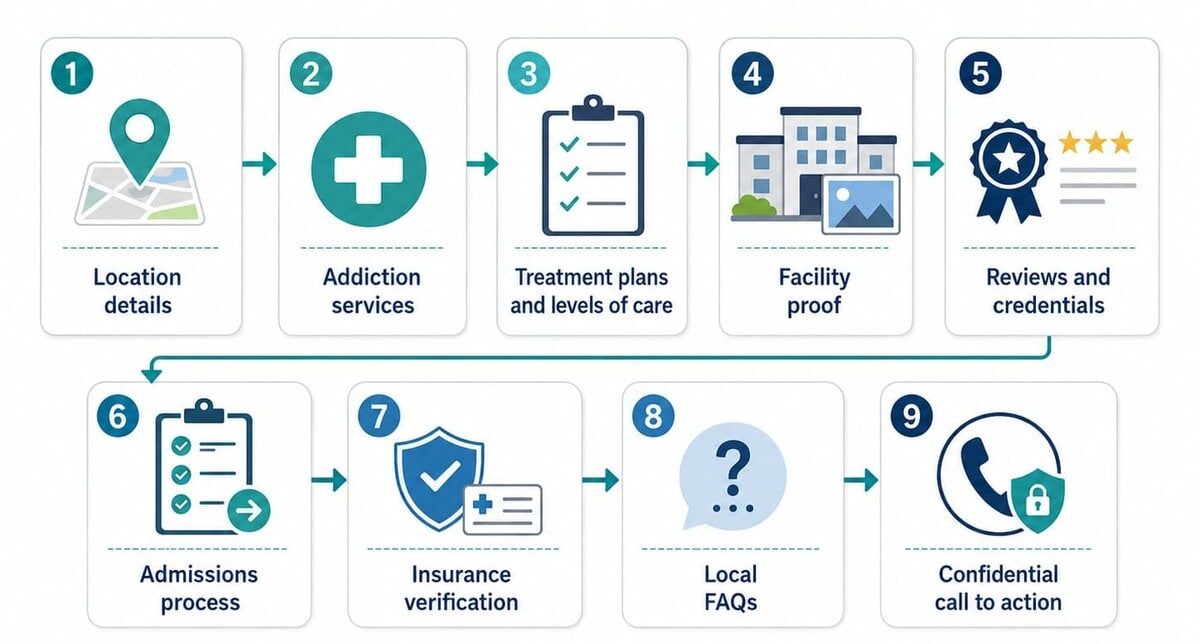
Start with the facility details. Then add services, treatment plans, facility photos, reviews, credentials, admissions steps, insurance verification, local FAQs, and contact options.
Recommended page flow:
Location details → addiction services → treatment plans and levels of care → facility proof → reviews and credentials → admissions process → insurance verification → local FAQs → confidential call-to-action
That order answers the reader before asking for private information. The same order helps Google connect your facility, services, and location details.
Show the Location Details First
Place the facility name, address, phone number, hours, and map near the top. A family should never hunt for basic location facts.
Those details help local search systems match your facility to nearby treatment searches. Google states that local results are based mainly on relevance, distance, and prominence, which is why local rankings and Google Maps visibility depend so heavily on accurate location data. Accurate business details help Google connect local businesses to relevant searches.
Near the top of the page, include:
- facility name
- city and state
- street address
- service area
- local phone number
- admissions phone number, if different
- business hours
- admissions hours
- map embed
- directions
- parking notes
- Google Business Profile link, when useful
Example opening block:
Recovery Center Phoenix
123 Main Street, Phoenix, AZ
Admissions available by phone 24 hours
Alcohol addiction treatment, opioid addiction treatment, IOP, family support, and insurance verification for adults and families in the Phoenix area.
This block shows families the facts before asking for contact. The same block also gives Google consistent location and service details.
List the Addiction Services Available at This Location
Your service section needs to list the addiction-related needs this location supports. Families should never have to guess which services are available at this facility.
Cover addiction services before levels of care. A person may search for alcohol detox, opioid addiction treatment, fentanyl treatment, or dual diagnosis support. Match the service language to what your location actually provides.
Only include services that are available, coordinated, or clinically supported at that location:
- alcohol addiction treatment
- alcohol detox
- opioid addiction treatment
- opioid detox
- fentanyl addiction treatment
- heroin addiction treatment
- prescription opioid addiction treatment
- benzodiazepine detox
- prescription drug addiction treatment
- cocaine addiction treatment
- methamphetamine addiction treatment
- stimulant addiction treatment
- polysubstance use treatment
- dual diagnosis support
- medication-assisted treatment
- family support or family therapy
- relapse prevention support
- aftercare planning
Use a table when service availability needs more detail.
| Addiction service | Available here? | What families should know |
|---|---|---|
| Alcohol detox | Yes / No / Coordinated | State whether withdrawal support is onsite or referred. |
| Opioid detox | Yes / No / Coordinated | Mention medical support only when accurate. |
| Alcohol addiction treatment | Yes / No | Briefly describe the support available. |
| Opioid addiction treatment | Yes / No | Mention MAT only when offered or coordinated. |
| Benzodiazepine detox | Yes / No / Referral | Be specific because withdrawal may need medical supervision. |
| Stimulant addiction treatment | Yes / No | State whether therapy or outpatient support exists. |
| Dual diagnosis support | Yes / Limited / Referral | State mental health scope honestly. |
| Family therapy | Yes / When appropriate | State how family participation works. |
If a service is unavailable, state the limit directly. For example, this location does not provide on-site detox. Admissions can discuss referral options before outpatient treatment starts.

Explain Treatment Plans and Levels of Care
Your treatment plan section should list each level of care available at this location. Families may not know the difference between detox, residential treatment, PHP, IOP, outpatient care, MAT, and aftercare.
Keep each treatment level short and practical. State what the location provides, what admissions can answer, and what someone should know before calling.
Medical detox: State whether withdrawal support is onsite, coordinated, or referred elsewhere. Avoid implying that medical detox is available when the location does not offer it.
Residential treatment: If clients live at the facility during care, describe the living environment and daily structure. State whether residential beds are available at this location.
Partial hospitalization program, or PHP: State whether structured day treatment exists at the location. State how PHP differs from standard outpatient care.
Intensive outpatient program, or IOP: Describe scheduled treatment while clients continue living at home or another safe residence. Mention day or evening options only when accurate.
Outpatient treatment: State therapy, groups, medication support, recovery planning, or continuing care options. Avoid implying residential care when outpatient care is the service.
Medication-assisted treatment, or MAT: Mention MAT only when your center provides or coordinates it. Use careful language and avoid broad promises.
Dual diagnosis treatment: State the support available for substance use concerns with co-occurring mental health concerns. Be specific about clinical scope and referral limits.
Aftercare planning: Describe continued care planning after treatment. Mention therapy referrals, recovery planning, support groups, or step-down care when available.
Your page can educate without diagnosing. Admissions should remain the next step for personal program questions.
Use Real Facility Photos
Real facility photos help families verify the location and picture the first visit. Photos answer questions that a copy cannot answer, and pairing them with reviews, photos, and service details gives your local SEO an added lift.
Use photos that show the actual facility. Stock images weaken credibility when families need proof. Captions need to identify the location and the part of the facility shown.
| Photo | Question answered |
|---|---|
| Exterior | Can the family identify the facility? |
| Entrance | Where does arrival start? |
| Admissions area | Where does the first conversation happen? |
| Therapy room | Where does counseling happen? |
| Group room | What does programming space look like? |
| Common area | What does the environment look like? |
| Bedroom, if residential | What would the living space look like? |
| Parking area | Where should visitors arrive? |
Use captions that verify location details:
- Exterior of the Phoenix addiction treatment location near the main admissions entrance.
- Group room is used for intensive outpatient programming at the Phoenix location.
- The admissions area, where families can ask about services, insurance verification, and next steps.
Protect privacy. Avoid showing patients, charts, sign-in sheets, whiteboards, private documents, or anything that could expose treatment status.
Show Reviews Without Exposing Private Details
Review sections need to summarize public themes without confirming anyone’s treatment status. Reviews can help families understand the center through public feedback.
Handle reviews with privacy in mind. Avoid confirming that a reviewer received treatment. Avoid turning review language into a guarantee of an outcome.
Group review themes rather than exposing private details.
Admissions and communication
- admissions response
- staff communication
- family updates
- information during intake
Facility and treatment experience
- respectful intake
- facility environment
- therapy experience
- group support
Planning and support
- insurance help
- discharge planning
- aftercare support
- referral support
Safe review summary example:
Public reviews frequently mention respectful communication, helpful admissions support, and a clean treatment environment.
This wording builds credibility without using private details or outcome promises.
Explain What Happens When Someone Calls Admissions
Your admissions section should explain what happens after a call or form submission. The first call becomes easier when the page sets expectations.
Place this section before the final call-to-action. Families need to know what admissions may ask and which information may help.
A practical admissions flow can look like this:
- A family member or patient calls or completes a contact form.
- Admissions asks for basic contact details and general concerns.
- Your team reviews service needs and location availability.
- Insurance information may be requested if verification is needed.
- Admissions explains possible next steps.
- Another option or referral may be discussed if needed.
Add reassurance without overpromising: You do not need to know the exact level of care before calling. Admissions can ask questions and explain available options, and a clear page like this is one of the ways SEO can bring more admissions calls.
Admissions details turn contact from a hard ask into an informed step.
Make Insurance Verification Clear
Your insurance section needs to explain verification steps without promising approval or payment. Families need guidance on payment before sharing private information.
State what information may be needed. State what your team can check. State what your team cannot promise before verification.
Include:
- admissions phone number
- insurance verification form
- plan name
- member ID
- policyholder information
- in-network details, only when accurate
- out-of-network benefit notes, only when accurate
- private pay information, if available
- authorization or medical necessity notes, when appropriate
Avoid:
- guaranteed approval language
- free treatment language
- outdated payer lists
- unapproved payer logos
- All insurance accepted claims
- coverage promises before verification
Use wording that sets limits:
Insurance coverage depends on plan benefits, authorization requirements, medical necessity, and location availability. Verification does not guarantee approval, admission, or payment.
This wording provides payment guidance without creating false expectations.
Add Credentials and Trust Signals
Your page needs credentials before the final call to action. Families need proof before you ask for contact.
Place verification details near the final contact section. Do not hide the strongest proof in the footer.
Clinical proof
- state licensure
- accreditation
- clinical leadership
- staff credentials
- therapy models
- medication support, when available
- dual diagnosis scope, when clinically supported
Page proof
- real facility photos
- review themes
- accurate service list
- privacy language
- admissions process
- insurance verification steps
Local proof
- address
- map
- local phone number
- directions
- Google Business Profile consistency
Avoid unsupported claims such as:
- best rehab center
- top-rated treatment guaranteed
- guaranteed recovery
- highest success rate
- free rehab for everyone
If your center uses paid search, review ad platform requirements as well. Google’s healthcare advertising policy references certification requirements for addiction services advertising.

Keep Your Location Page and Google Business Profile Consistent
Your location page and Google Business Profile need to describe the same facility, so it helps to optimize your Google Business Profile alongside the page. Mismatched details create doubt before a family contacts admissions.
Google local results use relevance, distance, and prominence as main matching factors. Accurate business details help your page and profile describe the same facility.
Check core business details:
- business name
- address
- phone number
- business hours
- admissions hours, if listed
- website link
- appointment or contact link
Check local SEO details:
- primary category
- service area
- listed services
- photos
- description
Check conversion details:
- call button
- appointment link
- insurance verification link
- directions link
Example: if your Business Profile lists outpatient treatment while the page promotes onsite detox, families may call with the wrong expectation. Keep both records accurate.
Add Schema for the Facts Already on the Page
The schema needs to mark the facts that are already visible on the location page. Do not use schema to add services, reviews, or credentials; the page does not show.
Google states that structured data can help its systems understand page content and marked entities. Google also warns that violating structured data quality guidelines can affect rich result eligibility.
Useful schema types may include:
- Organization
- LocalBusiness
- MedicalOrganization
- PostalAddress
- GeoCoordinates
- Service
- FAQPage
- ImageObject
Avoid marking up unavailable services, fake reviews, unsupported credentials, or treatment options missing from the page. The schema needs to support the proof families that can already be verified.
Format the Page for Google and AI Answers
A location page is easier to extract when each section answers a single question. One-question sections help families, search engines, and AI systems read the page.
Use direct headings, short paragraphs, service tables, image captions, and local FAQs. The goal is readable answers first and machine extraction second.
Examples:
Does this location offer alcohol detox?
Yes, this location provides alcohol detox with medical support for eligible clients. Admissions can discuss availability, safety considerations, and starting point options.
Where should families arrive for the first visit?
Families should use the main entrance on North Street. Parking is available behind the building near the admissions entrance.
Can family members contact admissions?
Yes. A family member can contact admissions to ask about services, treatment options, insurance verification, and next-step information.
Can insurance be verified before admission?
Yes. Admissions can start insurance verification before admission. Coverage depends on plan benefits, authorization requirements, medical necessity, and location availability.
Use page elements that are easy to scan:
- direct answer sentences
- short lists
- comparison tables
- service-specific examples
- image captions
- local FAQs
- useful internal links
This structure serves families first. Search systems benefit because the page answers local treatment questions in a clean format.
Fix Page Issues That Stop Families From Calling
If families cannot verify basic facts, they may leave before calling. Wrong details, vague claims, and missing steps make your rehab location page harder to trust and make it harder to improve your rehab website rankings.
Fix these issues before asking families to contact admissions:
- Remove the copied city copy that does not describe the actual facility.
- Replace stock images with real facility photos.
- Show the correct address, phone number, map, and hours.
- Remove detox claims if detox is not available at this location.
- Remove unsupported best rehab center claims.
- Add the addiction services available at this location.
- Add the treatment plans and levels of care available here.
- Explain what happens during the first admissions call.
- Add insurance verification steps without promising coverage.
- Match the page details with your Google Business Profile.
- Add local FAQs that answer real family questions.
- Make the phone number tap-to-call on mobile.
- Add licensure, accreditation, staff, or clinical proof where available.
- Remove any claim your team cannot verify.
Every missing answer pushes families toward another center. Complete the page before asking families to contact admissions.
Check the Page Before Publishing
Before publishing, review the page for family questions and search requirements. Your page needs to satisfy both readers and search systems.
Use this checklist before the page goes live. Each missing item can create doubt, lead to bad calls, or cause local SEO conflicts.
Location
- H1 includes the location name.
- Address matches your Google Business Profile.
- Phone number works on mobile.
- The admissions contact appears near the top.
- Directions and parking details are visible.
- The map points to the correct location.
Services
- Services match location availability.
- Substance-specific services are accurate.
- Alcohol detox and opioid detox claims are accurate.
- Dual diagnosis claims have clinical support.
- Internal links point to relevant service pages.
Treatment plans and levels of care
- Detox, residential, PHP, IOP, outpatient, MAT, and aftercare details are accurate.
- Treatment levels use plain language.
- Page avoids implying unavailable treatment options.
- Admissions remains the next step for program questions.
Proof
- Photos show the real facility.
- Review themes avoid private details.
- Credentials appear before the final CTA.
- Privacy language is present.
- Claims have visible support.
Admissions and insurance
- Admissions steps are explained.
- Insurance verification steps are listed.
- Coverage promises are avoided.
- Contact options work on mobile.
- CTA helps rather than pushes.
Search and AI readiness
- Schema marks visible facts.
- Google Business Profile details match the page.
- Image captions describe location details.
- FAQs answer local decision questions.
- Headings describe the section topic.
Build Location Pages Families Can Trust Before They Call
A strong rehab center location page helps families verify the center before calling admissions. The page needs to prove that your location is real, nearby, and ready to answer service questions.
If the page lists only an address and a phone number, families still carry too much uncertainty. Show available services, treatment plans, facility photos, insurance verification steps, admissions details, and proof that families can check.
Local search can bring families to the page. The page earns the next step when families can verify the services, location, admissions process, and payment steps.
IMMWIT can help your center build rehab location pages with accurate services, facility proof, Google Business Profile alignment, schema, admissions content, and local SEO structure.
Build each rehab location page around one goal: help the right family contact admissions with fewer unanswered questions.
Resources
- Google Search Central: Creating helpful, reliable, people-first content
- Google Business Profile Help: Tips to improve your local ranking on Google
- Google Business Profile Help: Manage photos and videos for your Business Profile
- Google Search Central: Introduction to structured data markup in Google Search
- Google Ads Policy: Healthcare and medicines — addiction services