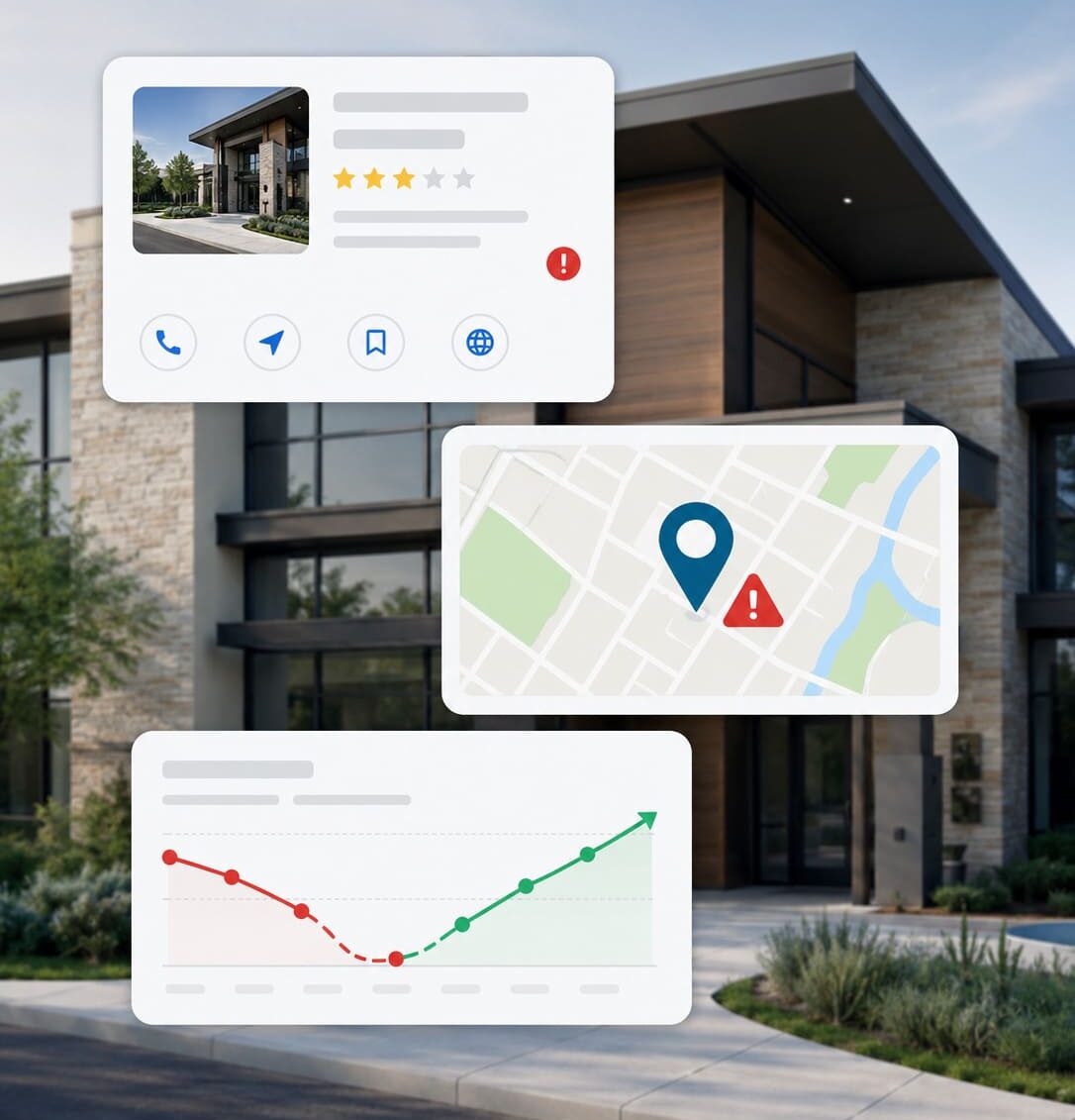
Recovery homes need sober living SEO services that make it easier to find costs, locations, reviews, and admissions details before someone calls or submits a form. Local SEO, recovery home website SEO, and Google Business Profile optimization answer those questions. IMMWIT plans the work with technical SEO, reporting, content updates, and AI search visibility.
Trusted by over 100+ rehab and detox centers worldwide
Families and referral partners review rules, costs, location, photos, reviews, and Google Business Profile details before calling or submitting a form. Recovery home SEO should place those details where people can evaluate the home without having to search through several pages.
Local SEO should align Google Maps, directory listings, city pages, and website contact information. The audit checks for conflicts or incomplete entries in service areas, phone numbers, addresses, location pages, and profile details.
Admissions inquiries become easier to handle when people already know the rules, pricing, eligibility, referral process, and contact route. Admissions-focused SEO places that information near calls, forms, and referral requests, so families, residents, and referral partners can ask more relevant questions.
Sober living SEO differs from rehab SEO because it targets long-term residential and community-based searches, not urgent clinical, detox, treatment, or insurance-driven searches. Rehab SEO is usually built around immediate care. Sober living SEO is built around housing comparison, local availability, resident criteria, and post-treatment transition.
Key differences in SEO strategy:
Sober living SEO services should include local SEO, Google Business Profile cleanup, recovery home website structure, admissions content, reviews, technical SEO, tracking, reporting, and AI search visibility planning. At IMMWIT, we organize those service areas around how families, residents, and referral partners find, compare, and contact a recovery home.
For recovery homes, those items include website pages, Google Business Profile details, local listings, reviews, forms, calls, and referral touchpoints. Planning starts with the clearest search, website, profile, tracking, or inquiry problem.
Core service areas include:
Families, residents, and referral partners compare local search results, Google Business Profile details, reviews, website pages, local listings, and contact options before contacting a recovery home. Sober living SEO should organize those assets around local visibility, website structure, review trust, and admissions contact.
Local search connects the home to city, map, and near-me searches. The website structure organizes the pages families use to compare rules, costs, eligibility, and contact options. Tracking shows which pages and contact points lead to calls, forms, and referral activity that the admissions team can evaluate.
Our local SEO work reviews the service areas, listings, location pages, and Google Maps presence tied to each sober living home. The audit identifies incorrect service areas, mismatched listings, and low-detail location pages that limit map presence or local rankings.
The local SEO audit reviews city terms, service-area details, directory accuracy, and location page content. Those details should match the same service area, business information, phone number, website, and contact option.
Location page work adds city, neighborhood, access, and nearby recovery resource details that help the visitor. Local SEO for sober living homes aligns the website, Google Maps presence, and public listings around one accurate service area.
Google Business Profile optimization for recovery homes focuses on the fields that affect local search actions, including calls, website clicks, directions requests, reviews, Q&A, services, and service-area information. For many local searches, the Google profile appears before the website, so incorrect fields can send families or referral partners to the wrong phone number, page, or location.
The profile audit checks the fields people see first: name, category, address or service area, phone number, website link, photos, reviews, Q&A, and services. Tracking then shows whether the profile is sending people to calls, website clicks, or direction requests.
Google requires accurate address or service-area information for Business Profiles. For a recovery home, the profile audit checks whether the location, service area, phone number, website, and contact process match the real business.
Website structure for sober living homes should separate admissions pages, family information, and referral content. Admissions pages need contact, eligibility, and availability details. Family pages need cost, rules, location, photos, and daily expectations. Referral pages need service scope, suitability details, and a clear referral contact.
The website audit checks homepage paths, navigation labels, internal links, contact sections, and page placement. Our team maps these page paths before writing or revising copy, so each audience can find the information that matches their question.
Sober living website SEO connects admissions teams, families, and referral partners to the right page before they call, submit a form, or refer.
Search terms show whether someone needs local housing, admissions information, family answers, or referral support. Keyword mapping separates local, admissions, family, and referral intent before page copy gets written. That keeps one page from carrying every sober living search intent.
The keyword map assigns each search type to the page or section that should answer it. Sober living SEO should align with the reason behind the query.
Reviews help families, referral partners, and prospective residents compare recovery homes before calling, submitting a form, or making a referral. Genuine feedback carries more weight when it appears on Google, directory profiles, testimonials, and branded search results.
Reputation assets include Google reviews, review responses, directory profiles, testimonials, and brand search results. Each profile or proof source should show accurate details, legitimate feedback, and supportable claims, not manufactured praise.
No fake reviews belong in recovery-home marketing. Our reputation review organizes legitimate feedback, improves review responses, and checks how proof appears across Google, directories, testimonials, and branded search results.
Technical SEO for sober living websites checks whether pages can be found, used, and measured. A well-written page will not help search visibility if search engines cannot index it, and a working contact page still needs forms, calls, and analytics to track properly.
Our technical SEO audit includes indexing, speed, mobile layout, redirects, metadata, schema, internal links, forms, calls, and analytics before results are evaluated. Slow mobile pages, broken links, form errors, and missing tracking can reduce call volume, form submissions, and referral activity.
Clean tracking provides the SEO program with a stronger reporting foundation for rankings, calls, forms, and inquiries. Without it, the recovery home may see traffic but still not know which pages support admissions activity.
AI search tools need specific page details before they can accurately describe a recovery home. Missing service-area details, unclear information about who the home serves, or vague contact options can result in incomplete AI responses.
The AI search review checks whether the page includes:
Answer sections, consistent recovery housing terms, and structured data help search systems connect the home, service area, and contact options. Structured data should match the visible page content, not stand in for missing information.
Optimize Your Recovery Home Online
Strengthen your local visibility, recovery housing pages, Google Business Profile, trust signals, service details, tracking, and resident inquiry paths.
A sober living SEO campaign starts with an audit of the issues limiting visibility, calls, forms, and admissions inquiries. The audit checks indexing, Google Business Profile accuracy, admissions page coverage, and call and form tracking.
review local rankings, organic search positions, Google Business Profile activity, and indexed pages.
separate local, admissions, family, and referral searches before writing or revising content.
check page structure, admissions pages, contact points, and missing service information.
update Google Business Profile fields, photos, services, links, and contact options where needed.
create or revise pages around location, rules, cost, eligibility, referrals, and resident match.
fix indexing, speed, mobile layout, redirects, schema, forms, calls, and tracking issues.
measure rankings, calls, forms, reviews, profile actions, and admissions inquiries.
Indexing, tracking, profile data, and page structure should be in place before more content is added. Fixing those items first reduces wasted edits and gives the recovery home more reliable reporting before the campaign expands.
SEO helps the right people contact a recovery home by answering questions about rules, cost, eligibility, support level, and contact details before the call or form submission. Some visitors may need detox, clinical care, or another support level instead of sober living.
Weak contact: “Do you have sober living?”
Better contact: “I read the rules and want to ask about availability.”
Admissions-focused SEO content creates that difference by answering fit, cost, rules, and contact questions before the conversation starts. Location, eligibility, photos, reviews, and contact options help visitors decide whether to call, submit a form, or refer someone.
Admissions teams spend less time repeating basics when visitors already know the rules, cost, location, and contact route. Sober living admissions SEO should prepare visitors to contact the home with rules, cost, eligibility, and availability in mind, not only to increase page visits.
Rankings show visibility, but calls and forms show contact activity. Profile actions, review growth, organic traffic, and AI mentions show what happens beyond rankings.
| Metric group | Metrics tracked |
|---|---|
| Local rankings | City and map visibility |
| Google Business Profile calls | Profile contact activity |
| Website calls | Page contact activity |
| Form submissions | Written inquiry activity |
| Admissions inquiries | Contact quality for the business |
| Review growth | Reputation signal movement |
| Organic traffic | Search reach |
| AI mentions | AI search representation |
Reporting should show which SEO actions created measurable contact activity. Page traffic, profile actions, calls, forms, and inquiry data should guide the next round of SEO work.
Recovery homes choose IMMWIT when generic local SEO is not specific enough for sober living search intent, admissions content, referral trust, or Google Business Profile accuracy. The service is for homes that need search intent mapped, local visibility reviewed, website pages organized, technical issues fixed, and tracking connected to calls, forms, and profile actions.
Some homes also need pages that explain location, rules, cost, resident match, and referral process without making recovery claims that sound clinical. For recovery homes, local search, page structure, reviews, tracking, and content should all support the same admissions decision.
Request a sober living SEO visibility review from IMMWIT. Send your website, service area, and main search problem, and the review can identify where your page structure, Google Business Profile, content, tracking, or contact points may be limiting sober living search visibility.
Sober living SEO timelines depend on site condition, local competition, Google Business Profile strength, content depth, reviews, and technical health. Early work should address blockers such as indexing issues, incomplete profile details, low-detail location content, or missing tracking. After that, the SEO program builds the local and content base over time.
Sober living SEO services cost depends on the number of locations, website condition, content needs, profile work, technical issues, and reporting scope. A recovery home with one location and a working site usually needs a different scope than a multi-location organization with duplicate pages, weak tracking, and incomplete profiles. A review of the website, Google profile, content, and reporting setup should come before a quote.
SEO can support a weak Google Business Profile by improving profile accuracy, reviewing categories, adding reviews, ensuring citations, supporting the website, and creating local content. The profile and website should be reviewed together because map visibility usually depends on several signals working together: profile accuracy, location relevance, reviews, citations, and website support.
Yes. Multi-location recovery homes need a location structure, accurate profile information, location-specific content, duplicate-page control, and location-based reporting. Each home needs its own search footprint, while the brand still needs consistent service descriptions across the site.
Referral-driven recovery homes can still benefit from SEO, as families and referral partners often check the website, Google profile, reviews, and location details before contacting. SEO strengthens those trust checks. It can also capture people who search directly rather than through a referral source.
SEO and Google Ads serve different roles. SEO builds organic visibility and website trust over time. Ads can create paid exposure, but cost, policy, and ad wording review matter in recovery-related categories. A channel decision should start with budget, urgency, search demand, website quality, and tracking readiness.
SSEO can support a weak Google Business Profile by improving profile accuracy, reviewing categories, adding reviews, ensuring citations, supporting the website, and creating local content. The profile and website should be reviewed together. Map visibility usually depends on profile accuracy, reviews, website support, citations, and location relevance working together.
A trustworthy sober living website provides people with the details they need before contacting: location, house rules, cost details, admissions steps, photos, reviews, testimonials, referral information, and contact options. Visitors should not have to search across the site to understand the home. Good page structure places those details near the decisions people make before contact.
We Cover top 70 cities around the world