

How to Make Your Rehab Center Visible in ChatGPT Search


Start with the source ChatGPT cites, not another rehab blog post. A directory with the wrong treatment program needs a correction. A website that blocks the search crawler needs a technical fix. To improve your rehab center’s visibility in ChatGPT Search, check both, then publish accurate answers about your services and locations. No change guarantees a mention or citation.
Test Four Searches a Family Might Make
Use ChatGPT’s web search for each test. Start a new conversation, name the city and state, and save the full response. Open the cited pages before making changes to your website.
For a fictional Phoenix center offering adult intensive outpatient treatment (IOP), the test questions could be:
- Center name: “Does [center name] in Phoenix, Arizona, offer adult IOP?”
- Without the center name: “Which treatment centers in Phoenix offer adult IOP? Include sources.”
- Program limits: “Can someone live at home while attending [center name]?”
- Admission details: “How does a family contact [center name] to ask about IOP and insurance?”
A named-center answer and a general local answer serve different questions. Record them separately. For each result, save the prompt, date, answer, cited URL, and any factual error. Record “no citation” when none appears.
ChatGPT may rewrite web searches or use approximate location information. OpenAI documents both in its ChatGPT Search instructions. Answers can vary between tests.

Match the ChatGPT Answer to Its Actual Source
Do not rewrite your website because one ChatGPT answer was wrong. Open each cited URL. Locate the statement about your facility, then compare it with approved program and location records.
| Result | What to inspect | Action |
|---|---|---|
| Your center appears with correct program details | The page ChatGPT cited | Retain the accurate content; record the source |
| A directory calls your outpatient center residential | The directory’s treatment description | Request a correction from its publisher |
| ChatGPT gives the wrong service, but the cited page is accurate | The exact cited passage | Save the mismatch and retest; do not rewrite correct facts |
| Your center is absent from an unbranded answer | Relevant program pages and crawler access | Diagnose the site before adding pages |
| Another center appears for a service you provide | Its cited page and the question asked | Compare verified answers and service details |
A missing mention has no single proven cause. The question, available sources, and search access may affect the answer. Checking citations helps identify errors you can correct.
Confirm OAI-SearchBot Can Reach Your Public Pages
OpenAI uses OAI-SearchBot for ChatGPT search discovery. Check access to the program and location pages you want considered, not just your homepage. Include the affected URLs in a technical SEO review, then ask your developer to inspect the following:
- Crawler rules: Open
yourdomain.com/robots.txt. Check the effective instructions for OAI-SearchBot on each important URL. - Firewall access: Compare blocked requests with OpenAI’s published search crawler IP ranges.
- Page responses: Find
403errors, missing pages, redirect loops, and login barriers. Confirm that public program details appear in the delivered HTML. - Indexing settings: Review page-level robots controls and canonicals for mistakes, without assuming any one setting proves a ChatGPT ranking problem.
- Server logs: Look for verified OAI-SearchBot requests to the affected URLs. An empty short log sample does not prove the bot was blocked.
For a public site, the relevant permission might include:
User-agent: OAI-SearchBot
Allow: /
That example is not a complete security configuration. The developer must review other crawler rules and keep patient portals private. OpenAI states that updated crawler rules can take about 24 hours to reach its systems. That is not a promised appearance time.
OAI-SearchBot and GPTBot serve different purposes. GPTBot concerns model-training crawls. ChatGPT-User can fetch a URL after a user requests it, but that visit does not prove search discovery. The official crawler reference documents all three.
Answer Treatment Questions in the First Paragraph
A person asking about IOP should find the program and location immediately. Replace broad promises with facts an admissions team can verify.
Generic opening
We offer compassionate addiction treatment in a supportive environment.
Answer-first opening, for the fictional Phoenix center
[Center name] offers adult intensive outpatient treatment at its Phoenix facility. The program does not provide overnight residential care. Contact admissions for the current schedule, eligibility screening, and insurance-benefits process.
Use that example only if every statement matches an active program. A center with residential care at a separate address must identify that location. Never present an unavailable service merely to match a search phrase.
Under the opening, answer the next questions in natural sections. State who the program serves, where treatment takes place, how sessions are scheduled, and how a family contacts admissions. Publish exact hours or eligibility conditions only after staff approve them.
A service page with these facts helps families make a treatment decision even if ChatGPT never cites it. Before publishing new articles, review existing treatment pages for missing answers, evidence, and internal links.
Give Every Question One Main Page
A treatment center should avoid answering the same insurance or program question across several nearly identical pages. Choose one primary URL for each question, then connect related pages with descriptive links.
| Family question | Best page | Evidence the page needs |
|---|---|---|
| Does this location offer IOP? | IOP program page | Current program and facility approval |
| Is overnight care available? | Residential or program-level page | Exact level of care at that location |
| Can insurance help pay for treatment? | Insurance verification page | Current benefits-check process and limits |
| How does admission begin? | Admissions page | Contact steps and screening process |
| Who provides clinical oversight? | Team or program page | Verified staff names, roles, and credentials |
Link each program page to the correct facility, admissions, and insurance pages. A rehab website URL structure blueprint can help separate these page types before adding more URLs. Create another location page only for a genuine facility or distinct local service.
Structured data must match the visible page. Use appropriate Organization, LocalBusiness, Service, or Article markup only for accurate, public facts. Google’s structured data documentation covers implementation for Google Search. No schema type guarantees ChatGPT Search placement.

Add Proof Specific to the Facility, Not Generic Trust Claims
A visitor cannot verify “experienced medical team” without names or credentials. Replace that phrase with accurate information the center permits you to publish. The same rule applies to licenses, accreditation, insurance, and treatment outcomes.
Match each claim with its source:
- Services offered: Current program records and approval from the facility manager or clinical team.
- State license: The relevant state licensing authority and the facility or service covered.
- Accreditation: Current confirmation from the named accreditor, including its scope.
- Clinical staff: Verified credentials, current roles, and permission to publish the profile.
- Insurance: Confirmed payer arrangements and an individual benefits-verification process. Avoid guaranteed-coverage claims.
- Medical outcomes: Suitable clinical evidence and qualified review. Remove unsupported recovery percentages.
Add facility-specific details that help someone compare actual options. An approved evening IOP schedule may answer a working parent’s question. A generic paragraph about the value of recovery cannot. Record who approved each fact and when. Use that record to correct outdated pages after program changes.
Do not put patient names, intake details, or treatment records into ChatGPT prompts or marketing logs. Federal 42 CFR Part 2 protections apply to records held within covered substance use disorder programs. HIPAA can impose other requirements. Obtain appropriate clinical and privacy review for public treatment copy.

Correct Outside Listings That Describe the Wrong Program
Check any directory ChatGPT cites against the center’s current address, phone number, and treatment services. Include state licensing records, relevant insurer listings, and FindTreatment.gov where the facility appears.
If a FindTreatment.gov entry is wrong, SAMHSA accepts corrections at FindTreatment@samhsa.hhs.gov or 1-833-888-1553. Supply the outdated information, its replacement, and the effective date. The FindTreatment.gov FAQ also covers applying for a new listing.
Keep the correction request, source URL, and date in your records. Retest the original ChatGPT question after the public entry changes. Accurate listings serve families first; they do not guarantee AI citations.
Worked Example: Fix a False Residential Claim
Imagine the fictional Phoenix center offers adult IOP without overnight care. ChatGPT describes it as residential and cites a directory with that same error. The center’s website also has an unhelpful “Our Programs” paragraph.
Before the correction
We provide several addiction treatment options in Phoenix.
Approved replacement example
[Center name] provides adult IOP at its Phoenix facility. Patients attend scheduled sessions without staying overnight. Admissions can confirm current eligibility, session times, and insurance verification.
Admissions sends the directory owner the corrected program details. The website editor updates the IOP page and links it to the facility and admissions pages.
Next, the marketing manager repeats the original prompt and opens every cited source. Record if the answer changed and if the wrong directory still appears. Do not describe the correction as a ranking improvement without supporting measurements.
Measure ChatGPT Visibility Without Inventing Rankings
Keep a fixed set of test prompts and review them monthly or after a correction. One record should include the question, location, test date, answer, mention status, cited URL, factual error, and next action. Keep patient information out of this record.
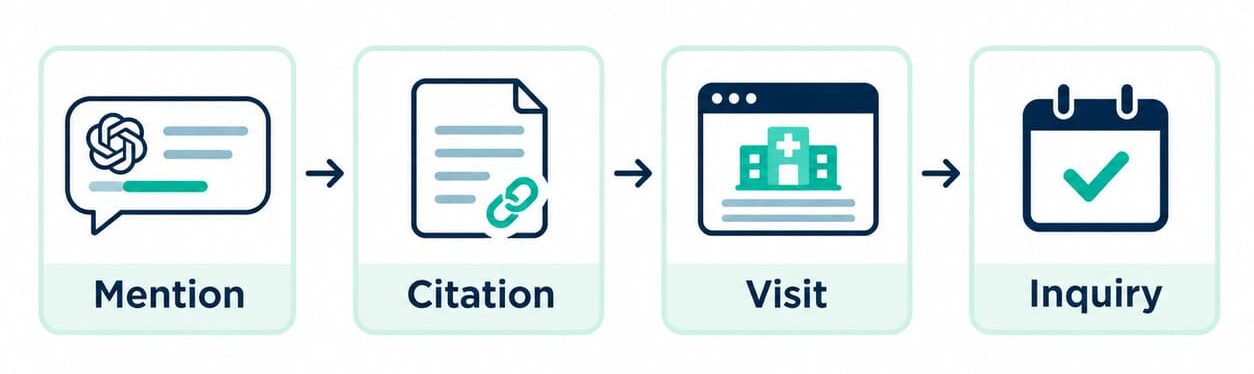
Measure four different outcomes:
- Mention: ChatGPT names the facility.
- Citation: ChatGPT links to a specific source page.
- Referral: A visitor reaches the website from a tracked ChatGPT link.
- Inquiry or admission: Your approved business records connect a contact or admission with an attributable visit.
For referrals, inspect chatgpt.com in Google Analytics traffic acquisition reports when attribution data is available. A citation that receives no click will not appear as a website visit. Neither a mention nor a referral proves an admission.
Make the Next Change Match the Finding
Start with the confirmed problem. Fix blocked access before rewriting content. Correct an outside directory before adding another service page. Update a vague program opening before publishing a duplicate blog.
Create a new article only when an important treatment question lacks a suitable existing page. Record the affected URL, the evidence behind the problem, the correction needed, and the date for retesting.


