How Drug Rehab Centers Can Rank Higher on Google


Drug rehab centers rank higher on Google through focused treatment keywords, local SEO, dedicated program pages, patient-centered content, verified provider details, technical fixes, internal links, and relevant backlinks.
Patients and families often search for information during critical treatment decisions. According to SAMHSA, in 2024, only 19.3% of individuals aged 12 or older who needed substance use treatment received it.
Even with strong programs, a rehab center may lose search traffic to competitors with a stronger Google Maps presence, more organized program pages, and better local SEO signals. Many of those losses trace back to common rehab SEO mistakes to avoid, from thin pages to inconsistent listings.
Drug rehab SEO is the process of improving organic visibility for treatment-related searches across program pages, location pages, patient articles, and Google Maps assets.
Effective drug rehab SEO aligns search demand with treatment services, detailed program information, and admissions support. Rankings deliver business value when increased visibility leads to qualified admissions inquiries.
Takeaways
- Target drug rehab SEO keywords.
- Build program-specific pages.
- Improve Google Business Profile.
- Create location pages.
- Answer patient and family questions.
- Add license and accreditation details.
- Fix technical SEO issues.
- Build internal linking and topic clusters.
- Earn relevant backlinks.
What Affects Drug Rehab Center Rankings
Google defines SEO as the work that helps search engines interpret content and helps users decide whether a page deserves a visit. Drug rehab center rankings depend on search intent, local accuracy, program depth, patient resources, technical health, links, and verified provider information.
- Keyword targeting: Match treatment, local, commercial, and question-based searches with the right pages.
- Service pages: Build dedicated pages for detox, residential treatment, outpatient programs, and other services.
- Google Business Profile: Maintain accurate profile details, services, reviews, photos, and Q&A.
- Location pages: Target important cities, service areas, and local treatment searches.
- Patient content: Answer treatment, cost, insurance, and admissions questions.
- Provider signals: Add license details, accreditation, staff bios, and reviewer credentials.
- Technical SEO: Fix crawlability, indexability, mobile usability, speed, and duplicate pages.
- Internal links: Connect treatment pages, location pages, and supporting articles.
- Backlinks: Earn relevant links from healthcare, local, and community sources.
- Schema markup: Add schema data for organization, location, articles, FAQs, and breadcrumbs.
- Mobile performance: Make phone calls, forms, menus, and program pages easy to use.
- Page speed: Reduce image weight, script load, layout instability, and slow templates.

Start With the Right Drug Rehab SEO Keywords
Many owners search for ways to improve their rehab center’s ranking when seeking a comprehensive SEO strategy. Drug rehab SEO begins with keyword selection, as each search represents a unique need.
- Drug rehab [CITY]
- Drug addiction treatment [CITY]
- Addiction treatment center [CITY]
- Outpatient drug rehab
- Drug rehab near me
- [CITY] Drug rehab
- Detox center near me
Service keywords should be placed on treatment pages, while local keywords are best suited for city, state, and service-area pages. Question-based keywords are most effective in blog posts, FAQ pages, and patient resource articles. This keyword mapping is one of several proven SEO strategies for treatment centers that reduce overlap and sharpen relevance.
A well-structured keyword map minimizes page overlap and enhances ranking relevance. Effective mapping attracts searchers based on location, treatment needs, and admissions intent.
Build Strong Service Pages for Each Treatment Program
A rehab website should include dedicated pages for each major treatment program. A single homepage typically cannot address the full scope of detox, residential treatment, outpatient services, insurance, and admissions information.
Create a page for each treatment program.
Each program page should focus on a single treatment topic. Separate content should be created for detox, inpatient rehab, outpatient services, residential treatment, PHP, IOP, alcohol rehab, and dual diagnosis.
Match each page to a single primary search intent.
Each page should address a specific visitor need. For example, a detox page should cover withdrawal support, clinical supervision, common timeline questions, and insurance verification.
- Detox program page
- Residential treatment page
- Inpatient rehab page
- Outpatient rehab page
- PHP page
- IOP page
- Alcohol rehab page
- Dual diagnosis page
- Insurance verification page
- Admissions page
Program pages link treatment searches to the appropriate services. Visitors seeking outpatient rehab require more detailed information than what is typically found in a brief homepage section.
Improve Local SEO and Google Maps Visibility
Local SEO connects rehab centers with individuals searching in specific cities, counties, and treatment areas. Google Maps, local pack results, reviews, citations, and location pages all contribute to local visibility.
According to Google Business Profile documentation, local results are ranked by relevance, distance, and prominence. Rehab centers can lose local search traffic when listings, reviews, NAP data, or location pages send weak local signals.
Optimize Google Business Profile
A fully optimized Google Business Profile can drive calls before a visitor even reaches the website. Google Business Profile documentation notes that accurate business information improves eligibility for relevant local searches.
- Business name
- Address
- Phone number
- Website URL
- Primary category
- Treatment services
- Facility photos
- Reviews
- Q&A
Make Local Listings Consistent
Consistent local listings reinforce a center’s presence across external websites. Errors in directories can create conflicting location signals and decrease trust in search systems.
A citation audit should review healthcare directories, local directories, outdated profiles, duplicate listings, and old phone numbers. Maintaining consistent NAP data strengthens local relevance.
Build Location Pages for Important Service Areas
Location pages should address local treatment demand with original content. Each page should include locally relevant information, service details, facility access instructions, and links to treatment pages.
- City pages
- State pages
- Service-area pages
- Detox location pages
- Alcohol rehab location pages
- Outpatient treatment location pages
- Nearby area pages
- Internal service links
A center aiming to rank for ‘drug rehab near me’ should create location pages that link city-specific searches to available services, admissions processes, and program availability.
Publish Helpful Content Patients and Families Search For
Google’s people-first content guidance prioritizes helpful, reliable information created for users, rather than content designed solely to influence rankings. Rehab content should address treatment, cost, insurance, safety, and admissions questions before introducing commercial messaging.
Patients may compare treatment programs or seek information about detox. Family members often research warning signs, payment options, privacy concerns, and details about admissions calls.
- Does insurance cover rehab?
- How much does rehab cost?
- What happens in rehab?
- Detox vs rehab
- Inpatient vs outpatient rehab
- How long does treatment take?
- How to help someone enter rehab
- What to ask before choosing treatment
- What families should know before calling
- How admissions calls work
Each article should link to a relevant program page. Addressing patient questions, family concerns, and treatment topics helps establish greater topical authority for addiction treatment SEO.
Strengthen Trust Signals on Every Important Page
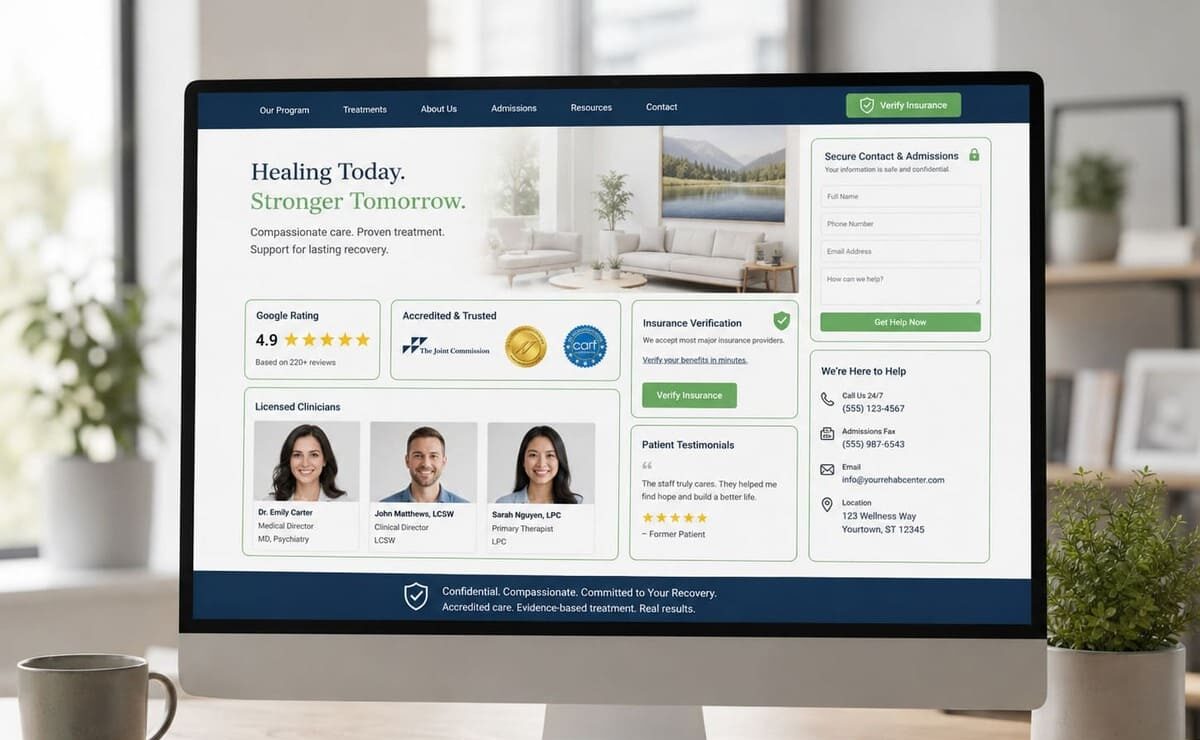
Addiction treatment searches require greater trust in providers than many other service categories. Visitors often review clinical details, privacy policies, insurance options, and provider credentials before reaching out to admissions.
Search engines need entity confidence. Facility details, author information, reviewer credentials, accreditation, and accurate claims connect content with a credible treatment provider.
Show Licensing, Accreditation, and Facility Details
Visitors seek verification before contacting a treatment provider. Providing facility details, license information, accreditation, and clear contact options helps reduce barriers during their research process.
- State license
- Accreditation
- Facility address
- Facility photos
- Phone number
- Insurance information
- Program details
- Admissions contact
Add Clinical Reviewers and Expert Bios
Clinical review information should be included in content covering treatment, symptoms, programs, or recovery topics. Listing reviewer names, credentials, roles, and update dates helps readers evaluate the quality of the source.
Author bios link content to qualified contributors. A reviewer page should include professional background, areas of expertise, credentials, and the scope of content reviewed.
Avoid Unsupported or Exaggerated Claims
Treatment content should align the strength of its claims with supporting evidence. Overstated claims without proof can undermine visitor trust, lower content quality, and increase compliance risks.
- Guaranteed recovery claims
- Unsupported success rates
- Pressure language
- Vague clinical claims
- Unverified treatment outcomes
- Missing source attribution
Carefully substantiated claims protect readers and enhance SEO for rehab centers operating in a sensitive, high-stakes field.
Fix Technical SEO Problems That Hold Rankings Back
Technical SEO eliminates obstacles between key pages and search engines. It also enhances user access on mobile devices, forms, phone buttons, and program pages.
- Crawlability
- Indexability
- XML sitemap
- txt
- Canonical tags
- Page speed
- Mobile usability
- Broken links
- Redirect chains
- Duplicate pages
- Thin pages
- Schema markup
- Core Web Vitals
Google Search Central describes schema data as explicit clues to a page’s meaning. Rehab websites can use schema to identify organization details, location data, articles, FAQs, breadcrumbs, services, and reviewer information.
Technical improvements can boost Google rankings for drug rehab centers by making detox, outpatient, and location pages easier for search engines to crawl, index, and understand.
Use Internal Links and Topic Clusters to Support Your Main Treatment Pages
Internal links show how treatment pages, location pages, insurance information, and patient questions connect across a rehab website. For drug rehab SEO, those links should direct visitors to the most relevant treatment page.
A topic cluster organizes supporting content around a main treatment page. A detox page can include links to articles on withdrawal symptoms, detox timelines, insurance coverage, and what happens before admission. An outpatient rehab page can include links to content on work schedules, family support, relapse prevention, and aftercare.
Use descriptive anchor text such as detox program, residential treatment, outpatient rehab, alcohol rehab, insurance verification, and admissions process. For example, an article about insurance coverage can link to the insurance verification page, while a city page can link to the closest treatment program page.
Earn Relevant Backlinks and Local Mentions
Rehab centers can establish authority by being listed in healthcare directories, local directories, community websites, treatment resources, and through editorial mentions. A relevant local citation is more valuable than numerous unrelated links.
Comprehensive, practical resources attract higher-quality mentions than brief promotional pages. For example, a family resource page covering insurance verification, admissions questions, or local recovery options can earn citations from community organizations, therapists, and resource sites.
Get Help With Drug Rehab SEO
A rehab center may require SEO support if rankings stagnate, local competitors outperform on Google Maps, program pages receive low traffic, or organic visits do not generate qualified inquiries.
A specialized drug rehab SEO company integrates keyword strategy, local visibility, treatment service pages, content planning, technical SEO, and authority development. General SEO services may overlook the complexities of searches for addiction treatment, which is why choosing the right SEO agency for your rehab center is a decision worth taking seriously.
Looking to improve your rehab center’s Google rankings? Our drug rehab SEO services enhance organic visibility, local rankings, and generate qualified admissions inquiries for addiction treatment centers.
Frequently Asked Questions
How can a drug rehab center rank higher on Google?
A drug rehab center can rank higher on Google by matching each search intent with the right page. Build separate pages for detox, outpatient treatment, insurance, locations, and patient questions. Then improve local SEO, technical SEO, internal links, and relevant backlinks.
What keywords should drug rehab centers target?
Drug rehab centers should target service, local, program, insurance, and family-search keywords. Core terms include drug rehab SEO, rehab center SEO, addiction treatment SEO, drug rehab near me SEO, detox keywords, inpatient rehab keywords, outpatient rehab keywords, and admissions searches.
Does local SEO help rehab centers get more calls?
Yes. Local SEO can help rehab centers get more calls from Google Maps, the local pack, and Google Business Profile. Accurate business details, reviews, citations, treatment services, and location pages help searchers compare nearby options before contacting admissions.
Why is my rehab center not ranking on Google?
Your rehab center may not rank because one broad page is trying to target too many searches. Detox, outpatient treatment, insurance, and city searches need separate content assets. Other common problems include weak local SEO, thin pages, technical issues, low authority, and keyword overlap.
Should rehab centers hire a specialized SEO agency?
Yes, if the center needs stronger rankings, better local visibility, and more qualified admissions inquiries. A specialized drug rehab SEO agency can build treatment keywords, program pages, local SEO, technical SEO, and trust-focused content around addiction treatment searches.
Resources
- https://www.samhsa.gov/newsroom/press-announcements/20250728/samhsa-releases-annual-national-survey-on-drug-use-and-health
- https://developers.google.com/search/docs/fundamentals/SEO-starter-guide
- https://support.google.com/business/answer/7091?hl=en
- https://developers.google.com/search/docs/fundamentals/creating-helpful-content
- https://developers.google.com/search/docs/appearance/structured-data/intro-structured-data