Google AI Search Optimization Guide: What SEOs Need to Know in 2026


Google Search Central has released new material on generative AI features. AI Overviews and AI Mode now shape how users review search results. SEO remains essential for visibility across both traditional and AI-driven Google Search experiences. SEOs require clear, source-backed guidance, defined priorities, and fewer distractions from AI search trends.
AI Search has become part of mainstream search behavior, moving beyond initial testing phases. Google reported over 2 billion monthly AI Overview users in Q2 2025. Most SEO teams should focus on page priorities before adopting new AI terminology.
Most SEO teams do not need another AI-search checklist. They need to know which pages deserve work, which tasks can wait, and which advice Google has already dismissed.
What Google Published in May 2026
Google released new Search Central material on generative AI Search for website owners, SEO teams, and developers. The content addresses AI Overviews, AI Mode, shopping, local data, images, videos, and agents. This material was introduced via Search Central on May 15, 2026.
- Source type: Search Central documentation.
- Search surfaces: AI Overviews and AI Mode.
- Reader group: Owners, SEOs, and developers.
- Work area: Content, access, visibility, and usefulness.
- Release frame: Source reference, separate from ranking update news.
SEOs should use this release as a primary planning resource. Review it before investing in new AI visibility tactics. This article is designed to help teams distinguish sustainable efforts from short-term trends.
SEO Remains Core To Google AI Search
Google directly addresses SEO relevance in the Search Central material, stating that SEO best practices remain important for generative AI features. These features rely on core Search ranking and quality systems.
AI Search requires pages that are relevant, accessible, and valuable to users. While the interface has evolved, core SEO practices continue to determine visibility. Teams should focus on improving content, technical access, internal linking, and relevance.
Why SEO Work Still Applies
AI-driven answer formats have changed the appearance of search results, but source retrieval continues to rely on Google Search infrastructure. SEOs influence relevance through content, internal linking, and technical accessibility.
Effective pages should have a clear purpose and provide helpful answers. Google must be able to identify these pages and match their content to user needs. Pages with superficial answers are less likely to perform well in Search and AI results.
AEO And GEO Should Support SEO Work
AEO and GEO can describe aspects of AI visibility work, but for Google Search, these terms should remain secondary to core SEO fundamentals. Teams must prioritize useful pages, accessible content, and supporting evidence.
- Term: Use AEO and GEO as shared vocabulary.
- Priority: Keep editorial SEO and technical SEO central.
- Outcome: Build pages worth retrieval, citation, and user trust.

How RAG And Query Fan Out Change SEO Planning
RAG links AI-generated answers to content retrievable from the Search index. Google defines retrieval-augmented generation as grounding responses in current indexed pages, which enhances quality, accuracy, and freshness.
Query fan out expands a single search into related queries. Google notes that the model can generate concurrent related queries, which collect additional Search results relevant to the user’s question.
A single page should address related questions within a unified task. Create separate pages only when the audience, depth, or format requires it. Planning should be guided by reader tasks, not isolated keywords.
What RAG Changes
RAG increases the importance of having retrievable, current, and focused pages. For example, a page on AI Search SEO should address key questions, including search changes, work priorities, and lower-value tasks.
Freshness is important when topics evolve with product releases. Source eligibility influences grounded AI responses and clickable links. SEOs should ensure information remains current, especially for rapidly changing topics.
What Query Fan Out Changes
A single search may branch into supporting questions and related subtopics. Use the following branch list as a planning model to group related questions before creating new URLs.
Seed query: Google AI Search Optimization Resource
├── Is SEO relevant for AI Overviews?
├── What is query fan out?
├── Does Google need schema data for AI Search?
├── Do SEOs need llms.txt?
└── Which pages should teams update first?
Plan using question clusters, then select the most appropriate page format.
- Answer related questions inside one strong resource.
- Build a separate resource with a fresh angle.
- Create a dedicated comparison or checklist.
- Use different formats, such as video, tables, FAQs, or glossaries, when useful.
Entity Reference For SEOs
Entity clarity helps readers and AI systems understand the article. Introduce definitions early when using technical Search terms. The following table keeps terminology concise and reusable.
| Entity | Plain meaning |
|---|---|
| AI Overviews | Google AI summaries shown for selected Search queries |
| AI Mode | Google Search experience for deeper AI-assisted queries |
| RAG | Retrieval augmented generation using indexed source content |
| Query fan out | Related searches generated around one user query |
| Search index | Google collection of discovered and processed web content |
Each definition should address a specific reader need. Entity definitions also support schema planning, internal linking, and FAQ extraction. Avoid excessive jargon that may hinder reader comprehension.
Create Original, Useful Content With New Value
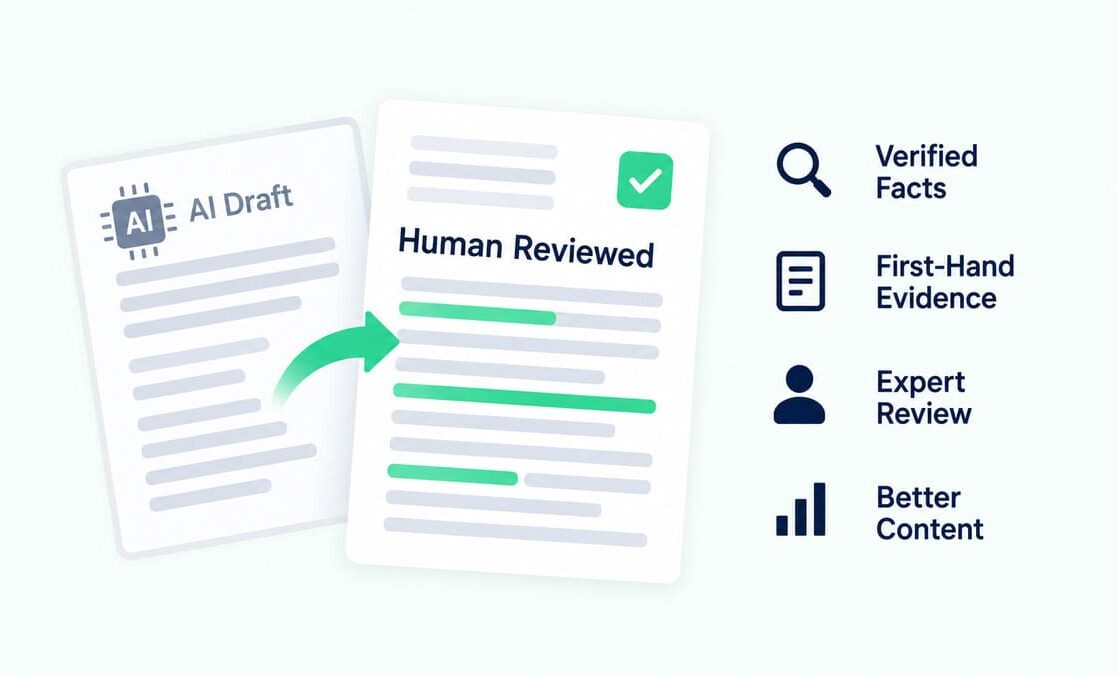
Google prioritizes content that is useful and unique. Strong pages provide evidence, experience, examples, and expert review. Pages that simply repeat common advice without demonstrating tested work are less effective.
The primary goal is to deliver practical value, not to increase word count. Readers need actionable examples and evidence, while search systems require substantive content beyond summaries.
Weak Content Examples
| Weak topic | Why it underperforms |
| 7 AI Search SEO Tips | Broad idea, thin proof, easy duplication |
| What Is AI Search | Definition only, shallow reader value |
| Best Practices For AI Overviews | Vague advice, weak evidence, repeated claims |
These approaches are effective when supported by evidence. Without testing, examples, or expert input, they become filler content. Strong content should demonstrate work that readers can review.
Stronger Content Examples
- AI Overview Review: Analyze source patterns across sample results.
- Technical SEO Audit For AI Search: Show process changes.
- AI Search Content Audit Template: Offer a usable work asset.
- Local AI Overview Source Study: Add vertical detail and examples.
Each stronger approach provides readers with more than a summary. Articles gain attention through evidence, methodology, and practical detail. Original work enables readers to make more informed decisions.
What Strong Pages Add
- Proof: Add screenshots, datasets, logs, or testing notes.
- Project lessons: Include setup problems, limits, and edge cases.
- Expert review: Add named input from a specialist.
- Before and after: Show changes across page updates.
- Named actions: Replace broad advice with concrete tasks.
- Reader tools: Add checklists, tables, diagrams, or templates.
Publish only when a page offers value beyond a summary. This standard protects readers from repetitive advice and superficial formatting, and helps teams determine when a page merits further development.
Avoid Thin Pages For Every Query Variation
Use query fan out to guide content coverage, not to create excessive page sprawl. Google cautions against producing separate content for every search variation, especially when intended to manipulate rankings or AI responses.
Weak responses result in multiple URLs targeting the same intent, leading to overlapping pages and wasted editorial resources. This also complicates internal linking management.
/google-ai-search-resource
/google-ai-search-resource-for-seos
/google-ai-search-resource-2026
/google-ai-search-resource-ai-overviews
/google-ai-search-resource-ai-mode
These pages overlap in intent, compete with each other, and repeat the same answers. They offer little value to readers since each serves the same purpose. Search teams should consolidate similar topics before drafting new content.
A more effective approach is to create a single, comprehensive resource with distinct sections.
One resource:
Google AI Search Optimization Resource
Distinct parts:
├── What Google published
├── Why SEO remains central
├── How RAG and query fan out affect planning
├── Which technical checks deserve work
├── Which tactics waste effort
└── Which actions come first
Create another page only when the reader’s task changes.
- E-commerce SEO and news SEO need separate treatment.
- Audit checklists and news analysis serve different jobs.
- Technical implementation needs more detail than an overview.
- Template, case study, comparison, glossary, or checklist.
- Original data deserves its own dedicated article.
Create separate pages only for clearly distinct reader needs. Consolidate overlapping questions before developing new URLs. This approach safeguards reader experience, crawl budget, and editorial focus.

Technical SEO Shapes Eligibility
Google requires pages to be indexed and eligible for snippets before they can appear in generative AI features. While inclusion is not guaranteed, technical accessibility is the first step toward eligibility. Technical SEO directly impacts how Google processes priority content.
Indexing initiates the eligibility process for Google AI Search. Google must be able to access a page before it can be retrieved. Even high-quality articles will not perform if access signals are broken.
AI Search Technical Readiness Checklist
- Indexability: Check robots, noindex, canonical, and sitemap inclusion.
- Crawl access: Confirm Googlebot can reach priority pages.
- Rendered content: Test critical JavaScript content.
- Snippet eligibility: Avoid accidental snippet blocks.
- Internal links: Link priority resources from relevant hubs.
- HTML structure: Use headings, lists, tables, and descriptive elements.
- Duplicates: Consolidate near-identical URLs.
- Page usability: Reduce intrusive layout, latency, and broken interactions.
- Search Console: Monitor indexing, queries, and performance.
JavaScript SEO
JavaScript frameworks can introduce processing risks. Ensure critical content appears in rendered HTML without relying on fragile dependencies. A well-designed page may lose visibility if scripts obscure its main content.
Blocked resources can distort how Google interprets a page. Test the rendered output before revising content. Technical checks should safeguard content before editorial teams make changes.
Page Structure
A readable structure benefits users first. Use headings, lists, tables, captions, alt text, and accessible navigation to aid comprehension. Strong structure also supports editors, developers, and search systems.
Before publishing, ask: Can a reader quickly find the answer, supporting evidence, and next steps? If not, refine the page for clarity.
Images, Video, Local, And Ecommerce Data
AI Search visibility extends beyond standard text links. Google notes that generative AI Search can display relevant images and videos. Established image and video SEO practices continue to support these features.
Ecommerce, local, and visual topics require robust supporting data to help Google interpret entities, products, or services. Relying solely on text may not adequately address visual or commercial queries.
For E-commerce Sites
Product data is important, as AI responses may feature product listings. Google advises merchants to use Merchant Center and maintain accurate product feeds. Product pages should align on-page copy with feed data.
- Merchant Center: Keep product feeds accurate and up to date.
- Product titles: Match product identity with user language.
- Product descriptions: Add specs, benefits, compatibility, and constraints.
- Price: Align displayed price and feed price.
- Availability: Update stock data before it misleads shoppers.
- Shipping: Add cost, timing, and policy details.
- Product images: Use high-quality images with helpful context.
- Specifications: Add dimensions, materials, variants, and requirements.
For Local Businesses
Accurate business profiles enhance local entity confidence. Google states that AI responses may include local business information and recommends maintaining up-to-date Google Business Profiles.
- Business Profile: Complete every relevant field.
- Categories: Choose categories matching the primary service.
- Services: Add detailed service names and descriptions.
- Opening hours: Update holiday and special hours.
- Location: Keep address and map data accurate.
- Phone: Match the number across the site and profile.
- Photos: Add current exterior, interior, team, and product photos.
- Reviews: Encourage honest reviews from eligible customers.
For Publishers, SaaS, And B2B Sites
Visuals can clarify complex answers more efficiently than lengthy text. Screenshots, workflow diagrams, feature tables, charts, and videos simplify interpretation. The most effective assets remove barriers to reader decision-making.
Use each visual asset to address a specific reader need. Diagrams should simplify mechanisms, tables should facilitate comparisons, and screenshots should validate claims.

AI Search Tactics Google Says You Can Ignore
Google has eliminated several distractions from AI Search optimization. The resource advises against using special AI files, forced content chunking, AI-only writing, inauthentic mentions, and special schema for generative AI Search.
| Tactic | Priority call | Stronger task |
| llms.txt for Google AI Search | Later task | Improve crawlable, indexable pages |
| Special AI markup | Lower priority | Use standard markup where eligible |
| Forced content chunking | Lower priority | Build readable sections |
| AI-only writing style | Lower priority | Write for reader tasks |
| Inauthentic mentions | Avoid | Earn references through useful assets |
| Thin variation pages | Avoid | Consolidate intent clusters |
| Special AI schema | Lower priority | Use schema for rich results |
Some tactics may be effective outside Google Search. For Google Search, prioritize access, usefulness, evidence, and source quality, as these align more closely with official documentation.
Consider shortcuts secondary until there is evidence of their value for the intended platform. Prioritize tasks that deliver direct reader value. Trend-driven work should follow after content, access, and trust are established.
Google Ranking Systems Still Shape AI Search
Google ranking systems process massive amounts of Search index content. The ranking systems page says most systems work at the page level. Site-wide signals and classifiers also contribute to page understanding.
AI Search leverages context from the broader Search ecosystem. Ranking systems influence source eligibility, page interpretation, and trust signals. SEO teams should focus on actionable signals rather than ranking system details.
Relevant systems include BERT, neural matching, RankBrain, passage ranking, freshness, spam, and reviews. Google says BERT helps Search interpret word combinations, meaning, and intent.
Page-Level Quality Still Counts
A focused page helps Google align content with user intent. For example, a page about Google AI Search should address a primary search objective, answer the main question, and support its claims.
Site-Wide Signals Still Count
Site-wide patterns influence how Google interprets individual pages. Domains with consistently useful content provide a stronger foundation for priority pages. Remove thin sections before publishing additional content.
Exact-Match Keywords Are Too Narrow
Semantic systems lessen the need for exact keyword matches. Google can associate related concepts, passage relevance, and user intent. Excessive exact-match pages weaken site architecture over time.
What SEOs Should Do Next
Begin with pages that already generate impressions and valuable query data. Address access issues, enhance supporting evidence, cluster related questions, and then improve supplementary assets. This sequence helps teams avoid unnecessary work.
1. Audit Crawlability And Indexation
Check index coverage before rewriting content for AI Search.
- Review robots.txt and crawl restrictions.
- Check noindex, canonical tags, and sitemap inclusion.
- Inspect internal links to priority pages.
- Monitor Search Console indexing reports.
2. Enhance Content with Demonstrated Experience
Provide evidence before creating new pages. Generic advice is less effective than documented experience and proof.
- Add expert input from named specialists.
- Add screenshots from audits, tests, or workflows.
- Add comparison tables with practical criteria.
- Add testing notes, method notes, or project findings.
- Eliminate filler content that repeats widely known information.
3. Map Query Fan Out Into Intent Clusters
Group-related questions when one user’s task connects them.
- Same page: related subquestions.
- Support page: deeper related need.
- Comparison page: alternative selection.
4. Strengthen Core Pages Before Adding New Content
Update pages that already receive impressions. Most sites benefit from pruning, merging, and refreshing existing content before publishing new material.
- Refresh outdated examples.
- Merge overlapping articles.
- Remove pages that lack a clear, distinct purpose.
- Expand pages that have strong demand but insufficient depth.
5. Incorporate Useful Visuals and Section Formats
Use visuals when text alone may slow reader decision-making.
- Add diagrams for mechanisms.
- Add tables for comparison.
- Add screenshots for proof.
- Add videos for demonstrations.
- Add checklists for repeatable work.
6. Enhance Local or E-commerce Data When Applicable
Prioritize business and product data enhancements only when relevant to your site.
- Update Google Business Profile fields.
- Improve Merchant Center feed quality.
- Align product, service, price, and availability data.
7. Disregard Unsupported AI Search Shortcuts
Focus efforts on areas where Google provides clear, positive signals.
- Deprioritize the use of special AI files for Google Search.
- Avoid creating thin pages for minor query variations.
Internal Links To Add
Internal links guide readers from understanding to action. Add links only when the next page supports continued progress. Avoid links added solely for anchor text density.
- AI Overviews SEO: Link from the SEO relevance section.
- Technical SEO audit: Link from the eligibility section.
- Content audit: Link from the original content section.
- Schema data SEO: Link from the tactic table section.
- E-commerce SEO: Link from the e-commerce subsection.
- Local SEO: Link from the local subsection.
- Search Console analysis: Link from the action plan.
Conclusion
AI Search increases expectations for effective SEO execution. Google continues to require pages it can access, process, retrieve, and trust. High-quality content should provide readers with experience, evidence, examples, and practical value.
Ineffective AI-search shortcuts divert attention and weaken visibility efforts. Strong SEO execution remains the most effective strategy for search teams. Begin with quality pages, supporting evidence, technical access, and clear reader tasks.
FAQs
Is Google AI Search Optimization Resource A Ranking Update?
Google published a Search Central resource, separate from ranking update news. The material covers generative AI features, including AI Overviews and AI Mode. It serves site owners, SEO teams, and developers.
Is SEO Relevant For AI Overviews And AI Mode?
Yes. Google states SEO best practices remain relevant for generative AI features. Those features draw from core Search ranking and quality systems. Pages still need useful content, accessibility, and relevance.
What Is Query Fan Out?
Query fan-out creates related concurrent queries for a single search. Those queries gather additional Search results for the user’s question. SEOs can use the concept for intent clustering.
What Is RAG In Google Search?
RAG stands for retrieval augmented generation. Google describes it as grounding through relevant pages from the Search index. The technique supports response quality, accuracy, and freshness.
Do I need llms.txt for Google AI Search?
For Google Search, llms.txt carries no special requirement. Google also rejects special AI files, special markup, and Markdown requirements. Standard crawlable pages deserve priority for Google Search.
Is Schema Data Required For Generative AI Search?
Google says schema data has no special requirement for generative AI Search. The resource says no special schema.org markup exists for these features. Use supported markup for normal SEO and rich result eligibility.
Should SEOs Create Pages For Every Query Fan Out Variation?
Create separate pages only when the reader needs changes. Google warns against pages built for every possible search variation. That warning applies to ranking or AI response manipulation.
Resources
- https://developers.google.com/search/blog/2026/05/a-new-resource-for-optimizing
- https://developers.google.com/search/docs/fundamentals/ai-optimization-guide
- https://developers.google.com/search/docs/appearance/ranking-systems-guide
- https://blog.google/company-news/inside-google/message-ceo/alphabet-earnings-q2-2025/